
Introduction
Content management systems (CMS) are essential in managing and organizing digital content for websites. Selecting the appropriate CMS is essential to develop an effortless and efficient website. This article will examine the significant distinctions between Statamic and conventional CMS platforms. Statamic is a modern CMS with distinct features and benefits distinguishing it from conventional CMS solutions. If you are contemplating Statamic development or looking into traditional CMS options, knowing the differences between these two will help you make a well-informed decision about your website.
Understanding Traditional CMS
Traditional CMS platforms are widely used to manage and publish content on websites. Here's a summary of what the traditional CMS includes:
A. Define examples of conventional CMS platforms:
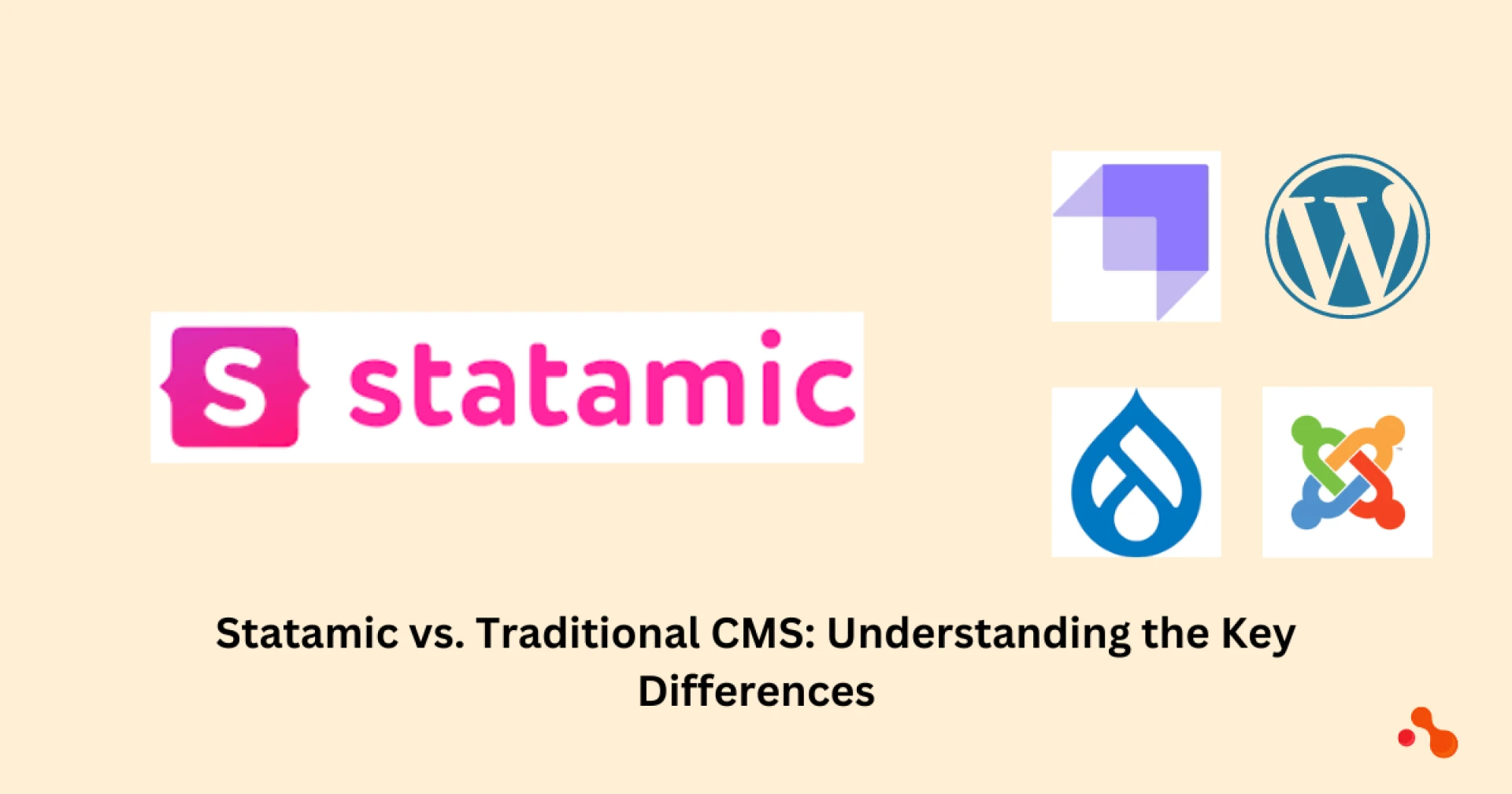
Traditional CMS is a content management system that stores and controls website content in databases.Traditional CMS platforms are WordPress, Drupal, and Joomla.B. The key features and functions of a traditional CMS:
WYSIWYG Editor Traditional CMS platforms provide a user-friendly editor that allows one to create and edit content without programming.Theme and Plugin Support: They offer an extensive selection of themes and plugins that can modify the appearance of your website and enhance functionality.User Management User Management: Traditional CMS platforms let you set up multiple user accounts with different roles and access rights.Media Management: They provide tools for managing and organizing videos, images, and media files.C. The pros and cons of CMS traditional:
Pros:A large user base and significant community support.Rich plugin ecosystem to extend capabilities.A user-friendly interface is designed for users who need to be more technical.Cons:It can consume many resources and slow down when you have complex websites.At the risk of security threats and frequent updates are required.Flexible and limited the option of customization.Traditional CMS platforms are the most popular choice for many websites because of their ease of use and comprehensive support for plugins. However, they have some limitations regarding performance and flexibility compared to more modern alternatives like Statamic.
Introduction to Statamic
Statamic is a contemporary Content Management System (CMS) that uniquely manages and develops websites. Statamic employs a flat-file design in contrast to traditional CMS platforms, which makes it speedy efficient, scalable, and adaptable. Here's a simple introduction to Statamic:
A. Define and explain Statamic
Statamic is a CMS that uses flat-file storage, not databases.It combines the ease of static website generators and the flexibility of traditional CMS.It is based on Laravel, a well-known PHP framework that ensures stability and the ability to expand.B. Unique features and benefits of Statamic
Flat-file storage Statamic is a text file storage system that stores information in simple text files, which allows for simple version control and transferability.The templating process: Statamic uses Blade templating, a powerful and easy method of designing website layouts.Flexible modeling of content: Statamic permits custom content structures and relationships, allowing developers to develop custom solutions.C. Use examples and cases of websites created using Statamic
Blog platforms: Statamic's ease of use and flexibility makes it an excellent choice for bloggers and content creators.Business websites: Statamic's custom structure of content and user-friendly interface make it ideal for all kinds of businesses.E-commerce websites: Statamic offers e-commerce plugins and integrations which makes it a viable alternative for stores that sell online.Statamic provides an innovative method of CMS development thanks to its flat-file structure, flexible models of content, and powerful templating system. If you require a simple blog or a complicated business site, Statamic development services provided by a reputable Statamic development company can help you take advantage of the benefits of this innovative CMS.
The critical differences between Statamic and Traditional CMS
A. Content Structure and Organization
Hierarchical vs. Flat Content Structure:Traditional CMS typically utilizes a hierarchical structure with subpages and nested pages.Statamic employs flat content structures that organize content without a strict hierarchy, which makes it more scalable and easy to manage.Tagging and Taxonomies in Statamic:Statamic offers built-in support for taxonomies and tagging, making it easier to categorize content and organization.Traditional CMS platforms may require additional plugins or adjustments to provide the same functionality.B. Templating and Static Site Generation
Dynamic vs. Static Page RenderingTraditional CMS platforms usually create pages regularly, creating content for each request.Statamic uses static site generation (SSG), where pages are rendered and delivered in static HTML files, which results in faster loading times and better performance.The benefits of Static Site Generation in Statamic:SSG provides efficient caching and decreases the need for server-side processing, which results in better capacity and less server load.Static pages are very safe, as vulnerabilities cannot be exploited in dynamic code execution.C. User Interface and User Experience
The Admin Panel and Content Editing in Traditional CMS:Traditional CMS platforms typically have an admin panel through which content can be edited and managed.Editing content in traditional CMS could require navigating through various menus and sections, which could lead to an arduous learning curve.Flat-file Editing and an Intuitive Interfaces in Statamic:Statamic offers an editing system that works on flat files, allowing users to edit content directly inside text files.The user-friendly interface of Statamic simplifies content management and allows users to easily navigate and edit information without the requirement for complicated administration panels.D. Customization and Flexibility
Plugin Ecosystem in CMS Traditional:Traditional CMS platforms typically offer a range of extensions and plugins that allow users to add functions and personalize their websites.The availability of plugins can differ, and certain modifications may require technical knowledge or extra development effort.Flexible Content Modeling with Statamic:Statamic provides a flexible content modeling system that lets users create custom fields, data structures, and relationships.The flexibility of Statamic allows content customization and developers to build custom web pages without relying on plugins.In the end, the critical distinctions between Statamic and other traditional CMS platforms are in the structure of their content, templating method user interface, and the options for customization. Recognizing these differences is essential in deciding which CMS best fits your business's needs.
Selecting the Best CMS for Your Project
Various aspects must be considered when choosing the suitable CMS for your project. Here are a few essential things to consider:
A. Analyzing the project's requirements and objectives:
Consider the specific requirements for your venture, including the kind of content you'll need to handle and the features you'd like to have.Think about your project's long-term goals to ensure that the CMS is in line with these goals.B. Evaluating the need for content management
Analyze the difficulty of your content management needs. Are you dealing with a large amount of content or multiple types?Think about the ease with which CMS allows creation, editing, organization, and creation.C. Consider future growth and scalability:
Check if the CMS will be able to handle your project's needs for scalability. Can it accommodate future expansion of content or changes?Choose a CMS that can grow with you by introducing new features, connecting with third-party tools, or coping with the increased traffic volume.D. Cost and budget factors:
Examine the costs associated with the CMS, including licensing fees, development costs, and ongoing maintenance costs.Check out the benefits and features the CMS offers against its price to ensure it is worth your investment's cost.Remember that when it comes down to Statamic development, it's vital to find a reputable Statamic development agency or company that can provide expert Statamic development solutions. They can assist you in the process and assist you in making an informed choice based on the requirements of your project and the goals.
Conclusion
This blog post discussed the significant distinctions between Statamic and traditional CMS platforms. We've discovered that Statamic provides unique content management methods thanks to the flat-file structure, static website generation, and a user-friendly interface. Conversely, traditional CMS platforms offer an organized structure for content and a range of plugins to customize. Selecting a suitable CMS is crucial to building an effective website that can meet your requirements. Consider your options and choose the CMS that best fits your goals and goals.































Sign in to leave a comment.