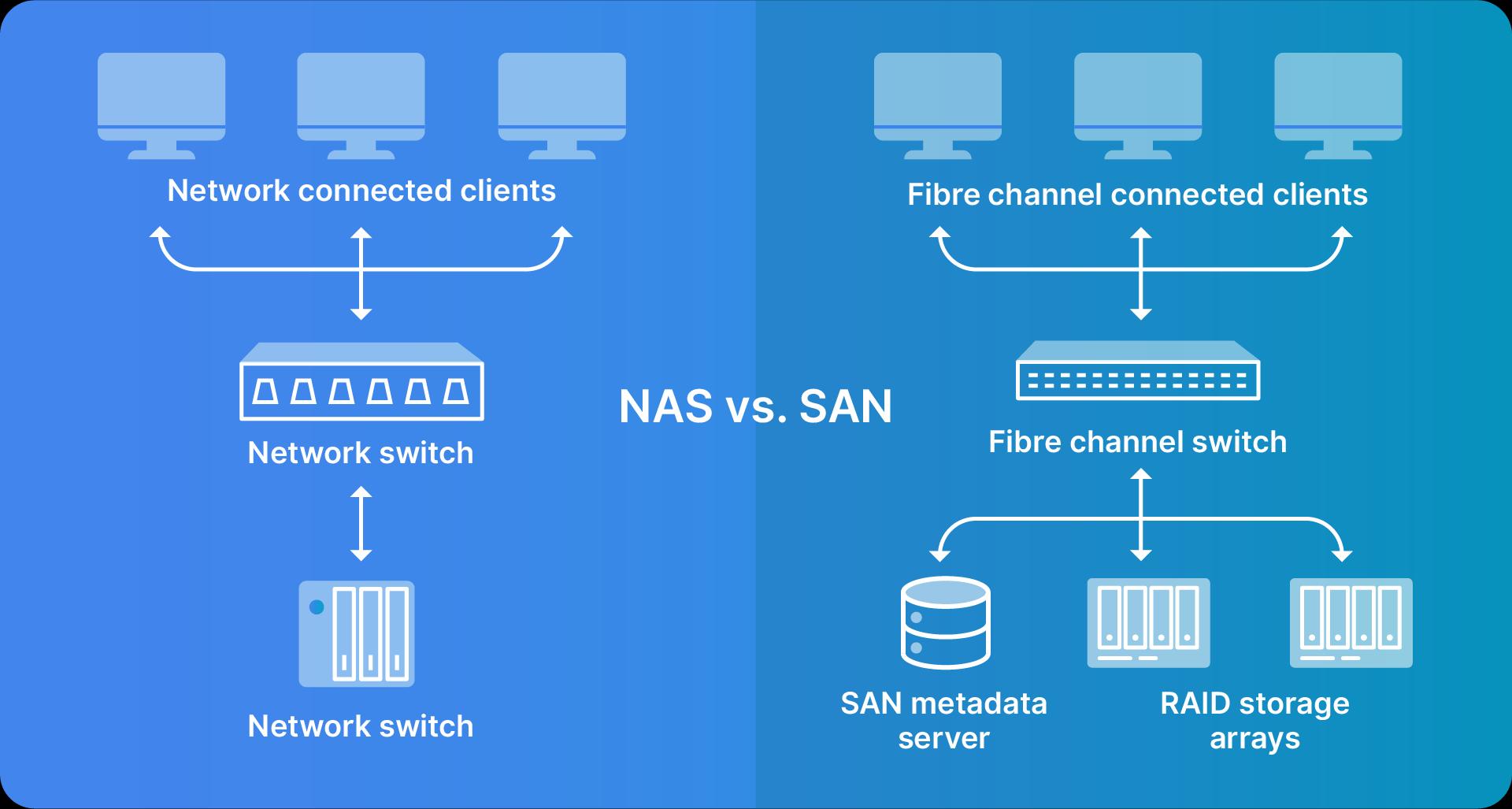

Storage Area Networks (SANs) have revolutionized how businesses store and manage their data. In today's data-driven world, where information is the lifeblood of organizations, reliable and high-performance storage solutions are paramount. SANs have emerged as a critical technology for businesses of all sizes, offering significant advantages in terms of performance, scalability, and data availability. Learn the difference between SAN and NAS in our detailed guide.
What is a Storage Area Network (SAN)?
A SAN is a dedicated high-speed network that connects servers directly to shared storage devices. Unlike traditional Network Attached Storage (NAS) systems, which typically rely on a single server to access data, SANs provide a separate, independent network for storage traffic. This dedicated infrastructure ensures faster data transfer speeds, reduced latency, and improved overall performance.
Key Components of a SAN:
Storage Devices: These can include various types of storage devices, such as:
- Fibre Channel (FC) drives: High-performance drives that offer excellent speed and reliability.
- Solid-State Drives (SSDs): Offer significantly faster read/write speeds compared to traditional hard drives.
- Hard Disk Drives (HDDs): Provide high capacity at a lower cost per terabyte.
Switches: These devices connect the storage devices to the servers and other components of the SAN.
Host Bus Adapters (HBAs): These are specialized network interface cards installed in servers to connect them to the SAN.
Storage Area Network (SAN) Software: This software manages the storage resources, provides data protection features, and facilitates data management tasks.
Benefits of Using a SAN:
Enhanced Performance:
- High Bandwidth: SANs offer significantly higher bandwidth compared to traditional network storage, enabling faster data transfer speeds.
- Reduced Latency: Dedicated network infrastructure minimizes latency, leading to quicker response times for applications.
- Improved Application Performance: Faster data access translates to improved performance for applications that rely heavily on data, such as databases, virtual machines, and high-performance computing.
Increased Availability and Reliability:
- Data Redundancy: SANs can be configured with redundant components, such as RAID arrays and multiple paths to storage devices, to ensure high data availability and minimize the risk of data loss.
- Disaster Recovery: SANs can be integrated into disaster recovery plans, enabling businesses to quickly recover data in the event of a system failure or other unforeseen events.
Improved Scalability and Flexibility:
- Easy Expansion: SANs can be easily expanded to accommodate growing data storage needs by adding new storage devices and increasing storage capacity.
- Centralized Management: SANs provide a centralized platform for managing storage resources, simplifying administration and reducing management overhead.
Enhanced Security:
- Data Encryption: SANs can be configured with data encryption to protect sensitive data from unauthorized access.
- Access Control: Granular access control mechanisms can be implemented to restrict access to specific data based on user roles and permissions.
Applications of SANs:
- Database Environments: SANs are widely used in database environments to provide high-performance storage for large databases.
- Virtualization: SANs are essential for supporting virtualized environments, providing shared storage for virtual machines.
- High-Performance Computing (HPC): SANs are critical for HPC applications that require high-bandwidth and low-latency storage.
- Media and Entertainment: SANs are used in media and entertainment industries for storing and managing large media files, such as video and audio files.
- Cloud Computing: SANs play a crucial role in cloud computing environments, providing scalable and reliable storage for cloud applications and services.
Types of SANs:
- Fibre Channel SAN (FC SAN): This is the most common type of SAN, offering high performance and reliability.
- iSCSI SAN: This type of SAN uses the Internet Small Computer System Interface (iSCSI) protocol to transmit data over standard Ethernet networks.
- InfiniBand SAN: This high-performance network architecture is often used in HPC environments.
Challenges and Considerations:
- Cost: SANs can be expensive to implement and maintain.
- Complexity: SANs can be complex to configure and manage.
- Vendor Lock-in: Choosing a specific vendor for SAN components can lead to vendor lock-in.
- Power Consumption: SANs can consume significant amounts of power.
The Future of SANs:
- Software-Defined Storage (SDS): SDS is emerging as a key trend in storage, allowing for greater flexibility and agility in managing storage resources.
- Cloud Integration: SANs are increasingly being integrated with cloud storage solutions to provide hybrid storage models.
- Artificial Intelligence (AI) and Machine Learning (ML): AI and ML are being used to optimize SAN performance and improve data management. Learn what is the difference between multi cloud strategy vs hybrid cloud in our guide.
Conclusion
SANs have become an indispensable technology for businesses that rely heavily on data. By providing high performance, increased availability, and improved scalability, SANs enable organizations to meet the growing demands of their data storage and management needs. As technology continues to evolve, SANs will continue to play a critical role in supporting modern data-driven businesses.


























Sign in to leave a comment.