

When it comes to landing top-tier technical roles in 2025, system design interviews are no longer optional—they are a standard, crucial part of the interview process. Whether you're aiming to be a Software Engineer, Engineering Manager, Staff Engineer, or Technical Program Manager, system design is often the deciding factor between candidates who merely write good code and those who can architect scalable, reliable, and maintainable systems.
This article is for anyone—whether you're switching from a development background, looking to scale up to a senior role, or targeting full stack or backend-heavy jobs. Let’s break everything down from the ground up.
TL;DR:
● System design is a must for mid and senior tech roles in 2025.
● Learn the basics: scalability, availability, databases, queues, caching.
● Use a structured approach: clarify, sketch, deep-dive, optimize.
● Practice real-world problems and focus on trade-offs.
● Leverage courses and peer support to grow faster.
Why System Design Interviews Matter Today
Companies expect engineers not just to write clean code, but also to make smart architectural decisions. Think about building platforms like Instagram, Uber, or Netflix. It’s not just about knowing Python or JavaScript—it’s about understanding how to handle millions of users, store billions of rows of data, keep things secure, and make sure services don't go down.
That’s where system design comes in.
Roles where system design is critical:
● Full Stack Developers (Mid and Senior)
● Backend Engineers
● Technical Leads
● Staff and Principal Engineers
● Technical Program Managers
● Engineering Managers and Directors
Whether you're interviewing at a startup or a FAANG company, if the role involves owning large components or leading a team, system design rounds will be part of your interview process.
What a System Design Interview Involves
System design interviews are typically 60–90-minute discussions where you're asked to design an end-to-end architecture for a real-world system. But it’s not about memorizing one right solution—it’s about how you:
● Understand requirements (both functional and non-functional)
● Break down big problems into manageable components
● Justify the trade-offs in your choices
● Communicate and think like an architect
Common questions asked in system design interviews:
● Design a URL shortener like TinyURL
● Design a scalable chat app like WhatsApp
● Design a ride-hailing platform like Uber
● Design a Netflix-style video streaming service
● Design a newsfeed system like Facebook or Twitter
How to Prepare for System Design Interviews in 2025
Let’s walk through a structured plan to prepare, especially if you’re new or feel under confident about this round.
Step 1: Strengthen Your Fundamentals
Before jumping into mock interviews, get your basics right:
● Load Balancers – How do they distribute traffic?
● Caching – When and how to use Redis, Memcached, etc.
● Databases – SQL vs NoSQL, sharding, replication
● Queues – Why use Kafka or RabbitMQ?
● Scaling Patterns – Vertical vs horizontal scaling
● CAP Theorem – Tradeoffs between consistency, availability, partition tolerance
If you’re enrolled in a System Design Course Online, these topics are usually broken down in a beginner-friendly format with visuals and real-world examples.
Step 2: Follow a Structured Framework
When asked to design a system, break it down step-by-step. This shows clarity and maturity.
- Clarify Requirements – Don't jump to solutions. Understand scope first.
- Define API Contracts – Define user actions and system responses.
- Sketch High-Level Architecture – Think services, databases, APIs.
- Deep-Dive into Components – Explain how each part works (auth, storage, feed)
- Address Bottlenecks – Where can things go wrong? What are your trade-offs?
- Summarize Design – Review everything, address future scaling or optimization.
Practicing this structure in mock interviews or study groups—especially with peers from a Full Stack Developer Course in Hyderabad or similar programs—can be incredibly helpful.
Step 3: Practice with Real-World Scenarios
Practice questions that reflect systems seen in modern SaaS or consumer platforms. Focus on:
● Handling millions of users
● Ensuring low-latency performance
● Managing data replication and consistency
● Dealing with real-time features like notifications or location updates
Resources like Grokking the System Design Interview or YouTube videos from experienced engineers can be valuable. But don’t just watch—draw, design, discuss.
Why Structured Courses Can Help
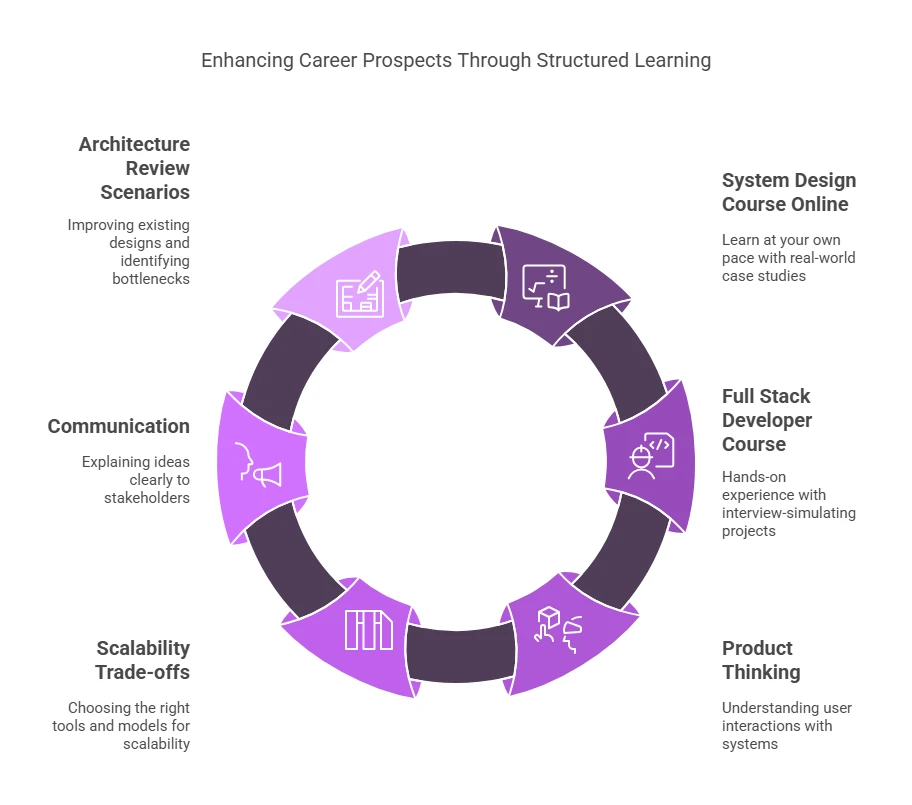
If you’re switching from a purely coding or frontend background, courses give you a structured path, mentorship, and accountability. For example:
1. System Design Course Online
● Learn at your own pace
● Real-world case studies
● Weekly assignments to reinforce learning
2. Full Stack Developer Course in Hyderabad
● Hands-on experience building systems
● Projects that simulate interviews
● Exposure to backend, database, deployment—everything you’d need for design interviews
Investing in the right learning path not only boosts your chances in interviews but also helps you perform well in the role once you land it.
System Design Interviews Today: What Companies Expect in 2025
Hiring teams are evolving. In 2025, many companies have dedicated rounds for system design, especially from SDE-2 level onwards. Here’s what they’re specifically looking for:
● Product thinking: Do you understand how users interact with the system?
● Scalability trade-offs: Are you choosing the right tools and models?
● Communication: Can you explain your ideas clearly to teammates or stakeholders?
For technical program managers and senior roles, these rounds can include architecture review scenarios, where you're asked to improve an existing design or identify bottlenecks.
You Don't Have to Be Perfect, Just Prepared
If you’ve ever been intimidated by system design, you’re not alone. It’s abstract, open-ended, and different from coding rounds. But with the right approach, consistent practice, and a learning environment that supports you—you can absolutely crack it.
If you’re already preparing through a System Design Course Online or even a Full Stack Developer Course in Hyderabad, keep going. You’re building long-term engineering maturity.
If you haven’t started yet—now is a great time. These rounds aren’t going away, and mastering them can unlock 10x better roles, salaries, and career growth.


























Sign in to leave a comment.