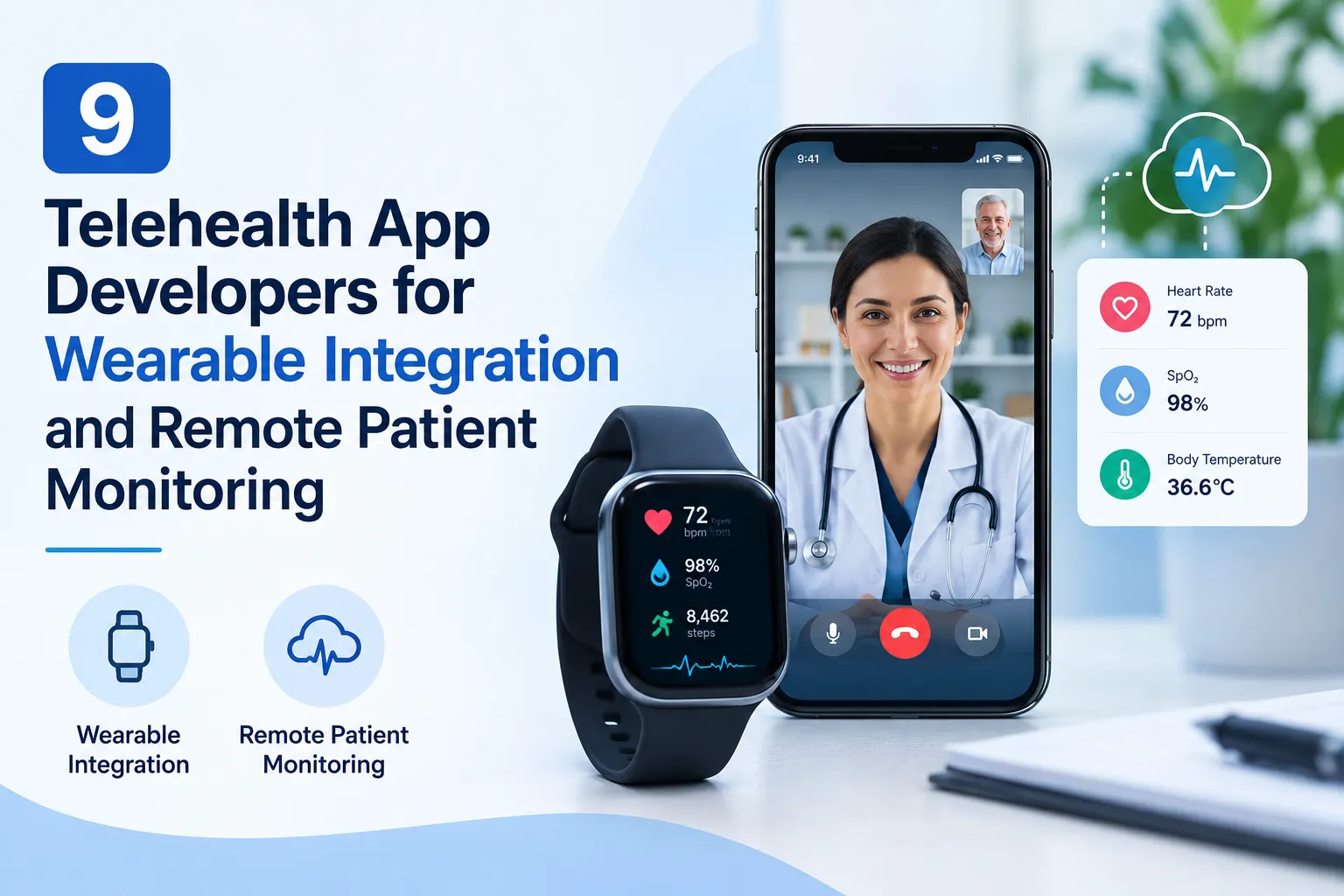

Medicare's 2026 remote patient monitoring (RPM) update means ten days of smartwatch data can now be billed, so the wearable side of a telehealth app has become a revenue question, not only a feature.
Until this year, Medicare's RPM rules had an awkward gap. If a patient sent fewer than 16 days of readings in a month, the practice could not bill for the device at all. The 2026 Physician Fee Schedule changed that. It added CPT 99445 for 2 to 15 days of monitoring and CPT 99470 for 10 minutes of management time, so short bursts of data now count.
A Worked Example: Ten Days After Discharge
A patient leaves hospital after a heart failure admission and a medication change. The care team asks them to wear a connected device for ten days and send daily readings.
- Before 2026: ten days is under the 16-day threshold, so the device could not be billed.
- From 2026: ten days of transmitted data falls inside the 2 to 15 day range of CPT 99445, and a nurse's 10-minute review can be reported under CPT 99470.
- The catch: this only works if the device and the way it sends data meet Medicare's equipment rules. Many consumer wearables may not qualify, so confirm with a compliance adviser before building revenue around one.
Short bursts are exactly what wearables produce: a smartwatch worn for ten days, a glucose sensor used during titration, a ring that tracks sleep after surgery. The data is real, but it arrives in irregular patterns and in formats that differ by brand. A telehealth app that cannot catch it properly turns a clever idea into a support headache.
That is why this list is organised around one question: which companies have shown they can connect wearables to telehealth apps in ways that survive real use? Nine are covered below, mostly healthcare-focused teams rather than household names, followed by use-case picks, a build-versus-buy decision guide and the red flags to watch for.
Why Wearable Integration Is Harder Than It Looks
Four technical facts shape every project, and knowing them helps you judge what a vendor tells you.
- Apple Health and Google's Health Connect live on the phone. Neither has a cloud API you can query. Your own mobile app has to read the data and upload it to your servers, including when the app is closed. Brands such as Oura, Fitbit and Polar work differently: they notify your system when new data is ready and you then pull it.
- Every platform describes the same thing differently. HealthKit and Google Fit use different data models, and Garmin and Fitbit have their own SDKs. A heart-rate reading from one is not shaped like a reading from another, so someone has to normalise them before a clinician sees a chart.
- Battery and signal matter more than screens. Constant Bluetooth polling drains devices and loses data in weak-signal homes, which is why good teams design for intermittent syncing.
- Not every device is billable. Medicare's RPM codes have rules about the type of device and how data is transmitted, and a consumer wearable may or may not qualify.
How One Reading Travels, and Where It Breaks
A single heart-rate reading passes through several hands before a clinician acts on it. Each step is a place where vendors differ.
- Capture: the watch, ring, patch or sensor records the reading. Breaks when battery saving drops samples or Bluetooth fails at home.
- Hand-off: the data reaches the phone's health store (Apple Health, Health Connect) or the brand's cloud (Oura, Fitbit, Polar). Breaks when the patient revokes permission or the brand changes its developer access.
- Upload: your app or backend collects it, ideally in the background. Breaks when the operating system closes the app and nothing syncs for days.
- Normalise: readings from different brands are converted into one consistent model, often stored on a FHIR server. Breaks when two devices report the same metric in different units or intervals.
- Alert and display: thresholds trigger alerts and the clinician sees a dashboard or an EHR entry. Breaks when thresholds are too sensitive and staff stop trusting the alerts.
- Bill: the system counts monitoring days and clinician minutes for the Medicare codes. Breaks when those counts are kept by hand.
When you speak to a vendor, ask which of these six steps it has actually built and run in production, and which it relies on someone else to cover.
How We Compiled the List
We looked at telehealth app development companies with a visible record in wearables, remote monitoring or health-data interoperability, favouring healthcare-focused teams and avoiding the very large names. Information comes from company websites, published case studies and engineering articles. Counts such as projects delivered and years in business are the companies' own claims, so treat them as starting points for your own questions.
Comparison at a Glance
| Company | How it handles wearables | Strongest at | Best for |
| Developer Bazaar Technologies | Flutter-based mobile layer; wearable specifics to confirm | Video consults, remote monitoring, EHR/EMR integration, AI and voice automation | One codebase on iOS and Android with telehealth basics |
| MindSea | Direct Bluetooth Low Energy links to Fitbit, Garmin and biosensor patches; offline-first sync | Battery-aware design, smartwatch AI case study | Proving a wearable concept before a full build |
| Momentum | Own open-source, self-hosted Open Wearables platform | One API across Garmin, Apple Health, Oura, Whoop, Polar, Suunto, Samsung Health Connect | Growing patient numbers without per-user connector fees |
| Orangesoft | IoMT and device integrations into clinical systems | Wearable data in clinician dashboards and external health systems | Teams whose main worry is what the clinician sees |
| Thinkitive Technologies | Device integration alongside HL7 and FHIR interoperability | Remote monitoring plus chronic care management | Practices designing data flow around billing |
| Fortunesoft | Native apps for Apple Watch, Wear OS, Fitbit, Garmin, Galaxy Watch | Showing readings to the doctor during a video visit | Elderly care, fall detection, in-visit data |
| Stormotion | Bluetooth protocols, HealthKit and Google Fit background delivery | Low-level device logic and a unified data layer | Complex or hardware-heavy device work |
| Nirmitee.io | Phone-side reads plus a "ping, then pull" pattern, sent to FHIR | Interoperability and openly documented method | Adding wearables to an app that already exists |
| PixelPlex | Normalisation layer across Apple Watch, Fitbit, Garmin | Consolidated dashboards (Patientory) | Multi-device dashboards from a cross-industry team |
Top 9 Telehealth App Development Companies for Wearable Integration
1. Developer Bazaar Technologies
Developer Bazaar Technologies is a custom development company founded in 2016, with an office in Indore, India and a US office in Fremont, California. As a telehealth app development company, it lists video consultations, remote monitoring and EHR and EMR integration on its telehealth app development company page, and it positions its engineering around AI, including agentic AI and voice automation.
Its experience with Flutter, noted in a Clutch review of an on-demand app, is relevant if you want one codebase on iOS and Android, since wearable connectors often sit in the mobile layer. The AI and voice work could matter for the layer on top of the data, such as automated patient check-ins or alert triage.
- Best for: teams that want video visits, remote monitoring, EHR and EMR integration and a cross-platform mobile app from one vendor.
- Watch out for: public detail on wearable-specific projects is thinner than for some others on this list. Ask which devices it has connected, in which products, and whether they run in production.
2. MindSea
MindSea is based in Halifax, Nova Scotia, with offices in Toronto and Boston, and says it has spent 18 years on digital health apps and delivered more than 250 projects. Its wearable work centres on the unglamorous problems: it connects Fitbit, Garmin and biosensor patches over Bluetooth Low Energy, reduces polling to save battery, and designs apps that work offline and then sync in bursts.
Its most unusual case study is Halterix, where an AI model evaluates physical therapy exercises using only a smartwatch, built with Canadian privacy rules in mind. It also offers a scoped early-stage package, which is a sensible way to prove a wearable concept before paying for everything.
- Best for: early-stage products, rehab and exercise programmes, and anyone worried about battery drain and missed syncs.
- Watch out for: the focus is on device-to-app connections. If you need heavy EHR work, ask how that part is handled.
3. Momentum
Momentum is a Wrocław, Poland company that has built healthcare software since 2016 and says it has delivered more than 100 applications. What sets it apart is that it wrote and maintains Open Wearables, an open-source, self-hosted platform that connects Garmin, Apple Health, Oura, Whoop, Polar, Suunto and Samsung Health Connect through one API. Fitbit support is listed as planned.
The practical consequence is cost structure. Because you host the platform yourself, you pay for your own infrastructure instead of a per-user fee that grows with your patient numbers. Its ZdroVeno project shows the kind of work this enables: a system for senior patients that spots heart-rate-variability anomalies and alerts caregivers through a pipeline that processes data in under 300 milliseconds.
- Best for: products expecting large or fast-growing patient numbers, and teams that want control over their data pipeline.
- Watch out for: you take on running the platform. Ask who monitors it after launch and who handles fixes when a brand changes its rules.
4. Orangesoft
Orangesoft is a healthcare software company that says it has been working for more than 15 years and has delivered over 50 healthcare projects. Its services include telemedicine platforms, remote monitoring, IoMT integrations, mental health apps and medical device software.
Independent roundups single out its focus on getting wearable data into clinical dashboards and external health systems, not only into a patient's app. If your main worry is what the clinician sees, a team that thinks in terms of dashboards and alerts is worth a closer look.
- Best for: programmes where clinicians review many patients and need clear dashboards and alerts.
- Watch out for: ask for an example of a threshold alert that was tuned after real patients used it, since alert quality is hard to judge from a demo.
5. Thinkitive Technologies
Thinkitive was founded in 2015 and describes itself as a healthcare-focused software company covering telehealth, remote patient monitoring, chronic care management and EHR interoperability. Its interoperability services list device and wearable integration alongside lab, radiology and payer connections, using HL7 and FHIR standards.
Remote monitoring and chronic care management are often billed together, so a vendor that understands both can design the data flow around how the practice gets paid.
- Best for: practices that bill for remote monitoring and chronic care management and want the data flow built around that.
- Watch out for: ask how its software tracks the monitoring days and clinician minutes that the new Medicare codes depend on.
6. Fortunesoft
Fortunesoft says it has 17 years of experience and builds native apps for Apple Watch, Wear OS, Fitbit, Garmin and Samsung Galaxy Watch. Its healthcare pages cover EHR connections to systems such as Epic and Cerner, and use cases such as elderly care with fall detection, pregnancy tracking and chronic disease management.
Its distinctive angle is putting wearable data in front of the doctor during the consultation. It describes connecting wearable apps to telehealth platforms so clinicians can see a patient's readings while on a video call, which turns a monitoring feature into part of the visit.
- Best for: products where the doctor reviews readings live during a video consultation, and elderly-care use cases.
- Watch out for: the pitch is broad across use cases, so ask which have been delivered for clinical clients and which are listed capabilities.
7. Stormotion
Stormotion has about nine years in fitness and healthcare and focuses on the low-level work: Bluetooth protocol integration, HealthKit and Google Fit with background delivery, native modules for complicated wearable logic, and apps for watchOS and Wear OS. It points out that Garmin, Fitbit and Apple Watch each use different SDKs and that HealthKit and Google Fit have different data models, then builds a unified layer above them.
- Best for: projects with unusual hardware, custom sensors or demanding background-sync requirements.
- Watch out for: its background is more fitness-leaning than clinical. Ask for healthcare references and how it handles consent, audit trails and HIPAA requirements around the data it collects.
8. Nirmitee.io
Nirmitee.io is a healthcare interoperability specialist, and the best evidence of how it works is public. In October 2026 it published an engineering guide on adding Apple Health, Garmin and Google data without rebuilding an app. The guide explains that Apple Health and Health Connect data has to be read on the phone and uploaded, and describes a "ping, then pull" pattern for Oura, Strava, Fitbit and Polar. It also covers sending the results to a FHIR server.
- Best for: teams that already have an app and want to add wearable data without starting over.
- Watch out for: company details are limited, so ask for client references and team size.
9. PixelPlex
PixelPlex is a software company that works across several industries, not only healthcare, which sets it apart from the rest of the list. Its health work includes Patientory, a platform that brings Apple Watch and Fitbit data into a dashboard for remote monitoring and personalised care.
Its wearable pitch is about normalisation: because Apple Watch, Fitbit and Garmin structure similar metrics differently, it builds a layer that converts them into one consistent format.
- Best for: products that need several brands of device shown in one consistent dashboard.
- Watch out for: because it is a generalist, check carefully how much of its team has worked on regulated health products.
Which Company Fits Which Use Case
The right pick depends on what the wearable data is for. Use this as a starting shortlist, then test each name against the questions later in this guide.
| Use case | Look first at | Why |
| Short-burst monitoring after discharge or a medication change | Thinkitive Technologies, Orangesoft | Billing-aware data flow and clinician dashboards |
| Controlling cost as patient numbers grow | Momentum | Self-hosted platform, no per-user connector fee |
| Proving a wearable idea before a full build | MindSea | Scoped early-stage package |
| Rehab or exercise programmes tracked by smartwatch | MindSea | Halterix physical therapy case study |
| Elderly care and fall detection | Fortunesoft, Momentum | Fall-detection use cases and caregiver alerting (ZdroVeno) |
| Doctor reviewing readings during the video call | Fortunesoft | Wearable data shown inside the consultation |
| Unusual hardware or demanding background sync | Stormotion | Bluetooth protocol and native module work |
| Adding wearables to an app you already run | Nirmitee.io | Phone-read and "ping, then pull" method, FHIR output |
| Several brands in one dashboard | PixelPlex, Stormotion | Normalisation layers across Apple Watch, Fitbit, Garmin |
| Telehealth app plus wearables on iOS and Android from one team | Developer Bazaar Technologies | Flutter experience, video, remote monitoring, EHR and EMR integration |
Build, Buy or Self-Host: Choosing Your Connector Strategy
Before you pick a vendor, decide how device connectors will be supplied. The three routes differ in who pays when a device maker changes its rules.
| Route | Upfront effort | Ongoing cost pattern | Control | Who absorbs API changes |
| Aggregator (a paid service that connects many brands) | Lowest, quick to start | Usually charged by usage, so it grows with patients | Tied to the aggregator's roadmap | The aggregator, within its contract |
| Open-source, self-hosted layer (such as Open Wearables) | Medium | Your own hosting and monitoring instead of a per-user fee | High | You or your development partner |
| Custom-built connectors | Highest | Engineering time to keep each connector current | Highest | You or your development partner |
How to decide:
- Small pilot or unproven idea: an aggregator or a scoped early-stage build keeps cost and risk low.
- Growing patient base: compare a usage-based fee against hosting and support costs for a self-hosted layer. The gap tends to widen as volume rises.
- Strict data-control needs: self-hosting or custom connectors keep the pipeline inside your own environment.
- Small in-house team: whichever route you choose, name who is responsible for connector fixes after launch.
Garmin, for instance, has changed access to its developer programme in recent years. That is the kind of external change that creates maintenance work after launch, whichever route you pick.
What Wearable Integration Adds to the Budget
The device connectors themselves are rarely the biggest cost. Mapping and normalising data, handling consent, storing it safely, building clinician dashboards and keeping connectors working when device makers change their rules usually take more effort. Quotes for a white label telemedicine platform cost often cover video and scheduling but leave wearable connectors as a separate line, so ask which devices are included and what each extra one costs.
Scope drives timeline more than the number of devices does:
| Scope | What it usually includes | Relative effort |
| Single device, basic display | One connector, readings shown in the patient app | Weeks |
| Multi-device, clinician view | Several brands, normalised data, dashboard, alert rules | Several times the first |
| Full clinical integration | All of the above plus EHR connection, consent handling, billing counts | Longest, and the most variable between vendors |
Ask every vendor for a range for each row, not a single figure, and what each range assumes.
Privacy and Consent: What Happens to the Data
Wearable data is health data, so the questions below belong in the contract, not only in the demo.
- Consent: how does the patient grant, review and withdraw permission for each device?
- Disconnecting: when a patient removes a device, is past data kept for the record, deleted, or both depending on role?
- Audit trail: can you see who viewed or exported a reading, and when?
- Regulation: HIPAA applies in the US, and projects in other regions, such as those built with Canadian privacy rules in mind, carry their own requirements.
Red Flags When Vendors Pitch Wearable Integration
- "We support every wearable" with no production reference for any of them.
- A demo that runs only on simulated data and has never met a weak-signal home.
- No answer to who pays and who fixes it when a device maker changes its developer access.
- Treating any consumer device as automatically billable for Medicare.
- No plan for short bursts of data, only for full-month monitoring.
- Vague answers on who owns the data pipeline after the project ends.
Questions to Ask Before You Choose
A shortlist is only useful if you can compare the companies on it. Ask each one:
- Which wearables have you connected in production, and can I speak to a client?
- Do you build your own connectors, use an aggregator, or use an open-source layer, and who pays when it changes?
- How do you handle a patient who has a short burst of data, not a full month?
- How does the clinician see the data, and who sets the alert thresholds?
- What happens to the data when a patient disconnects a device?
- How does the software record monitoring days and clinician minutes for billing?
If you plan to develop a telemedicine app for doctors that includes wearable data, also ask who owns the data pipeline at the end of the project. The top telehealth app development companies are comfortable giving a plain answer to that.
Final Thoughts
Wearable integration rewards teams that sweat the small stuff: battery use, data formats, consent, and what the clinician sees at 8 a.m. on a busy Tuesday. Start with one device type and one clinical use case, prove that the data is accurate and useful, and add more once the first is running smoothly. The best telehealth app development companies for you will be the ones who make that plan easy to follow.
Frequently Asked Questions
Q1. What changed in Medicare remote monitoring rules for 2026?
CMS added CPT 99445 for 2 to 15 days of device data in a 30-day period and CPT 99470 for 10 minutes of management time. They sit alongside the existing codes, so shorter monitoring periods can now be billed.
Q2. Can a consumer smartwatch be used for billable remote monitoring?
It depends on the device and how data is transmitted, because Medicare's rules set requirements for the equipment. Check with a compliance adviser before building a billing model around a consumer device.
Q3. Should I use an aggregator or build device connectors myself?
An aggregator is quicker to start but usually charges by usage and ties you to its roadmap. Building or self-hosting connectors costs more up front and gives more control. The right choice depends on your patient volume and in-house skills.
Q4. Can I pull Apple Health or Health Connect data from the cloud?
No. Neither has a cloud API you can query, so your own mobile app has to read the data on the phone and upload it to your servers.
Q5. How long does wearable integration take?
A single device with basic data display can be done in weeks. Multi-device platforms with clinician dashboards, alerts and EHR integration take considerably longer.


















Sign in to leave a comment.