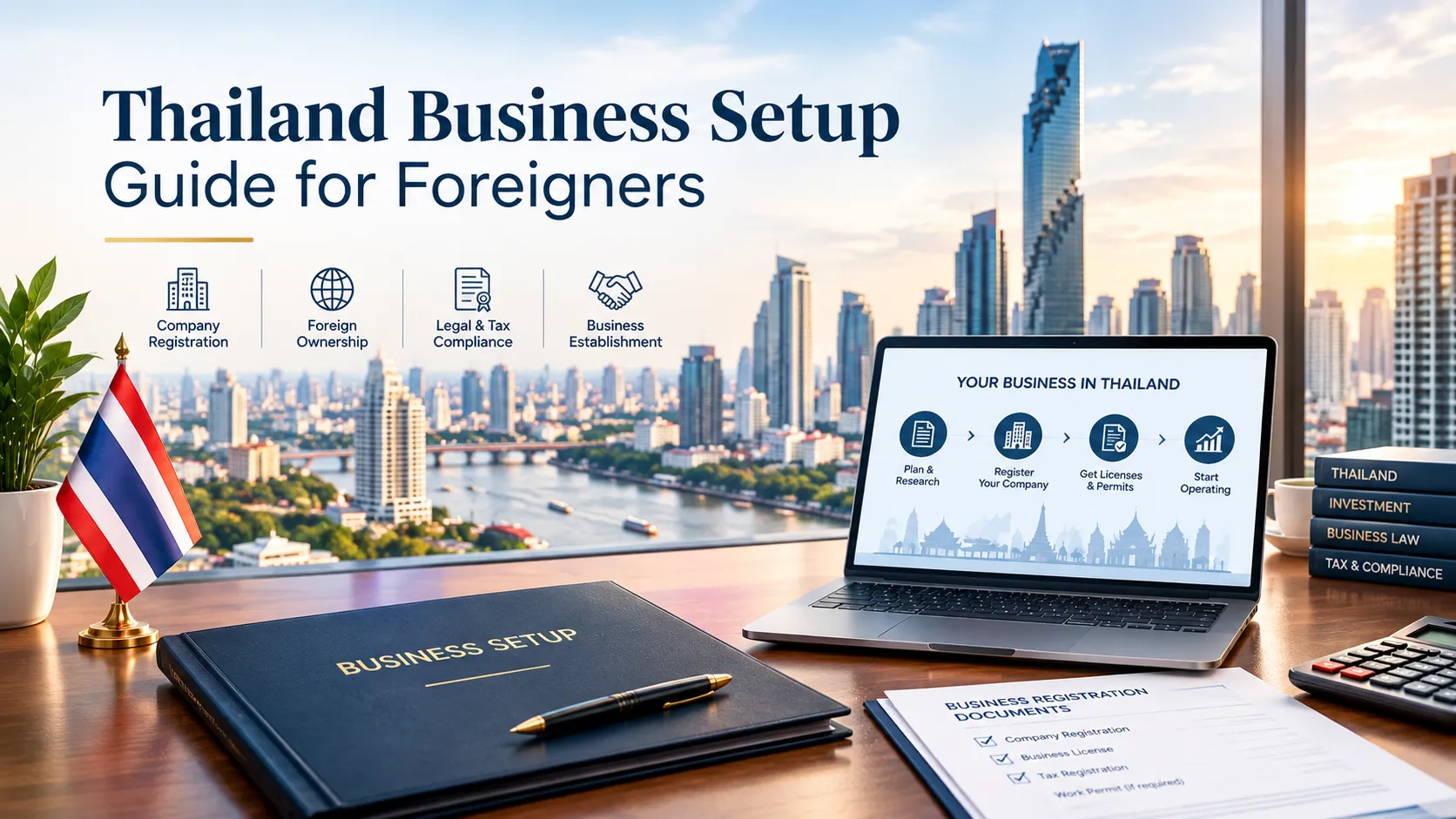

Setting up a business in Thailand as a foreigner involves more decisions than most people expect going in. Ownership structure, entity type, capital requirements, tax registration, and work permits all interact with each other, and the order you tackle them in matters just as much as getting each individual step right. This guide walks through the full process from first decision to ongoing compliance, so you know what's coming before you start.
This Thailand business setup guide for foreigners covers the sequence that actually works, not just a list of requirements in isolation.
Step 1: Understand Foreign Ownership Rules
Before anything else, confirm how the Foreign Business Act applies to your specific business activity. In most service, retail, and professional service categories, foreign shareholders cannot hold more than 49% without an exemption. Your options generally include:
- A Foreign Business License, granted through formal application and review
- BOI promotion, available for activities in technology, manufacturing, R&D, and other targeted sectors, allowing up to 100% foreign ownership plus tax and work permit benefits
- The US-Thai Treaty of Amity, available only to US nationals, granting near-equal treatment to Thai-owned businesses
- A genuine Thai shareholder partnership, provided it's a real commercial arrangement rather than a disguised nominee structure, which is illegal
This decision shapes your capital requirements, your entity structure, and how quickly you can move, so it deserves attention before you register anything.
Step 2: Choose the Right Entity Structure
Most foreign founders end up with one of these:
- Representative Office: suitable for market research, quality control, or supplier coordination, but cannot generate revenue
- Thai Limited Company: the standard vehicle for commercial operations, requiring at least two shareholders and one director
- Branch Office: allows revenue generation as an extension of a foreign parent company
- BOI-Promoted Company: offers full ownership and tax incentives for qualifying activities
Choosing based on what you actually plan to do in Thailand, rather than defaulting to whichever structure seems most common, avoids having to restructure later.
Step 3: Plan Capital Requirements Around Your Hiring Needs
Registered capital isn't just a formality. It directly determines whether you can sponsor foreign work permits, with roughly 2 million THB typically required per foreign employee under standard rules. Founders who under-capitalize at registration often find themselves unable to bring on the team they planned for, which is one of the more common and entirely avoidable mistakes in the setup process.
Step 4: Register the Company
Once ownership structure and entity type are confirmed, registration follows a defined sequence: reserving the company name, preparing the Memorandum of Association, holding a statutory meeting to appoint directors, and formally registering with the Department of Business Development. This typically takes a few days once documentation is properly prepared, though gathering that documentation correctly is usually where most of the actual time goes.
Step 5: Set Up Tax and VAT Registration
After incorporation, your company needs a tax identification number from the Revenue Department. If projected revenue exceeds the VAT threshold, register before you start invoicing rather than after. Thailand's standard corporate income tax rate is 20%, with reductions available for SMEs and BOI-promoted companies.
Step 6: Open a Corporate Bank Account
Foreign-owned companies should expect this step to take longer than domestic incorporations. Banks typically require completed registration documents, a physical office lease, and often an in-person meeting with directors before approving an account, driven by anti-money-laundering scrutiny that's tightened in recent years.
Step 7: Handle Visas and Work Permits
Registering a company does not authorize you to work in it. Foreign founders and employees need a Non-Immigrant B Visa followed by a separate Work Permit application through the Department of Employment. Standard companies generally need four Thai employees per foreign work permit, and processing takes weeks rather than days. BOI-promoted companies benefit from faster processing through a dedicated one-stop service.
Step 8: Build Ongoing Compliance Infrastructure
Thailand's compliance obligations run on a monthly cycle, not an annual one. This includes withholding tax filings, Social Security contributions if you have employees, and VAT filings if applicable. Many foreign-owned businesses outsource payroll and accounting from the start, since the monthly filing discipline is easy to underestimate coming from jurisdictions with lighter compliance cadences.
Common Mistakes Foreign Founders Make
- Registering the wrong ownership structure without confirming FBA restrictions first
- Under-capitalizing the company, then discovering it can't sponsor needed work permits
- Assuming company registration and the right to work are the same thing
- Underestimating how long bank account opening takes for foreign-owned entities
- Treating monthly tax and payroll filings as an afterthought rather than a core operational function
Alternative Paths for Testing the Market First
Not every founder needs to commit to full entity registration immediately. A representative office suits companies still validating the market, while an Employer of Record lets you hire staff quickly without registering an entity at all, useful for testing operational fit before committing further. Both let you delay the bigger commitment until the business case is clearer.
The Takeaway
Setting up a business in Thailand as a foreigner is a structured process, not a mysterious one, but it rewards founders who sequence their decisions deliberately rather than registering first and figuring out the rest later. Getting ownership structure, capital planning, and visa strategy right from the outset is what separates a smooth launch from months of avoidable rework.



























Sign in to leave a comment.