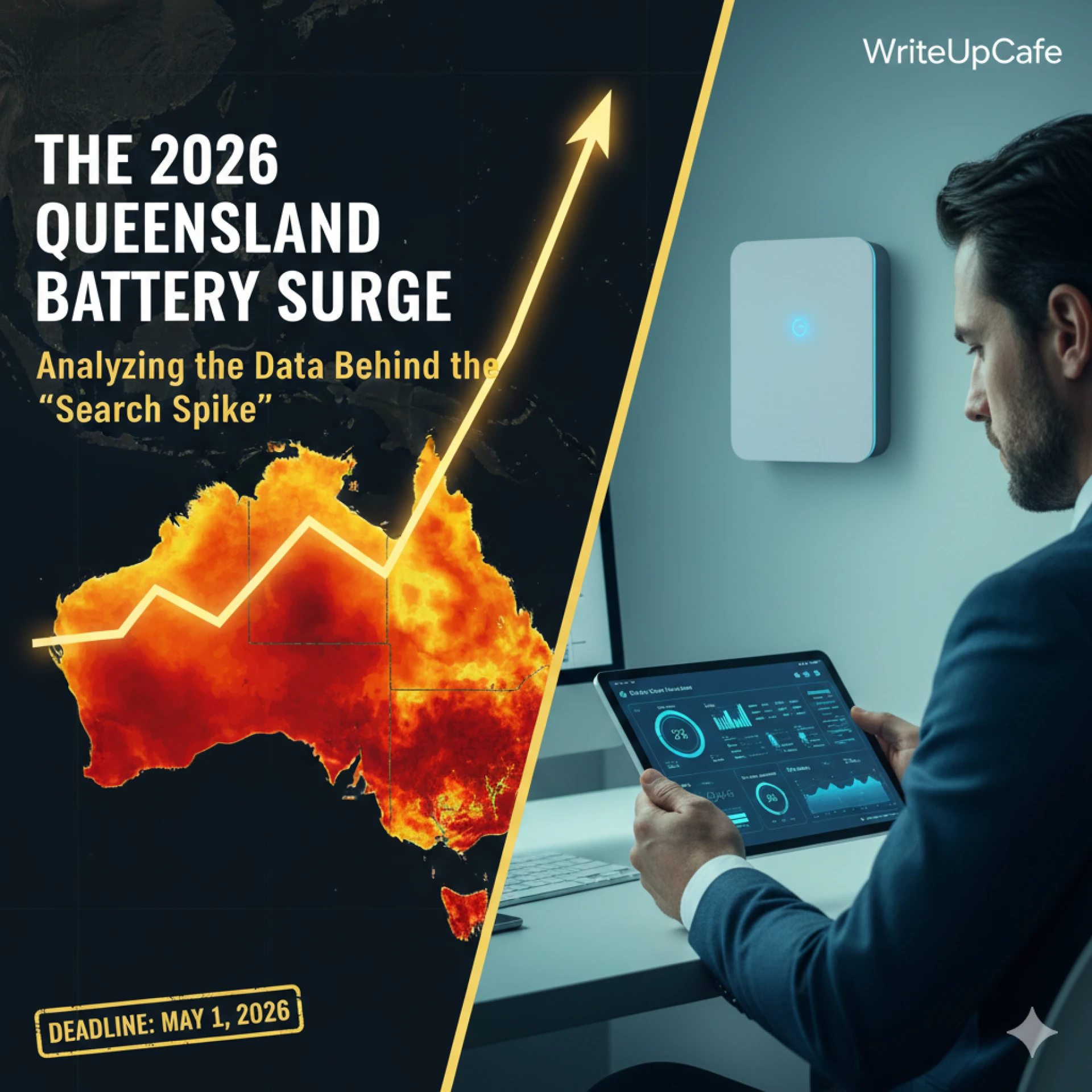

If you are a frequent traveler through the world of digital trends, you know that search peaks are rarely accidental. Recently, Google Trends has begun flashing a high-conviction signal for the Australian energy market: "battery" is currently peaking in search interest, with a massive concentration of queries originating from Queensland.
While Queensland has long held the title of the most solar-penetrated state in Australia, the 2026 data shows a fundamental shift. We are no longer in a "generation" phase; we have entered the "storage era."
Through a collaborative deep-dive into the technical and financial variables currently hitting the Australian market, and with data provided by the specialists at Cyanergy, we’ve identified the "why" behind this spike. It isn't just about rising energy costs—it’s about a ticking clock known as the May 1st Rebate Cliff.
1. The Deadline Driving the Data
The primary catalyst for the current search volume is the upcoming federal policy shift. On May 1, 2026, the Cheaper Home Batteries Program is scheduled to undergo a significant restructuring.
For the uninitiated, this program currently provides a substantial upfront discount via the Small-scale Technology Certificate (STC) system. However, the "yield" on these certificates is set to drop.
- The STC Factor Step-Down: Currently, the multiplier sits at 8.4. On May 1st, it is scheduled to drop to 6.8.
- The Impact on the Pocket: For a standard residential installation, missing this window could mean an immediate loss of $600 to $1,000 in government-backed incentives.
When thousands of households realize they are weeks away from a $1,000 "waiting tax," search volume naturally explodes. People are racing to get their systems installed before the calendar flips to May.
2. The 10kW Benchmark: Why Capacity Matters in 2026
In the middle of this search surge, one specific hardware configuration is leading the pack: the 10kW battery. In previous years, 5kW systems were common, but as of 2026, household energy demands (driven by EV charging and 24/7 smart-home connectivity) have made 10kW the new baseline for independence. But a 10kW label on the box is only half the story. The real value is in usable capacity and discharge endurance.
For a home in the humid Queensland climate, where air-conditioning needs to bridge the gap from sunset until midnight, the 10kW unit acts as a crucial "energy buffer." But how long will it actually keep your high-draw appliances running during a summer peak?
Before committing your capital, it is essential to look at the technical stress tests. You can find a complete breakdown of real-world runtimes here: how long will a 10kW battery last.
3. The 2026 Financial Case: Is the Investment "Worth It"?
The most common query accompanying "battery" in the QLD data is, "Is it worth it?"
The 2026 financial autopsy of the Australian grid makes the answer clearer than it was even a year ago. We are currently facing a "pincer movement" in energy costs:
- Feed-in Tariffs (FiTs): These have bottomed out at roughly 5c/kWh. Selling your solar back to the grid is no longer a viable financial strategy.
- Peak Grid Rates: These have climbed toward 40c/kWh in many regions during the evening.
This 35-cent price gap is the "profit" that a battery captures. By storing your solar energy rather than selling it for 5 cents, you are effectively "saving" 40 cents for every unit you use later.
According to the 2026 ROI reports from Cyanergy, a modern lithium-iron-phosphate (LFP) system now boasts a payback period of just 5 to 7 years. With warranties typically covering 10 years, you are essentially looking at a decade of "net-zero" bills after the system has paid for itself. For the full 2026 financial report, see: are solar batteries worth it in 2026 for Australia?
4. Navigating the "Tiered Rebate" Trap
One final detail that is driving savvy QLD searches is the introduction of Size-Based Tapering on May 1st.
Under the new rules:
- 0–14kWh systems: Retain 100% of the rebate eligibility.
- 14–28kWh systems: Only receive 60% of the rebate eligibility for the extra capacity.
- 28kWh+ systems: Receive a mere 15% for any additional storage.
This means if you have a larger property or high energy needs, you are financially incentivized to install a large-capacity system right now. Waiting until after the deadline will result in a significantly lower government contribution for larger battery stacks.
5. Final Checklist for QLD Residents
If you are currently part of the trending search wave, here is how you should proceed to ensure you capture the maximum value:
- Secure an Installation Date: Remember, the rebate is based on the date of installation, not the date of purchase. With the surge in demand, queues are growing.
- Verify VPP Capability: To qualify for the federal rebate in 2026, your battery must be technically capable of connecting to a Virtual Power Plant.
- Postcode Stacking: Check for additional state-level grants that can be combined with the federal rebate. You can run a live query for your area here: Check QLD Battery Rebate Availability.
Conclusion: Own Your Power
The "battery" peak on Google Trends isn't just a fleeting interest; it’s the sound of a market maturing. Queenslanders have realized that in 2026, the grid is a liability, and storage is the ultimate asset.
By acting before the May 1st cliff, you lock in the maximum government support and insulate your household from the next decade of energy inflation. Don't just watch the trend—be the one who capitalized on it.
























Sign in to leave a comment.