
The modern marketplace moves at a velocity that traditional corporate planning was simply never built to handle. In an era defined by lightning-fast shifts in consumer behavior, sudden regulatory adjustments, and the continuous emergence of disruptive technologies, the long-held corporate tradition of the static, five-year plan is officially dead. Organizations can no longer afford to operate like massive, unyielding ocean liners that require miles of ocean just to execute a simple turn. Instead, they must function like agile, responsive networks capable of reorienting their operations in real time.
As enterprises rush to incorporate artificial intelligence into their corporate blueprints to survive this shift, they frequently run into a frustrating paradox. Instead of becoming faster and more adaptable, they find themselves bogged down by complex software systems, fragmented data infrastructure, and an internal workforce paralyzed by the sheer speed of change. The problem isn’t the technology itself; it is a fundamental misunderstanding of how technology integrates with corporate structure.
True organizational adaptability cannot be bought off the shelf or achieved through fragmented IT upgrades. It requires a holistic, values-driven blueprint that bridges the gap between technological capacity and market execution.
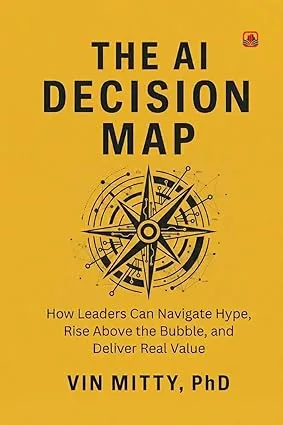
In his book, The AI Decision Map, author Vin Mitty addresses this exact modern corporate challenge. The book serves as a vital guide for contemporary executives, demonstrating that navigating technological disruption successfully requires a dual commitment: building an adaptive corporate Digital Strategy that explicitly enables long-term, sustainable Business Agility. This article explores how the core frameworks within The AI Decision Map empower organizations to cut through the industry noise, build scalable digital foundations, and maintain a definitive competitive advantage in a volatile world.
Part 1: The Evolution of Strategy in the Age of Automation
For decades, standard business planning operated under a straightforward assumption: the future was largely predictable, and market changes happened slowly enough to allow for annual or bi-annual adjustments. An executive team would outline their long-term milestones, allocate capital across various departments, and focus entirely on execution discipline.
The introduction of advanced machine learning and automated workflows has fundamentally dismantled that assumption. Today, waiting a year to adjust an operational approach to a shifting market trend or a new competitor can result in an absolute loss of market share.
To survive in this high-velocity environment, an enterprise must completely re-engineer its core planning methodology. According to The AI Decision Map, this evolution requires moving away from rigid, tool-centric planning and shifting toward a dynamic, responsive framework. A true corporate transformation is not about adopting a specific software tool simply because it is popular; it is about building an entirely new operational capability that allows the entire enterprise to learn, pivot, and scale at the exact speed of data.
Part 2: Building an Adaptive Digital Strategy
A modern corporate blueprint cannot simply be an extension of an IT department's checklist. It must serve as an overarching, unifying vision that aligns every technological investment directly with the primary economic goals of the business. Within the architecture of The AI Decision Map, a forward-thinking Digital Strategy is redefined as a dynamic framework designed specifically to convert raw technical capability into sustainable market value.
An adaptive technical blueprint is not a static document kept in a binder; it is a living ecosystem built upon four foundational pillars:
1. Data Capitalization and Architectural Readiness
The ultimate foundation of any intelligent system is the data that feeds it. A mature corporate approach prioritizes building centralized, secure, and highly accessible data architectures. By breaking down internal information silos and establishing clean, real-time data pipelines, an organization ensures that its automated systems are continuously informed by accurate, high-quality inputs.
2. Algorithmic Governance and Ethical Guardrails
Deploying advanced automated systems introduces unique structural and legal risks, ranging from data privacy vulnerabilities to algorithmic bias. A robust corporate approach builds safety, compliance, and transparency protocols directly into the software development lifecycle from day one. By establishing explicit oversight parameters, an enterprise protects its brand reputation and avoids costly, retroactive system adjustments.
3. Modularity and Ecosystem Flexibility
The technology landscape is shifting far too quickly for an organization to lock itself into a rigid, monolithic software infrastructure. A smart blueprint champions modular design, utilizing open application programming interfaces (APIs) and flexible cloud architectures. This architectural flexibility ensures that the company can easily swap out outdated components or integrate new, advanced capabilities without needing to rebuild its entire core framework from scratch.
4. Continuous Value Mapping and Financial Accountability
Advanced technology initiatives can be notoriously capital-intensive. A disciplined strategic framework avoids vanity metrics and instead demands strict, ongoing financial accountability. By implementing clear key performance indicators (KPIs) and value tracking models, leadership ensures that every technological deployment delivers a verifiable, positive impact on the company's bottom line.
Part 3: The Ultimate Goal — Business Agility
While a robust data and software blueprint provides the necessary infrastructure for digital transformation, structural adaptability represents the ultimate operational outcome. Business Agility is the capacity of an organization to rapidly sense market changes, identify emerging opportunities or threats, and smoothly redeploy its capital, human talent, and technological resources to capture maximum value.
In The AI Decision Map, Vin Mitty explains that true operational flexibility manifests across three critical corporate dimensions:
1. Strategic Flexibility and Rapid Resource Allocation
In a volatile market, a company must be capable of shifting its focus instantly when a primary revenue stream encounters disruption or a new market opens up. When an organization pairs its strategic planning with automated, predictive insights, leadership can reallocate capital and operational focus in hours rather than months, allowing the company to move ahead of slower, traditional competitors.
2. Operational Adaptability and Workflow Fluidity
Achieving organizational flexibility requires building a fluid, responsive workflow structure. By integrating intelligent automation into daily operations, enterprises can instantly scale their processing capacity up or down to match changing demand patterns. Automated tools can seamlessly handle sudden spikes in consumer transactions, customer service inquiries, or supply chain adjustments without causing internal bottlenecks or burning out human staff.
4. Cultural Resilience and a Safe Environment for Innovation
The deepest, most enduring form of organizational flexibility is cultural. A resilient company fosters a workplace environment where data-driven experimentation is actively encouraged, early project failures are viewed as valuable learning loops, and the workforce is entirely comfortable working alongside automated assistants.
Organizations that cultivate this continuous learning mindset view market disruptions not as existential threats, but as natural opportunities to innovate and capture new market share.
Part 4: The AI Decision Map Implementation Sequence
To bridge the gap between abstract corporate theory and daily operational reality, The AI Decision Map provides a practical, step-by-step roadmap designed to guide an enterprise smoothly through the integration lifecycle.
Phase 1: Dynamic Discovery and Operational Scoping
The optimization journey begins with a comprehensive, cross-departmental audit of all existing workflows. Rather than trying to automate every process simultaneously, the framework instructs leaders to map potential initiatives on a clear value-versus-complexity matrix. The organization uses this initial step to filter out low-impact vanity projects and focus its energy exclusively on high-probability opportunities that solve genuine operational friction points.
Phase 2: Ring-Fenced Piloting and Baseline Tracking
Before authorizing full corporate deployment or signing massive vendor contracts, the organization must establish precise operational baselines. Current transaction times, error frequencies, and human labor costs must be meticulously documented.
The company then deploys a limited pilot program within a controlled, ring-fenced environment. By comparing the pilot's performance directly against the recorded baseline data, leadership can mathematically prove the efficacy of the model before committing major capital.
Phase 3: Cross-Functional Scaling and Workforce Training
Once a pilot successfully validates the underlying business case, the project transitions into full enterprise-wide deployment. This phase requires a heavy investment in human capital.
Organizations must launch structured upskilling pathways and transparent internal communication channels to ensure that employees are confident and capable when interacting with the new digital tools. True operational adaptability is never achieved by technology alone; it is achieved only when human workers are fully trained, motivated, and empowered by their new digital workflows.
Phase 4: Continuous Auditing and Iterative Refinement
The final phase of the framework emphasizes that modern corporate execution is an ongoing loop, not a static destination. Following deployment, systems must be audited continuously to monitor for algorithmic drift, verify security protocols, and gather qualitative feedback from end-users. This continuous feedback loop ensures that the company's technology infrastructure actively evolves alongside changing market realities, protecting the organization's competitive edge over the long term.
Part 5: The Cost of Disconnection
The core lesson of The AI Decision Map is that an adaptive corporate vision and structural flexibility are completely co-dependent. An enterprise cannot achieve sustainable market leadership if it prioritizes one over the other.
Vin Mitty’s work demonstrates that enduring corporate excellence exists exclusively at the exact intersection of these two concepts. True market leaders use a robust, centralized Digital Strategy to build secure, scalable, and cohesive corporate foundations, while cultivating profound Business Agility to ensure that their workforce can pivot, experiment, and capture new market value in real time.
Conclusion: Organizing for an Unpredictable Future
The transition into a highly automated, AI-driven global economy is far more than a simple shift in the corporate IT landscape; it represents a fundamental rewiring of how business value is generated, protected, and scaled. In this new world, winning does not require outspending the competition on raw processing power or hoarding the latest custom models. It requires execution discipline, clarity of vision, and structural alignment.
By adopting the clear, structured principles laid out in The AI Decision Map, modern business leaders can look past the distracting industry hype and build a highly responsive, future-proof enterprise. Implementing a comprehensive, unified Digital Strategy ensures that an organization’s technological assets are secure, scalable, and perfectly aligned with its long-term financial objectives. Simultaneously, maintaining an unwavering commitment to Business Agility guarantees that the workforce remains inspired, flexible, and ready to extract maximum value from every market shift.
As the corporate world moves deeper into an increasingly unpredictable future, Vin Mitty's framework stands as an indispensable guide for leaders who refuse to be left behind—reminding us that the ultimate goal of advanced technology is to empower human ingenuity, cultivate adaptability, and drive sustained corporate excellence.



























Sign in to leave a comment.