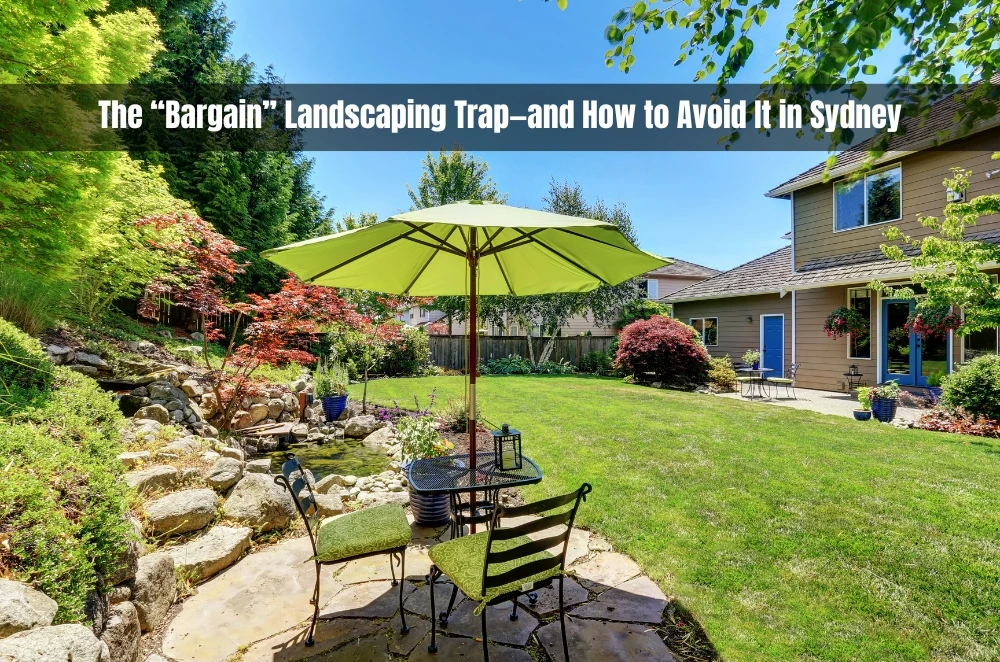

If you’ve ever stood at the back door, coffee in hand, looking at the yard and thinking I should really do something about this, you’re not alone. Sydney backyards have a way of slipping from “a bit untidy” into “how did it get this bad?” without anyone noticing. One season it’s a patchy lawn; the next it’s weeds that look like they’ve formed a small government.
And that’s usually when the word bargain enters the chat.
Because yes, you want it to look better—but you also don’t want to spend a fortune. Totally reasonable. The problem is that “cheap landscaping” can be like cheap headphones: it works for a week, then it crackles, then it breaks, and now you’re buying a second pair while muttering, I should have just done it properly the first time.
Landscaping is similar. The bargain isn’t the lowest quote. The bargain is the yard you don’t have to redo.
The moment you realise the yard has “problems.”
Most people don’t start with a grand vision board. They start with annoyances:
- The dog has created a mud highway along the fence line
- The side path is slippery or uneven, so you half-jump it in thongs
- Water pools in one corner, and your shoes sink slightly every time
- The front yard looks messy even when you’ve “tidied it.”
- You want somewhere to sit outside, but there’s nowhere that feels… finished
That list matters more than style trends. Because when you fix the annoyances, the yard feels better fast—and you start using it again, instead of avoiding it.
Start with one honest question: What do you want it to do?
Before you talk pavers, turf, garden beds, retaining walls, feature plants—ask this:
What do you want the yard to do on a normal week?
Not on the perfect weekend where you suddenly become a person who trims hedges for fun. A normal week.
Common answers sound like:
- “I want a dry path, so I’m not tracking dirt inside.”
- “I want a spot for a table that isn’t on sloping grass.”
- “I want it to look neat without constant effort.”
- “I want the kids to run around without turning it into a swamp.”
- “I want to stop fighting weeds every second weekend.”
When you know the job, the design becomes calmer. You stop chasing features and start building a layout that actually holds up.
The three sneaky budget blowouts (that no one posts on Instagram)
Landscaping costs aren’t just about how fancy you get—they’re often about the boring realities underneath.
1) Access (aka: “How do we get stuff in and out?”)
If you’ve got narrow side access, steps, long carries, or nowhere to park a trailer, labour time goes up. It’s not dramatic; it’s just physics and effort. Same with waste removal—old turf, soil, green waste, broken pavers, leftover rubble. If it’s coming out, it has to go somewhere.
If you’re comparing quotes, access and disposal are two reasons numbers can look wildly different.
2) Water and drainage (aka: “Sydney rain will find your weaknesses”)
This is where shortcuts get punished. If water runs toward the house, if the lawn stays soggy, if one area constantly erodes—those are clues that the yard needs better levels or drainage solutions before you put nice things on top.
New turf on bad drainage is heartbreak with a receipt.
3) Hard surfaces (aka: “The bit you’ll use the most”)
Paving, paths, edging, small patios—hardscape is often the part that makes a yard feel “done.” It also tends to be the cost driver.
The trick is not to avoid hardscape—it’s to use it strategically:
- enough to make the yard functional and clean,
- not so much that it blows the budget or creates heat and runoff issues.
What “doing it properly” usually looks like (without making it complicated)
A good landscaping job is less about the fancy parts and more about the sequence.
Step 1: Clear, level, and prep like you mean it
This is the part people want to skip. But soil prep and grading are the foundation of everything else.
Done well, it means:
- Surfaces sit flat,
- Water goes where it should,
- The lawn establishes more evenly,
- Garden beds don’t collapse into the path after the first big rain.
Step 2: Put in the “bones” first—paths, edges, main use area
If you’re budgeting, this is where value often lives.
A simple, stable path can change your whole relationship with the yard. Solid edging can make mowing easier and stop the slow creep of lawn into beds (or mulch into lawn—depending on who’s winning this month).
Even a small paved or compacted area can create a proper “outdoor room,” instead of a backyard that’s technically there but never quite usable.
Step 3: Then, do planting and lawn with a realistic maintenance plan
Sydney conditions aren’t gentle. Heat spells happen. Rain can be feast-or-famine. Some areas bake; others are shaded and damp.
The “right plant, right spot” idea is real, but it’s also simple:
- Don’t fight the sun with shade lovers,
- Don’t fight the shade with full-sun plants,
- Don’t create garden beds that you can’t easily reach for weeding or pruning.
A low-maintenance garden is usually a layout win, not a miracle plant list.
The staging approach that saves money (and sanity)
If you can’t—or don’t want to—do everything at once, staging is smart. But only if stage one prevents rework later.
A strong stage-one plan often includes:
- Sorting drainage or obvious level issues
- Setting the main path and a usable outdoor zone
- Establishing bed lines and edges
- Leaving “nice-to-haves” (extra paving, feature planting, decorative upgrades) for later
Why this works: you’re building the structure first. You’re not installing pretty surfaces that later need to be ripped up because water is pooling or the ground wasn’t stable.
If you’re trying to get a feel for how a practical, staged landscaping scope is typically framed—what’s included, what tends to change costs, and how hardscape/softscape elements are balanced—this page on andscaping (A Bargain Gardener) lays out the service area in a straightforward way.
The quiet truth about “cheap”: You pay for it somewhere
There are a few classic “budget” decisions that end up costing more down the track:
- Skipping edging → beds spill, lawns creep, mowing becomes annoying
- Minimal base prep under paving → movement, sinking, trip hazards, weeds in joints
- Planting too close together → looks great for three months, then becomes a crowded pruning job
- Choosing turf without thinking about shade/traffic → thin patches and constant repair
- Ignoring runoff → mulch washing away, soil erosion, soggy corners
None of these are moral failure. They’re just the predictable outcome of rushing the unglamorous parts.
Key Takeaways
- The best “bargain” landscaping is the job you don’t have to redo.
- Start with what you want the yard to do on a normal week, not a feature list.
- Access, disposal, drainage/levels, and hardscape are the biggest cost drivers.
- Stage the work so early spending reduces future rework (prep and structure first).
- The first month after installation often decides whether the yard thrives or frustrates.
























Sign in to leave a comment.