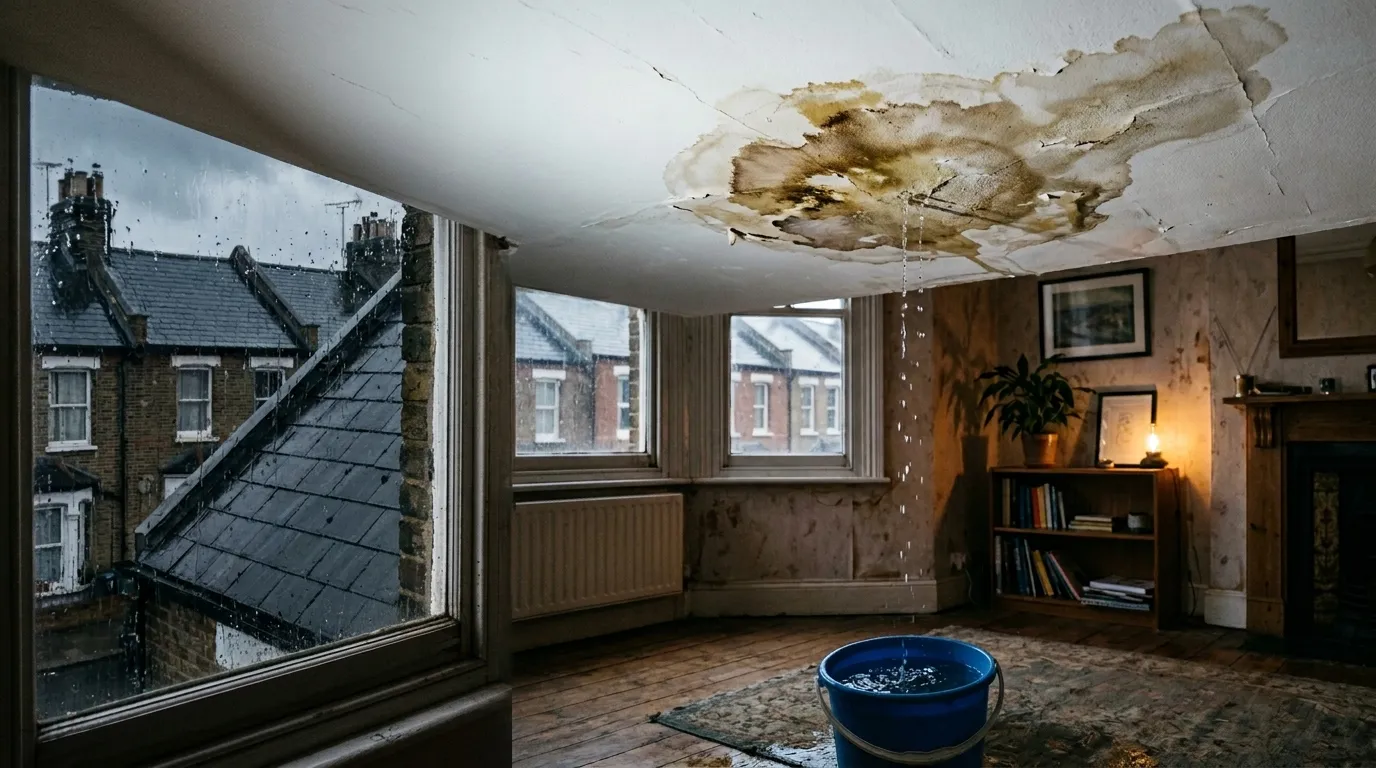

A roof that leaks only during windy weather is not a random issue and it is not a minor one. It is a very specific type of failure that tells you something important about how your roof is behaving under pressure.
Most homeowners assume that if their roof does not leak during normal rainfall, then it must be in good condition. But that assumption breaks down the moment wind enters the equation. Wind does not just increase the force of rain, it completely changes how water interacts with your roof.
In areas like Hackney, where many properties are older and often exposed to strong wind channels between terraced buildings, this type of problem shows up more frequently.
What Changes When Wind Is Involved
To understand why your roof leaks only during windy weather, you need to shift your thinking about how rain behaves. In calm conditions, rain falls vertically. Roof tiles are designed for this. They overlap in a way that allows water to flow downward safely without entering the structure.
But when wind is present, rain is no longer falling straight down. It is pushed sideways, lifted upward, and sometimes even driven back against the natural direction of flow. This turns simple rainfall into what is known as wind-driven rain.
Now your roof is no longer dealing with gravity alone. It is dealing with pressure. This pressure forces water into areas that are normally protected. Small gaps, edges, and joints that perform perfectly during calm rain suddenly become vulnerable. That is why your roof appears fine most of the time but fails only during storms.
What This Reveals About Your Roof Condition
If your roof only leaks when it is windy, it means your roof is not fully sealed against pressure. It is performing at a basic level, but not at a structural level.
There are small weaknesses present, gaps, looseness, or ageing materials that are not obvious during normal conditions. Wind simply exposes them. This is why professionals do not treat this as a coincidence. A roofing expert in London would immediately recognise this as a pressure-related leak, not a surface-level issue.
How Water Actually Gets Inside During Wind
When wind pushes rain across your roof, it does not need a large opening to enter. Even a slight imperfection becomes enough.
Imagine a tile that has shifted by just a few millimetres over time. In calm weather, water flows over it, and nothing happens. But during wind, water is pushed underneath that edge. Once it gets past the tile, it reaches the internal layers of the roof.
From there, it spreads through insulation and timber before eventually showing inside your home. That is why the leak often feels unpredictable. It is not the location that is changing; it is the way water is entering. This is exactly the type of behaviour that roofing contractors in Hackney look for when diagnosing storm-related leaks.
Why the Leak Disappears When the Wind Stops
This is the part that confuses most homeowners. When the wind drops, rain returns to falling vertically again. The pressure disappears, and those small gaps are no longer exposed in the same way. Water stops entering, and the leak seems to “fix itself.”
But nothing has actually been repaired. The weakness is still there. It is simply not being triggered. This creates a dangerous false sense of security. Many people delay action because the problem seems temporary, when in reality it is just condition-dependent.
The Role of Roof Movement and Ageing
Roofs are not static structures. Over time, materials expand, contract, and shift slightly due to weather exposure.
In older Hackney properties, this is even more common because roofs have often gone through multiple small repairs instead of full replacements. Tiles may not sit perfectly anymore, flashing may have loosened, and sealing materials may have started to degrade.
Under normal conditions, these small imperfections are manageable. But when wind applies force, those imperfections become entry points. This is why many homeowners eventually contact a roofing company in Hackney after repeated windy-weather leaks. The issue is not new; it has just reached the point where it can no longer be ignored.
Why This Type of Leak Should Not Be Ignored
A wind-only leak is often seen as less urgent because it does not happen all the time. That thinking is a mistake.
What you are dealing with is an early-stage failure. The roof is already compromised, but only under certain conditions. Over time, those conditions become less extreme. What starts as a leak during strong winds can eventually turn into a leak during normal rain.
At that point, the damage is no longer limited.
Water begins to affect insulation, weaken timber, and spread into ceiling areas. What could have been a small targeted repair becomes a larger structural issue. This is why experienced roofers in London treat wind-related leaks seriously, even if they seem occasional.
What Needs to Happen Next
At this stage, the goal is not just to stop the visible leak. It is to identify the pressure-sensitive weak point that is allowing water to enter.
This requires a different kind of inspection. A professional does not just look for broken tiles. They assess how the roof behaves under stress, checking alignment, sealing, joints, and areas where wind could force water inward. A qualified roofing company in Hackney or trusted roofing experts in Hackney will approach it as a system problem, not a surface issue.
Conclusion
If your roof leaks only during windy weather, it is not random and it is not temporary. It is a clear indication that your roof has developed weaknesses that only become visible under pressure.
The absence of leaks in calm weather does not mean the roof is healthy. It simply means the conditions are not strong enough to expose the problem. The real issue is already there, and over time, it will only become easier for water to enter.
FAQs
Why does my roof leak only when wind and rain happen together?
Because wind pushes rain sideways and forces it into small gaps under tiles, flashing, or roof edges that stay protected during normal vertical rain.
Can strong wind damage my roof even if I don’t see missing tiles?
Yes. Wind can slightly lift or loosen tiles without removing them completely, creating hidden entry points for water.
Is a wind-only roof leak a sign of serious damage?
It usually indicates early-stage failure. The roof has weak points that will worsen over time if not repaired.
Why can’t roofers find the leak easily?
Because the leak only appears under specific wind conditions. The entry point is often hidden and not visible during normal inspections.
Should I wait until it leaks again before fixing it?
No. Waiting allows the problem to get worse. A roofing company in Hackney or experienced roofers in London can identify pressure-related weak points before further damage occurs.




























Sign in to leave a comment.