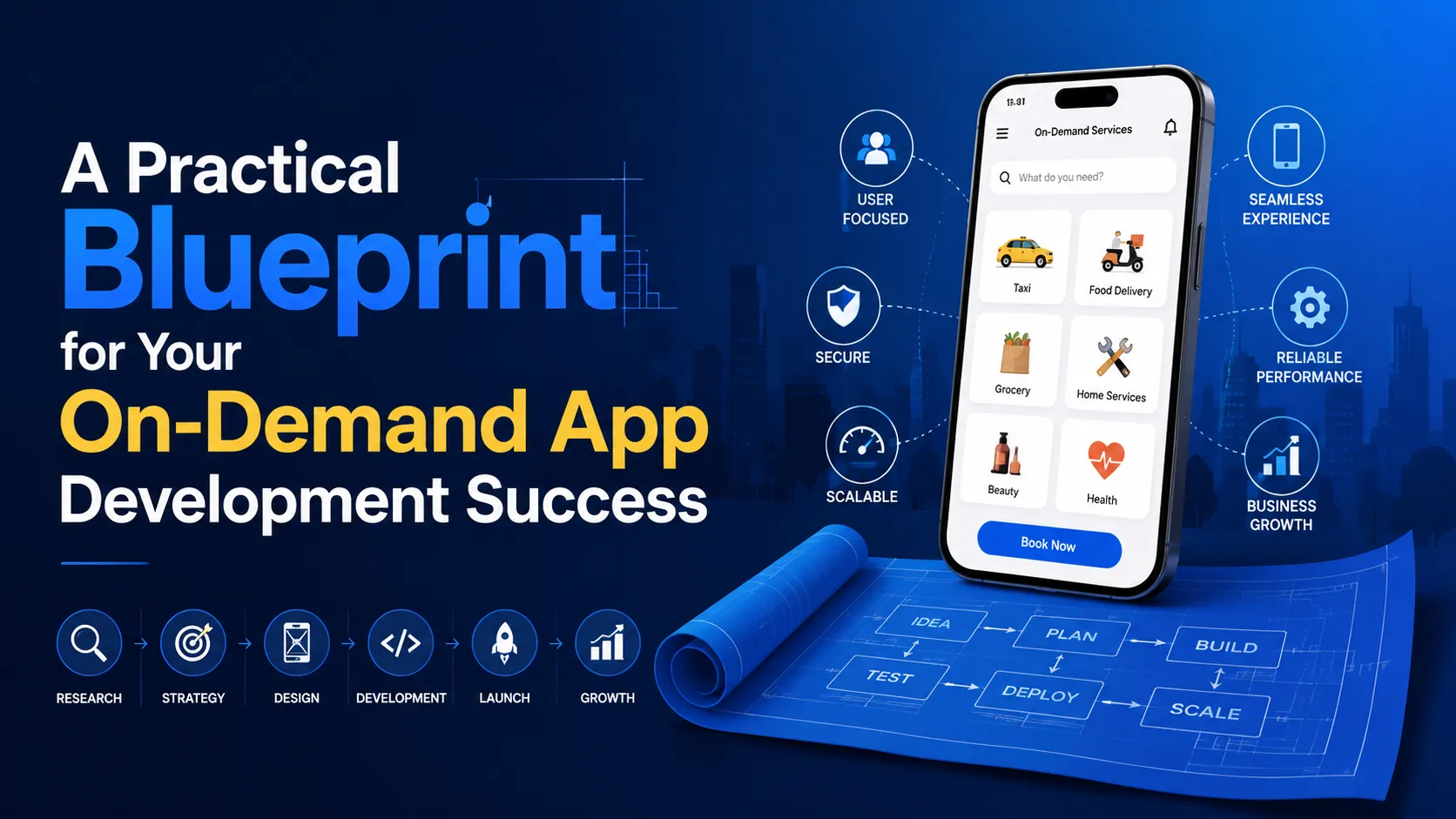

The on-demand economy has fundamentally reshaped how people access services. From food delivery and ride-hailing to healthcare consultations and home repairs, users today expect instant, frictionless service at their fingertips. If you are an entrepreneur or business leader thinking about entering this space, you are not just building an app — you are building an ecosystem. And doing it right requires a clear, practical blueprint from day one.
This guide walks you through the essential stages of on-demand app development, helping you avoid common pitfalls, make smarter decisions, and ultimately launch a product that users love and businesses trust.
Understanding the On-Demand Model Before You Build
Before writing a single line of code, you need to deeply understand what makes an on-demand app tick. Unlike traditional software, on-demand platforms connect two sides of a marketplace — service providers and end users — in real time. This dual-sided nature introduces unique challenges around trust, speed, reliability, and user experience.
Think about what problem you are solving and who you are solving it for. Are you targeting urban professionals who need grocery delivery within an hour? Small businesses that need freelance talent on short notice? Homeowners who want vetted plumbers at the tap of a button? The clearer your use case, the more focused your development effort will be.
Researching your target market thoroughly is non-negotiable. Study competitor apps, read user reviews, conduct interviews with potential customers, and map out the user journey from the moment someone opens your app to the moment their need is fulfilled. This foundational research will inform every decision that follows.
Defining Core Features and MVP Scope
One of the most common mistakes entrepreneurs make is trying to build everything at once. The most successful on-demand apps launched with a lean, focused set of features and expanded based on real user feedback.
Your minimum viable product (MVP) should cover the core loop of your service. For most on-demand apps, this includes user registration and profile management, service browsing or request submission, real-time provider matching or booking, in-app payment processing, live tracking or status updates, ratings and reviews, and push notifications.
Anything beyond this core loop should be placed in a future roadmap, not the initial release. Resist the temptation to add bells and whistles before you have validated that users actually want the core product.
Choosing the Right Technology Stack
Technology decisions made early in development have long-lasting consequences. Your stack needs to support real-time data processing, scalability as your user base grows, cross-platform compatibility, and secure payment handling.
For the frontend, React Native and Flutter have become popular choices for building cross-platform mobile apps that look and feel native on both iOS and Android without maintaining two separate codebases. This significantly reduces development time and cost.
On the backend, Node.js is widely favored for on-demand apps because of its ability to handle concurrent connections efficiently — a critical requirement when thousands of users might be requesting services simultaneously. Cloud infrastructure from AWS, Google Cloud, or Azure provides the scalability and reliability your platform needs to grow.
For real-time features like live location tracking or instant notifications, technologies like WebSockets and Firebase are commonly integrated. Payment processing is typically handled through trusted gateways like Stripe or Braintree, both of which offer robust APIs and compliance frameworks.
Choosing the right stack is a highly technical decision. If you do not have deep in-house expertise, this is one of the strongest reasons to partner with an experienced on-demand app development company rather than attempting to figure it out alone.
Partnering with the Right Development Team
Your development partner will make or break your product. Whether you choose to hire an in-house team, work with freelancers, or engage a specialized app development company, the decision deserves careful consideration.
Working with a dedicated on-demand app development company offers several advantages. These firms typically have pre-built modules and components — things like geolocation services, payment integrations, and real-time tracking — that can dramatically reduce development timelines. They bring battle-tested processes for quality assurance, security, and performance optimization. And they have usually already navigated the kinds of technical and business challenges you are about to face.
When evaluating potential partners, look beyond their portfolio. Examine their communication style, how they handle scope changes, what their post-launch support looks like, and whether they genuinely understand your business model. A good app development company does not just execute your requirements — they challenge your assumptions, suggest smarter solutions, and become a true extension of your team.
Ask pointed questions. How do they handle security vulnerabilities? What is their approach to testing before release? Do they have experience scaling apps beyond initial launch? These answers will reveal far more about a partner's capability than any case study.
Designing for the On-Demand User Experience
Speed and simplicity are the twin pillars of on-demand UX. Users turn to these apps precisely because they want something done quickly. Any friction in the user interface — confusing navigation, slow load times, excessive form fields — erodes trust and drives users to competitors.
Invest seriously in UX design before development begins. Create wireframes and interactive prototypes that allow you to test your user flows without any code. Conduct usability testing with real users from your target demographic. Watch where they get confused, where they hesitate, and where they drop off.
Design for the worst-case scenario: a stressed user, a slow internet connection, a small screen. If your app works beautifully under those conditions, it will delight users under normal circumstances.
Accessibility should also be a priority from day one, not an afterthought. Designing for inclusivity broadens your potential user base and demonstrates that your product is built with genuine care.
Launching, Measuring, and Iterating
A successful launch is not the finish line — it is the starting gun for the real work. Once your app is live, you need to be ruthlessly data-driven about what is working and what is not.
Set up robust analytics from the beginning. Track metrics like user retention rates, session lengths, feature usage, drop-off points in the conversion funnel, and customer support request volumes. These numbers tell the story of what users actually do inside your app, not just what you hoped they would do.
Gather qualitative feedback too. Respond to app store reviews. Run in-app surveys. Talk directly to your most active users and your churned users. The combination of quantitative data and qualitative insight gives you the full picture.
Use this intelligence to drive your iteration roadmap. Release updates frequently, even if they are small. Each improvement signals to your users that you are listening and evolving. Over time, this builds the kind of loyalty that is very difficult for competitors to displace.
Scaling with Confidence
As your user base grows, your app will face challenges it did not encounter at smaller scale. Server loads spike during peak hours. Edge cases in your matching algorithm surface. Payment processing errors emerge. These are not signs of failure — they are signs of success, and you need to be ready for them.
Work closely with your development partner to build scalability into your architecture from early on. Horizontal scaling, load balancing, database optimization, and caching strategies should all be part of your technical plan before you hit growth inflection points.
Operations, customer support, and your service provider network must scale in parallel with your technology. A perfectly functioning app means nothing if the underlying service delivery breaks down under demand.
Final Thoughts
Building an on-demand app that achieves meaningful success is a complex, multi-layered endeavor. It demands rigorous market research, disciplined product thinking, smart technology choices, and the right development partnership. Partnering with a proven on-demand app development company can give you a significant head start — bringing expertise, speed, and reduced risk to what is otherwise a demanding journey.
The on-demand economy rewards those who move thoughtfully, build with the user at the center, and never stop iterating. With the right blueprint and the right app development company by your side, your vision is well within reach.


























Sign in to leave a comment.