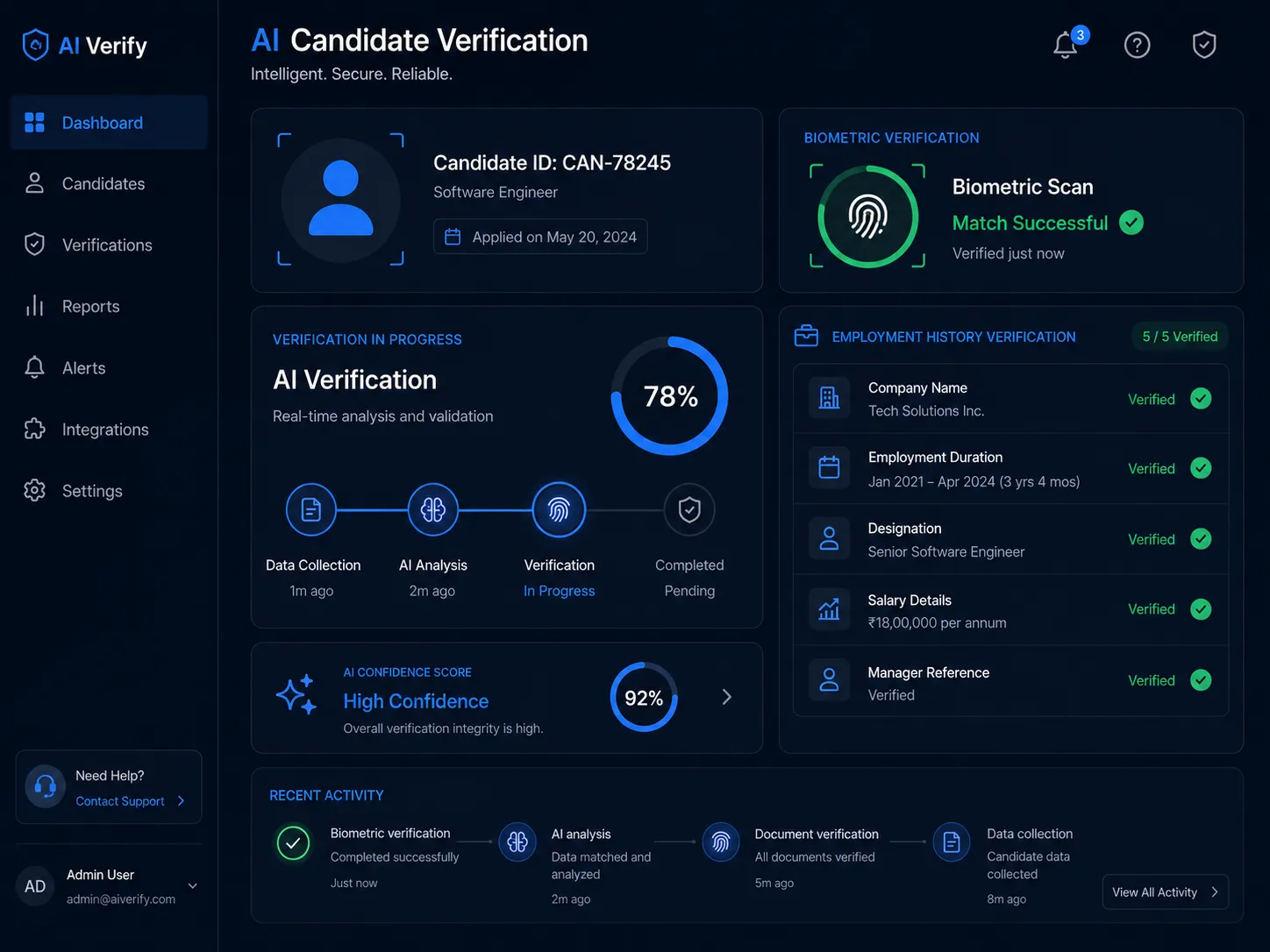

Seventy-six percent of hiring professionals report that candidates falsify employment details, according to the 2026 Global Workforce Trends Report. Yet many HR teams still rely on phone calls and spreadsheets to verify work history, creating delays that cost them qualified hires and expose them to compliance risk. An employment verification app fixes both problems at once: it automates credential checks, confirms identity biometrically, and returns results fast enough to keep your pipeline moving. This guide covers what to look for in a verification app, the compliance requirements you can't ignore, and why real-time AI verification is becoming a standard part of responsible hiring in 2026.
What Is an Employment Verification App, and Why Does It Matter?
An employment verification app is software, typically mobile-first or cloud-based, that automates the confirmation of a job candidate's employment history, identity, credentials, and background. It replaces manual outreach to past employers with direct database queries, payroll data pulls, and biometric checks that run simultaneously.
The shift matters for a practical reason: the global employment screening market was valued at USD 7.19 billion in 2025 and is projected to reach USD 13.71 billion by 2034, driven by the growing risk of credential fraud and the demand for faster hiring decisions. When verification is slow, top candidates accept offers elsewhere. When it's inaccurate, bad hires follow.
Core Functions You Should Expect
- Employment history verification: Confirms job titles, dates, and employers against payroll and HR records
- Identity authentication: Biometric or document-based checks that match the person to their claimed identity
- Criminal background checks: Criminal, financial, and conduct records pulled from law enforcement databases
- Credential verification: Education, licenses, and certifications confirmed against issuing institutions
- Compliance controls: Audit trails, consent management, and FCRA or GDPR-aligned workflows built in
How AI Changes What a Verification App Can Do
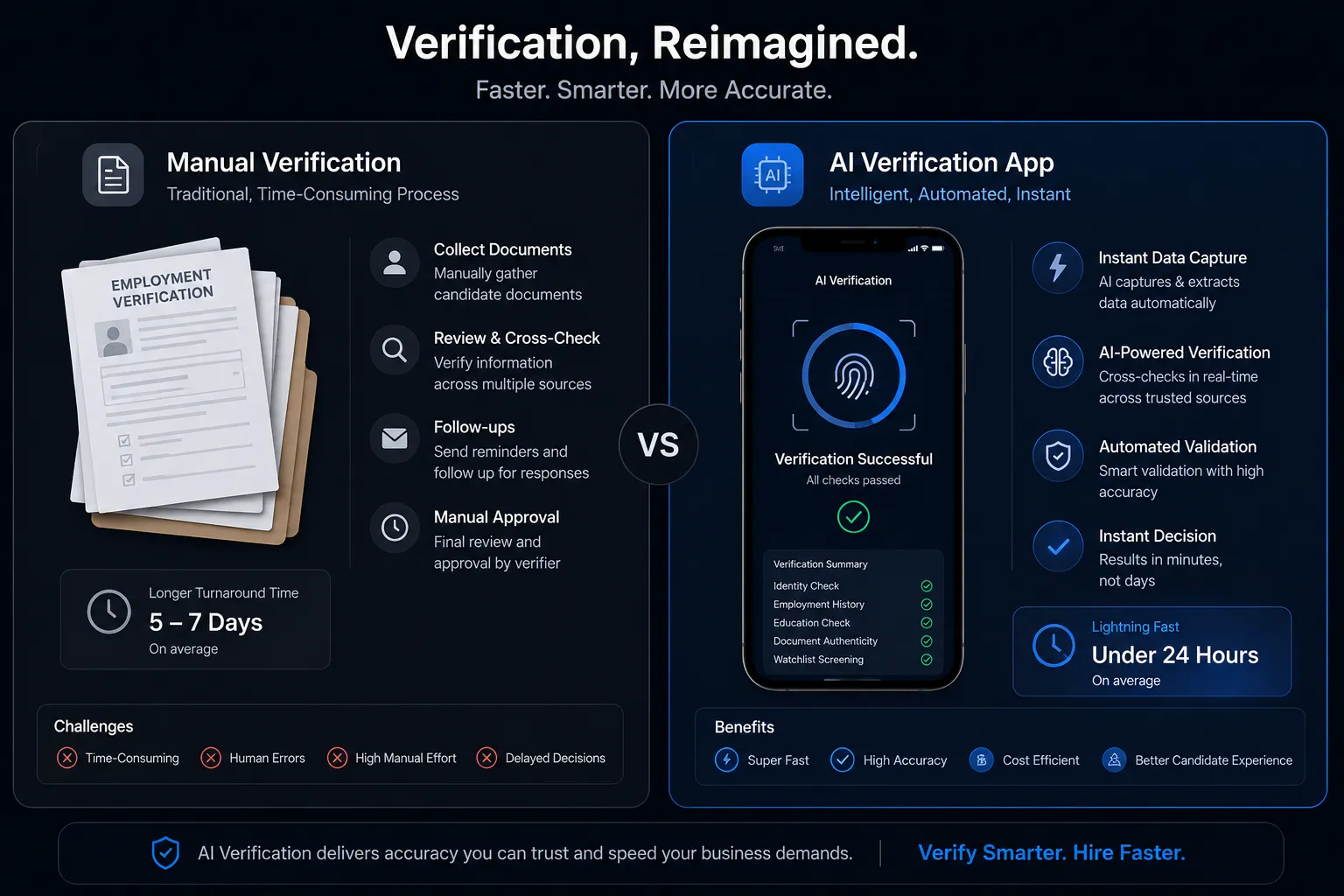
Traditional verification depends on humans: HR teams call former employers, wait for callbacks, and manually log responses. AI-driven apps change the mechanics. Machine learning models cross-reference multiple databases simultaneously, flag inconsistencies automatically, and surface only the records that need human review.
The result is measurable speed. Platforms using AI adjudication now handle the majority of straightforward cases without manual touch, cutting turnaround from days to hours. For VEVR's background verification services, that means your team sees results in real time instead of waiting for callbacks that may never come.
Manual vs. AI-Powered Employment Verification
| Factor | Manual Process | AI Verification App |
| Turnaround time | 3 to 7 business days | Minutes to 24 hours |
| Accuracy | Varies by source quality | Multi-database cross-check |
| Compliance tracking | Manual audit logs | Automated audit trails |
| Scalability | Bottlenecks at volume | Handles high-volume hiring |
| Candidate experience | Opaque, slow | Mobile portal, real-time status |
What Compliance Requirements Does Your Verification App Need to Meet?
Compliance is the part most teams underestimate. An employment verification app that misses a regulatory requirement exposes your organization to legal liability regardless of how fast it returns results.
Key Frameworks to Know
The Fair Credit Reporting Act (FCRA) governs how background check data is collected and used in the United States. It requires written candidate consent before any check, specific adverse action procedures if a report influences a hiring decision, and defined retention timelines. The Equal Employment Opportunity Commission (EEOC) further requires that any background screening policy does not create disparate impact on protected classes.
For organizations hiring remotely or internationally, I-9 verification adds another layer. SHRM's 2025 I-9 compliance guidance confirms that employers must conduct in-person or E-Verify-based identity checks and retain completed I-9 forms for three years after hire or one year after employment ends, whichever is later.
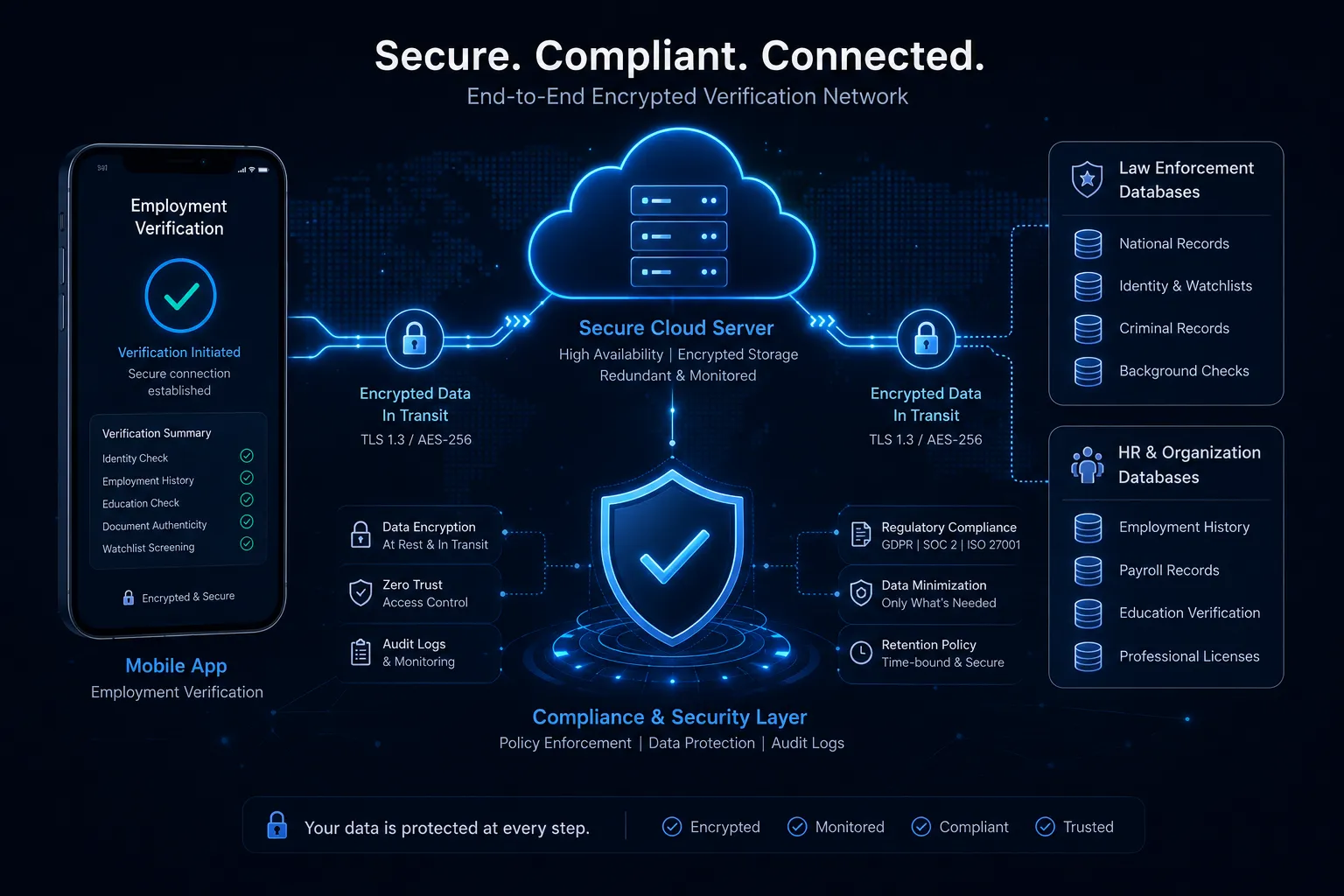
A compliant employment verification app builds these requirements in, not on as an afterthought. VEVR's platform includes consent management, encrypted record storage, and full audit trails aligned with GDPR and CCPA. You can review the specifics on our verification FAQs page.
What Should You Look for in an Employment Verification App?
Not every employment verification app is built the same. The right platform for your team depends on your hiring volume, the industries you operate in, and your compliance obligations.
Five Criteria That Separate Strong Platforms from Adequate Ones
- Real-time data access: The app should pull from live government, law enforcement, and payroll databases rather than cached records that may be months out of date
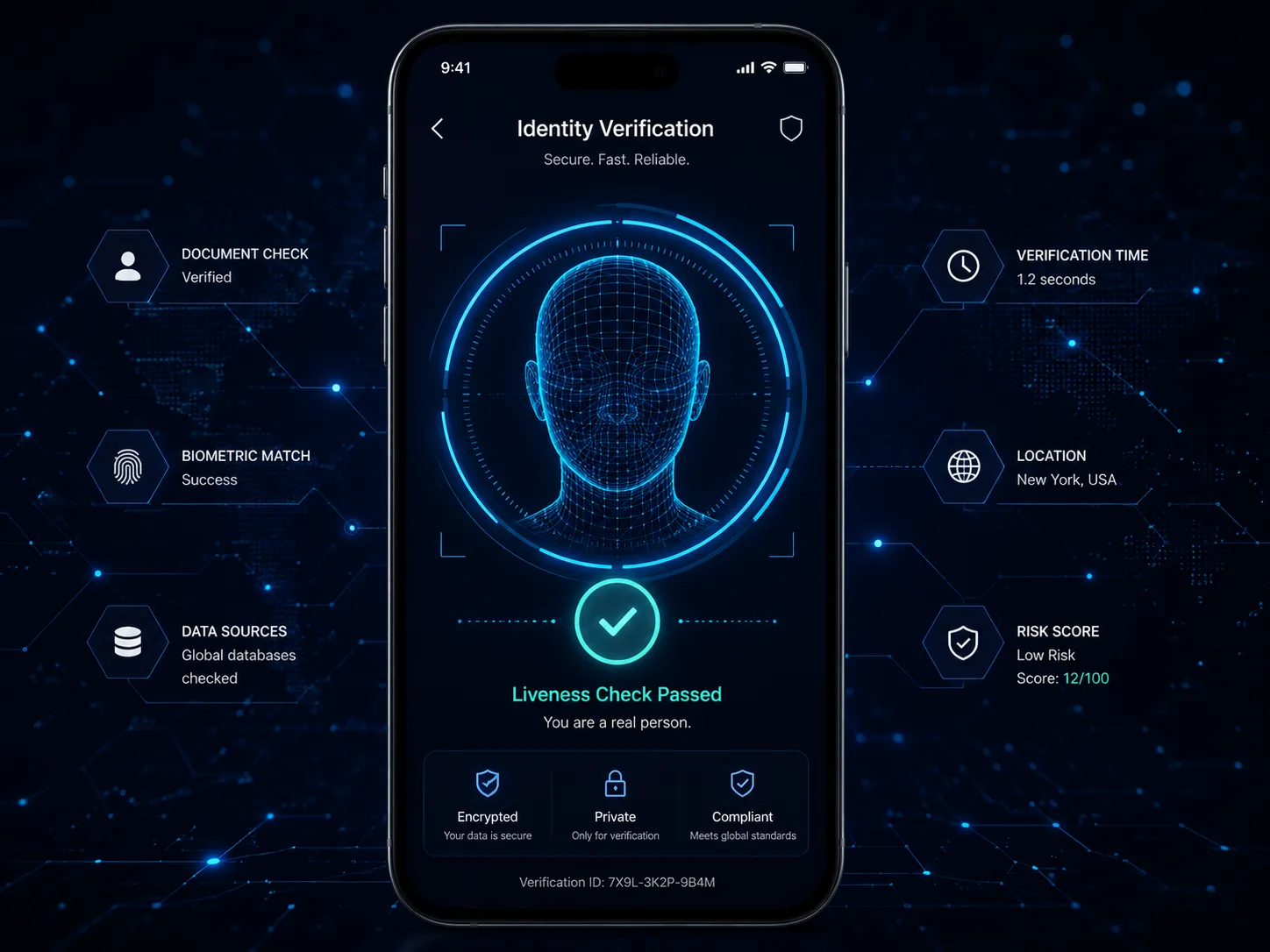
- Biometric identity confirmation: Facial recognition or document scanning ensures the person being verified matches the identity they are claiming, which matters especially for remote hiring
- Mobile-first design: Candidates should be able to complete their portion of the process from a phone, reducing friction and dropout rates
- HRIS and ATS integration: Verification data should flow directly into your existing HR systems rather than requiring manual data entry
- Transparent compliance controls: Built-in consent flows, adverse action workflows, and data retention policies reduce your legal exposure without requiring constant manual oversight
Real-World Use Case: High-Volume Healthcare Hiring
A mid-sized hospital network was onboarding 400 new staff members per quarter. Their manual verification process took an average of six business days per candidate, creating a backlog that left wards short-staffed and extended time-to-productivity for new hires.
After switching to an AI-powered employment verification app, the network reduced average turnaround to under 18 hours. Credential checks for nursing licenses ran automatically against state licensing boards. Criminal background checks pulled from real-time law enforcement data rather than periodic database snapshots. The compliance team gained a full audit trail for every check, making regulatory reviews significantly faster. Learn how VEVR supports organizations like this with verification built for modern hiring scale.
Honest Trade-offs to Consider Before You Switch
AI-powered verification is faster and more accurate than manual processes, but it's not without limitations you should plan for.
- Data coverage gaps: No app covers every employer globally. For niche industries or regions with limited payroll infrastructure, manual verification fallback is sometimes necessary
- Candidate friction: Biometric checks require candidates to upload documents or allow camera access, which some candidates find intrusive. Clear communication about why the data is needed reduces dropout
- Regulatory variation: Compliance requirements differ by country and even by state. An app built only for US FCRA compliance may need additional configuration for GDPR-governed hiring across Europe
Understanding these limitations helps you set accurate expectations internally and choose a platform that handles your specific edge cases. VEVR's multilingual, globally adapted interface is built to reduce friction across regions. If you have questions specific to your setup, our team can walk you through the details on our
Frequently Asked Questions
What does an employment verification app actually check?
Most platforms verify employment history (job titles, dates, employers), educational credentials, professional licenses, criminal records, and identity. More advanced apps like VEVR also include biometric identity confirmation and integration with real-time law enforcement databases, which adds a layer of accuracy that static database checks cannot match.
How long does mobile employment verification take?
With an AI-powered employment verification app, straightforward cases typically complete in minutes to a few hours. Complex checks involving multiple countries or records that require manual sourcing may take up to 24 hours. This compares favorably to manual processes, which average three to seven business days.
Is an employment verification app legally compliant?
Compliance depends on how the app is built. Any platform operating in the US must align with FCRA requirements, including written consent, disclosure obligations, and adverse action procedures. Internationally, GDPR and regional data protection laws apply. Always confirm that your chosen app has built-in compliance workflows, not just a compliance disclaimer in its terms of service.
Can candidates see what was checked about them?
Under FCRA, candidates have the right to see the background report used in a hiring decision and to dispute inaccuracies. A compliant employment verification app should include candidate-facing portals that show check status and provide access to results. VEVR's platform is built with this transparency as a core feature.
Does VEVR's verification app work for remote and international hiring?
Yes. VEVR supports multilingual interfaces and is adapted for use across regions, making it suitable for distributed and global hiring teams. You can explore VEVR's full feature set or download the app directly from the App Store or Google Play to see it in action.
Conclusion
An employment verification app is no longer a nice-to-have. With credential fraud affecting the majority of hiring pipelines and compliance requirements tightening across industries, manual verification creates more risk than it mitigates. The right app reduces your time-to-hire, surfaces accurate data, and keeps every check auditable and compliant.
VEVR combines real-time law enforcement integration, biometric identity confirmation, and AI-driven background checks into a single mobile platform built for modern hiring teams. The result is faster decisions, stronger compliance, and safer workplaces.
Ready to see how VEVR's employment verification app fits your hiring process? Contact the VEVR team or download the app on iOS or Android to get started.
























Sign in to leave a comment.