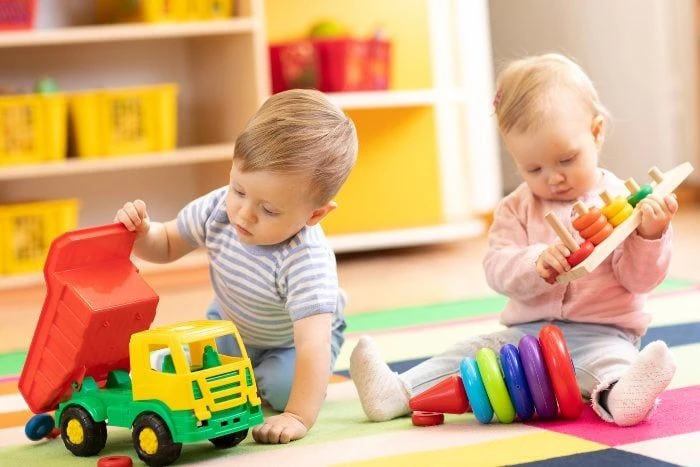

Remember When Learning Was Just... Fun?
Think back to your own childhood. What are your strongest memories of learning? Chances are, it wasn't a worksheet or a flashcard drill. It was probably building a magnificent fort, staging a dramatic rescue with action figures, or mixing all the 'ingredients' in your mud kitchen. That feeling the joy, the total engagement, the ownership that is the essence of deep learning.
As parents and educators, we’ve often felt the pressure to get our kids 'ready' for the academic grind, pushing them into structured lessons earlier and earlier. But guess what? The best minds in early childhood education are telling us that the academic rush is not just unnecessary; it’s counterproductive. The tide is turning, and the play based preschool isn't just a trend; it’s rapidly becoming the definitive new standard for early ed.
If you've been navigating the confusing world of daycare curriculum and preschool curriculum options, stick with me. I’m going to share why shifting your focus to true playful learning is the smartest move you can make for your child’s development.
What Play-Based Learning Actually Looks Like
When people hear "play-based," they sometimes picture chaos or just babysitting. That couldn't be further from the truth. The beauty of a true play based preschool is that the learning is intentional, even when it looks unstructured.
A great preschool teacher or nursery school environment that embraces this philosophy is not just letting kids run wild. They are meticulously creating an environment a sensory-rich, low-stress space where children are empowered to explore.
Here are some real-life examples:
· The Math Lesson: Instead of a worksheet with squares, children are building a tower with unit blocks, learning about balance, proportion, and weight. They are negotiating, "I need two more small blocks to make this side as tall as your three large ones." That’s organic fraction and geometry.
· The Literacy Lesson: The reading nook is transformed into a 'Post Office.' Kids create stamps, write scribbled "letters" to their friends, and organize the mail into numbered boxes. They are engaged in the purpose of writing and reading, which is far more powerful than tracing a letter 'A.'
· The Science Lesson: A teacher puts out cups of water, spoons, and food coloring. The kids aren't just making pretty colors; they are experimenting, hypothesizing, and observing cause and effect.
This intentional, hands-on activity is what we mean by the importance of play based learning. It directly feeds infant cognitive development and emotional regulation in ways a quiet desk never could.
The Irrefutable Data: Why Play Wins
For years, research has consistently pointed to the massive, long-term benefits of robust play based learning. This isn't just a 'nice to have'; it's critical infrastructure for a developing brain.
1. The Executive Function Advantage
The skills required for successful adult life problem-solving, self-control, mental flexibility, and focus are known as Executive Functions. Guess what develops them best? Complex, imaginative play.
When a child is pretending to be the 'Mayor' and must organize their 'citizens' (friends) to build a new 'town hall,' they are practicing negotiation, leadership, planning, and delayed gratification. They are essentially running a micro-business, years before they even learn to read a business plan.
2. The Emotional Regulation Engine
Play is the child’s natural way of processing the world. When they use educational toys or even simple materials to act out scenarios, they are safely rehearsing emotional responses. They can be angry as a 'monster' or bossy as a 'doctor' without real-world consequences. This allows them to build empathy and develop strong emotional intelligence.
3. Deeper Knowledge Transfer
Rote memorization often fades. But knowledge gained through joyful, self-directed activity sticks. When a child measures ingredients in a pretend bakery, they don't just know what "half" means; they feel it, they experience it, and that concept transfers easily to future academic situations. It’s the highest form of effective teaching strategies.
The New Tools of the Trade: Beyond Flashcards
As a parent navigating options, you might feel compelled to buy the latest "educational" gadget or app. But when exploring your child's daycare curriculum, remember that the best baby toys and materials are often the simplest ones.
· Loose Parts: Rocks, sticks, buttons, corks, bottle caps. These are the tools that spark creativity and demand imagination the definition of playful learning.
· Open-Ended Materials: Blocks, paint, clay, water, and sand. These materials don't have a single "right" answer. They allow the child to lead, which is key to great preschool learning.
· Real-World Objects: Old keyboards, measuring cups, and kitchen whisks. When children play with real items, they practice skills they see adults using, connecting their preschool curriculum to their home life.
Embrace the New Standard
The days of viewing early childhood as a mini-academic boot camp are fading. We now know, thanks to decades of research, that the most successful, well-adjusted, and highest-achieving adults are often those who had a rich foundation in play-based learning.
If you are currently evaluating a play based preschool for your child, ask the director not about their academic outcomes, but about their process. Ask: “How do you facilitate complex, cooperative play?”
The future of learning isn't just about what kids know; it's about how they learn to think, create, and adapt. And for that, there is no better foundation than the profound power of play.
What's your biggest takeaway from this shift? Let me know in the comments if you’ve noticed the difference that a truly play based preschool has made in your child's confidence and development!


























Sign in to leave a comment.