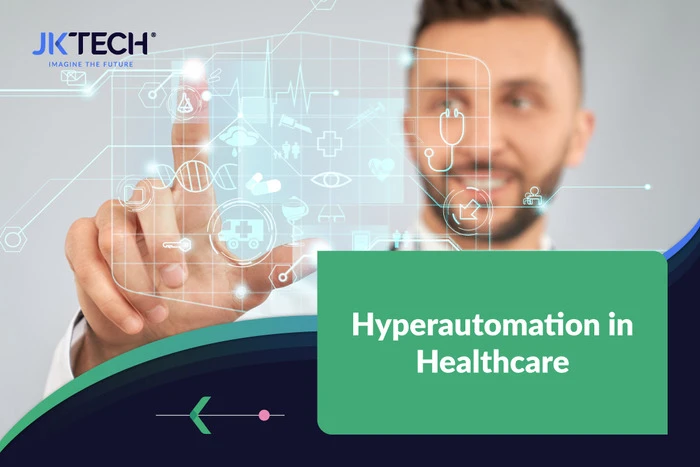

In the 21st century, there is too much load on healthcare services with ever-increasing problems associated with pollution and the evolution of new diseases. With the continuous demand for hospitals and health professionals, there is a need for maximum utilization of available resources.
The answer to the above problems lies in modern-day solutions and hyper-automation in healthcare is one of them.
Hyperautomation in Healthcare
In simple terms, hyperautomation is a process of automating everything related to a product or process available in that particular sector. It uses advanced tools like robotic process automation (RPA), machine learning, and artificial intelligence to automate processes.
It saves a lot of time and increases efficiency by automating recurring processes. Thus, implying hyper-automation techniques in healthcare services can do wonders for the healthcare sector at the diagnosis and management level.
The potential of hyper-automation in healthcare is immense as it can be applied at every level of healthcare services. It can be used for maintaining patient records, automating billing cycles, and providing diagnostic analysis of medical images like X-rays and CT scans.
Hyper-automation in revenue cycle management is an effective way of managing billing cycles. Automating billing cycles helps to avoid financial errors in the system and take off an unnecessary load of managing patient financial records. This saves a lot of time for healthcare staff and helps them to focus more on the patient’s medical conditions.
Benefits of Hyper-automation in healthcare services
Hyper-automation provides new-age solutions for traditional problems faced by patients and healthcare officials. These applications are path-breaking in modern-day healthcare. Let's check more such solutions:
Automated Digital Healthcare Solutions:
The Internet of Things (IoT) is one of the applications of hyper-automation which is helpful in online diagnosis, consultancy, and treatment of patients. Wearables and Smart technologies are some examples of IOT applications.
These are included in automated digital healthcare solutions and are effective in remote areas where available medical facilities are not efficient.
Telemedicine has become possible because of automation in healthcare solutions. This also helps in cost savings.
Healthcare data transformation-enabled solutions:
Medical data is too vast and cannot be handled and maintained manually. Even traditional systems are not capable of maintaining such a high amount of medical data with patient records along with their medical history.
Hyper-automation in healthcare provides data transformation-enabled solutions for such data. Compiling medical records, patient history, drug prescriptions, and past diagnostics and arranging them in usable form, makes it easier to diagnose and treat patients in the future.
Data transformation helps to streamline data in an easily accessible manner.
Data entry with automation saves a lot of time and relieves the load of medical staff increasing their efficiency in dealing with an increasing volume of patients.
Cost Savings
Hyperautomation helps in cost savings by eliminating errors in the financial accounting of patient bills, managing large amounts of diagnostic data and medical records, and scheduling staff.
Because of all such applications, top healthcare solution providers are implying hyperautomation techniques in their healthcare services. This will not only increase their efficiency but also increase the safety of patients.
Hyperautomation in healthcare services has a number of advantages which makes it an effective and attractive digital solution. From automation of billing cycles to offering online diagnostic services with prescriptions in terms of telemedicine, hyperautomation is a need for modern-day healthcare services.
JK Tech offers hyperautomation in healthcare services with all the added advantages mentioned above. So, if you want to manage your healthcare analytics better and offer fast-paced, effective, and efficient services, JK Tech is your destination.


























Sign in to leave a comment.