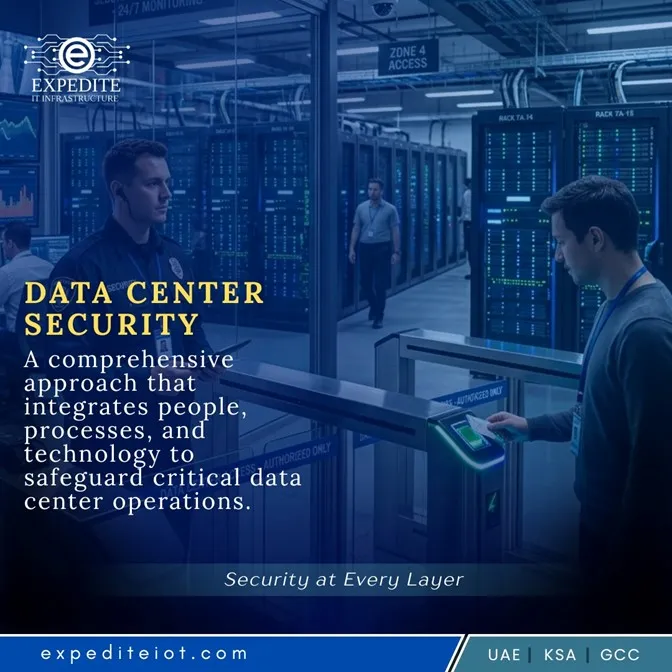

Kuwait's digital transformation under Kuwait Vision 2035 — New Kuwait — is accelerating the deployment of government cloud infrastructure, financial technology platforms, and national e-services at a pace that places unprecedented demand on the nation's data centre estate. Every byte of citizen data, every financial transaction processed by the Central Bank of Kuwait, and every government service delivered through the e-Kuwait portal ultimately resides in a physical facility that must be protected with the same rigour as the data it holds. Comprehensive Data Center Security is no longer a technology department concern — it is a board-level obligation, a regulatory requirement under the Communications and Information Technology Regulatory Authority (CITRA), and a foundational condition for Kuwait's ambition to become the GCC's premier digital hub. Expedite IoT delivers the integrated physical and cyber security architecture that Kuwait's data centre operators, financial institutions, and government agencies need to protect their most critical infrastructure.
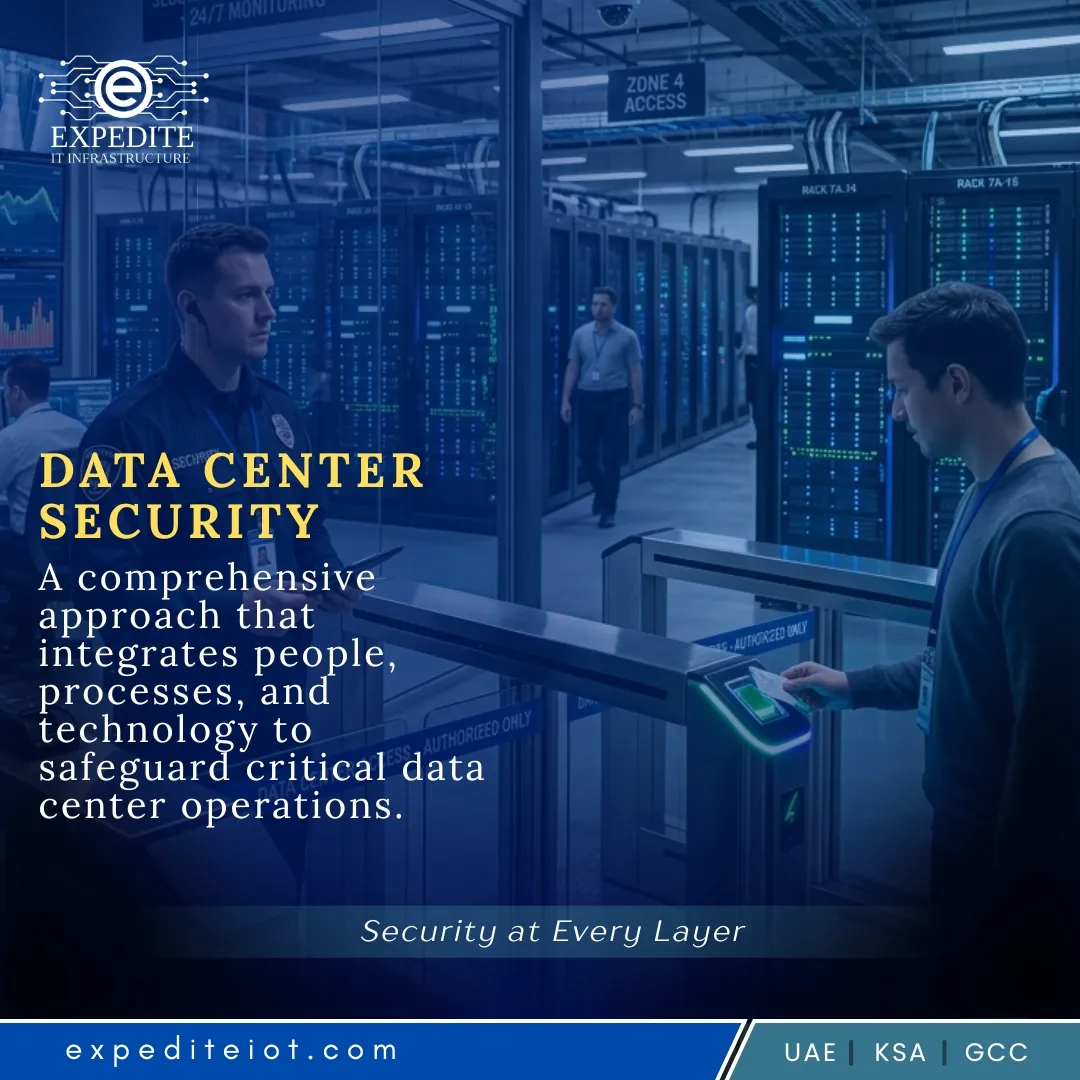
Kuwait's Data Centre Landscape and the Growing Security Imperative
Kuwait's data centre market is undergoing rapid transformation. The Ministry of Finance's Government Data Center (GDC) in Shuwaikh, the Central Bank of Kuwait's secure financial data infrastructure, Kuwait Telecommunications Company (STC Kuwait) and Zain Kuwait's carrier-grade facilities, and the rapidly expanding private colocation and cloud hosting market in Kuwait City and Jahra are collectively managing a growing proportion of Kuwait's critical national data assets — citizen records, financial system data, healthcare information, and government operational systems.
The threat landscape that makes robust data centre protection an urgent operational priority in Kuwait:
- State-sponsored and financially motivated cyberattack campaigns targeting GCC financial institutions and government infrastructure — Kuwait's Central Bank and Kuwait Finance House have both faced sophisticated intrusion attempts in the past five years
- Insider threat — disgruntled employees, compromised contractors, and social engineering attacks targeting data centre staff with physical access represent the most statistically frequent source of data centre security incidents globally
- Physical infiltration risks — tailgating through badge-controlled doors, false identity presentation to reception staff, and contractor social engineering attempts are the primary physical attack vectors against facilities that are otherwise electronically hardened
- Regulatory exposure — CITRA's Cybersecurity Framework, the Central Bank of Kuwait's Information Security Circular (2020), and Kuwait's upcoming National Cybersecurity Strategy align with ISO/IEC 27001 requirements that impose specific documented security controls on data centre operators handling regulated data categories
- Reputational and contractual liability — for colocation operators hosting international enterprise and financial sector tenants, a security breach triggering data exposure activates contractual penalty clauses and SLA breach claims that typically exceed the direct incident cost by a factor of five to ten
Cybersecurity for Data Center: Building Kuwait's Digital Defence Foundation
Cybersecurity for Data Center in Kuwait must address the full attack surface of a modern facility — from the network edge where external threats probe for vulnerabilities through the server infrastructure where data is processed, to the physical perimeter where unauthorised individuals attempt to gain hands-on access to hardware. Expedite IoT's integrated data centre security framework addresses all three attack domains simultaneously, creating a unified defence architecture where physical and cyber controls reinforce each other rather than operating as separate siloed programmes.
The integrated cybersecurity architecture Expedite IoT deploys for Kuwait data centre clients:
- Network perimeter hardening — next-generation firewall deployment, zero-trust network access (ZTNA) architecture, and network segmentation isolating data centre management networks from production environments and tenant networks
- Identity and access management (IAM) — multi-factor authentication (MFA) enforcement for all administrative access to data centre management systems, privileged access workstations (PAWs), and just-in-time (JIT) privileged access management (PAM) for emergency administrative operations
- Endpoint detection and response (EDR) — AI-powered threat detection on all data centre operator workstations and jump servers, with 24/7 SOC analyst monitoring and automated threat containment
- Vulnerability management — continuous automated scanning of all data centre network assets with risk-ranked remediation scheduling and CITRA compliance verification
- Security information and event management (SIEM) — centralised log aggregation from all network devices, servers, access control systems, and physical security platforms with AI-powered anomaly detection and automated alert generation
Data Center Encryption: Protecting Kuwait's Data at Rest and in Motion
Data Center Encryption is the foundational data protection control that renders intercepted or stolen data useless to an attacker without the corresponding decryption keys. For Kuwait's data centres processing Central Bank of Kuwait-regulated financial data, Ministry of Health patient records, Kuwait Municipality geospatial databases, and Kuwait Petroleum Corporation operational data, encryption is both a security best practice and an explicit regulatory requirement under Kuwait's Data Protection Law (Law No. 2 of 2023) and the CBK Information Security Circular.
Expedite IoT implements a comprehensive encryption architecture across the Kuwait data centre estate:
- Data at rest encryption: AES-256 full-disk encryption on all storage arrays, backup media, and SAN/NAS infrastructure — with hardware security module (HSM) key management ensuring encryption keys are never stored on the same system as the encrypted data
- Data in transit encryption: TLS 1.3 enforcement for all inter-server communications, management plane traffic, and tenant data transmissions — with certificate lifecycle management preventing the expired certificate vulnerabilities that have historically enabled man-in-the-middle attacks
- Storage media sanitisation: NIST SP 800-88-compliant cryptographic erasure protocols for decommissioned storage media — ensuring data centre hardware lifecycle processes do not create data leakage exposure through improperly sanitised devices
- Quantum-resistant cryptography planning: For Kuwait's most long-lived data assets — particularly government records and financial archives with 20-plus year retention requirements — Expedite IoT provides a migration roadmap to NIST-approved post-quantum cryptographic algorithms ahead of the projected cryptographic vulnerability window
Data Center Firewalls: Network Perimeter Defence for Kuwait's Critical Facilities
Data Center Firewalls in Kuwait's modern data centre environment are not the static packet-filtering devices of the previous decade — they are AI-powered next-generation security platforms that inspect traffic at the application layer, enforce micro-segmentation policies between server workloads, and integrate threat intelligence feeds to block known malicious traffic sources in real time.
Expedite IoT deploys and manages multi-layer firewall architectures for Kuwait data centre clients:
- Internet edge firewall: Next-generation firewall (NGFW) with application-layer deep packet inspection (DPI), SSL/TLS traffic decryption and inspection, and integrated IPS (intrusion prevention system) blocking attack traffic at the internet ingress point before it reaches the data centre core network
- Internal segmentation firewall: East-west traffic inspection between server zones — preventing lateral movement by attackers who have breached the perimeter from pivoting across the internal network to reach high-value targets in adjacent zones
- Tenant isolation firewall: Virtual firewall instances providing hardware-enforced traffic isolation between colocation tenants in multi-tenant Kuwait data centres — preventing cross-tenant data leakage and ensuring that a security incident in one tenant's environment cannot propagate to adjacent tenants
- Out-of-band management firewall: Dedicated firewall protection for the data centre's out-of-band management network — the lights-out management (LOM) infrastructure used for remote server administration that represents a high-value target for attackers seeking privileged hardware-level access
Data Center Access Control: Physical Security for Kuwait's Server Halls
Data Center Access Control is the physical security discipline that determines who can enter which zone of a data centre facility — and enforces that determination mechanically, biometrically, and electronically to a level of rigour that no staffed reception checkpoint can match. For Kuwait's Tier III and Tier IV data centres operated by stc Kuwait, Zain Kuwait, and private colocation providers, a layered physical access architecture is mandatory for maintaining uptime SLA commitments, satisfying ISO 27001 Annex A.11 physical security requirements, and meeting CITRA's data centre licensing conditions.
Expedite IoT's data centre physical access control architecture for Kuwait deployments:
- Perimeter security zone: RFID and biometric-controlled vehicle barriers and pedestrian gates at the facility perimeter, with ANPR camera arrays screening all approaching vehicles against the approved contractor and visitor database
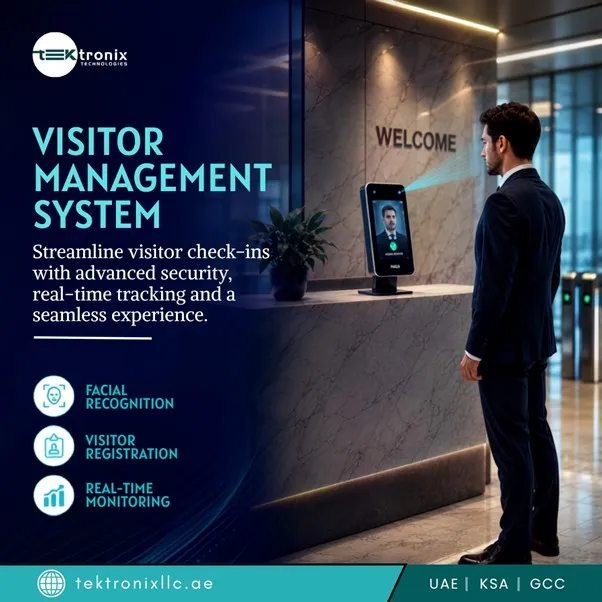
- Reception and visitor processing: Integrated visitor management system with government ID OCR scanning, pre-registration QR code processing, and photo badge issuance — with every visitor linked to a named escort and restricted to approved zones for the duration of their visit
- Man-trap / airlock vestibule: Two-door interlocked access vestibule requiring biometric verification for both entry and exit — physically preventing tailgating by ensuring the inner door cannot open until the outer door has fully closed and the entrant's credential has been positively verified
- Server hall and cage access: High-security biometric readers (facial recognition or palm vein) at server hall entry points and individual cage/cabinet lock controllers — with every access event logged to the SIEM platform for real-time monitoring and historical audit
- Raised floor and sub-floor access: Alarmed floor tile sensors and physical locks on raised floor access panels — detecting any attempt to access the under-floor cable infrastructure where physical network taps represent a persistent threat in high-security financial data centres
Data Center Surveillance: AI-Powered Visual Intelligence for Kuwait Facilities
Data Center Surveillance in Kuwait's most security-conscious facilities has evolved from passive CCTV recording to active AI-powered visual intelligence — camera networks that do not just record what happens but detect and alert on security-relevant events in real time, enabling security operations centre (SOC) analysts to respond to developing situations before they escalate into incidents.
Expedite IoT's AI-enhanced data centre surveillance capabilities for Kuwait:
- Tailgating and piggybacking detection — AI video analytics monitoring all controlled access points and alerting when more than one person enters on a single credential presentation, the most common physical security bypass technique in data centre environments
- Loitering detection — identifying individuals who remain stationary in high-sensitivity areas (server hall corridors, network equipment rooms, power distribution areas) beyond a configured dwell-time threshold — a behavioural indicator of reconnaissance or physical access probing
- Unattended object detection — alerting when a bag, equipment case, or unidentified object is left in a sensitive area without a registered owner — a critical indicator of potential device planting or supply chain attack preparation
- Camera health monitoring — AI-based detection of camera obstruction, lens tampering, and signal degradation — ensuring surveillance blind spots created by deliberate interference are immediately detected and alerted to the SOC
- Facial recognition integration — cross-referencing live camera feeds against the authorised personnel database and flagging unregistered individuals detected in restricted zones for immediate security team response
Data Center Intrusion Detection: Electronic Perimeter Intelligence
Data Center Intrusion Detection systems create an electronic sensing layer across the full physical perimeter and interior of Kuwait data centre facilities — detecting any attempted unauthorised entry through walls, ceilings, floors, doors, windows, and cable entry points, and alerting the SOC in real time with precise location data and camera snapshot evidence.
Expedite IoT's intrusion detection architecture for Kuwait data centres:
- Dual-technology perimeter detectors: Combining passive infrared (PIR) and microwave technology in single detector units to achieve near-zero false alarm rates — critical for Kuwait's data centres operating 24/7 where nuisance alarms degrade SOC operator alertness and response discipline
- Vibration and shock sensors: Seismic detectors on server room walls, raised floors, and equipment cage panels detecting the physical impact signatures of attempted forced entry, drilling, or cutting attacks — alerting before a breach is completed
- Glass break detection: Acoustic sensors tuned to the specific sound signature of breaking glass in facilities with glazed exterior walls or internal glass partitions — triggering immediate SOC alert and camera PTZ preset activation to the affected zone
- Door and hatch contact sensors: Magnetic contact sensors on every controlled access point, maintenance hatch, roof access door, and equipment delivery entrance — detecting any opening event whether forced or through an unrecorded access and logging it to the SIEM platform
- Laser perimeter detection: Invisible laser beam arrays across outdoor secure perimeter zones creating a detection curtain that triggers immediately upon any physical intrusion — with zero false alarm exposure from environmental factors that challenge PIR-only systems
Data Center Threat Detection: AI-Driven SOC Intelligence for Kuwait
Data Center Threat Detection combines the physical security event stream from surveillance, intrusion detection, and access control systems with the cyber security event stream from SIEM, firewall, and endpoint protection platforms — delivering a unified threat intelligence picture that enables Kuwait data centre SOC analysts to detect coordinated cyber-physical attack campaigns that neither system could identify independently.
The value of unified threat detection is most dramatically demonstrated in the blended attack scenario increasingly used by sophisticated threat actors targeting GCC financial and government infrastructure: a social engineering campaign that places a contractor with physical access privileges inside a data centre facility is coordinated with a simultaneous network intrusion attempt timed to exploit the security team's distraction. A unified cyber-physical SOC platform detects the correlation — an unusual physical access event coinciding with an anomalous network authentication attempt — and triggers a combined response protocol that neither the physical security team nor the IT security team would recognise in isolation.
Expedite IoT's threat detection capabilities for Kuwait data centre SOCs:
- User and entity behaviour analytics (UEBA) — AI baseline modelling of normal access patterns for every data centre employee and contractor, with automated anomaly scoring and alert generation when behaviour deviates from the established baseline
- Threat intelligence integration — automated enrichment of detected events with global threat intelligence feeds (MITRE ATT&CK, CISA advisories, regional GCC threat intelligence from the Kuwait Cybersecurity Center) to contextualise alerts with threat actor attribution and attack campaign correlation
- Automated playbook execution — SOAR (Security Orchestration, Automation and Response) platform executing pre-approved response actions automatically for well-understood threat scenarios — isolating a compromised network segment, revoking a suspicious physical access credential, or initiating a server snapshot — without waiting for human approval during the critical early minutes of an incident
Data Center Security Kuwait: Compliance with Kuwait's Regulatory Framework
Data Center Security Kuwait deployments by Expedite IoT are designed and implemented to satisfy the full spectrum of Kuwait's data centre regulatory and compliance requirements:
- CITRA Cybersecurity Framework: The Communications and Information Technology Regulatory Authority's framework maps to ISO/IEC 27001 and NIST CSF controls — Expedite IoT's security architecture implements all applicable CITRA technical controls for data centre operators and cloud service providers
- Central Bank of Kuwait (CBK) Information Security Circular: For financial sector data centres, CBK's 2020 circular mandates specific encryption, access control, and incident response requirements — Expedite IoT's financial sector deployment template addresses all CBK technical obligations
- Kuwait Data Protection Law (Law No. 2 of 2023): Data centre operators processing Kuwaiti citizen personal data must demonstrate adequate technical and organisational security measures — Expedite IoT's integrated security architecture provides the documented technical controls required for compliance
- Kuwait National Cybersecurity Strategy: Alignment with the National Cybersecurity Center's (NCC) sector-specific security baseline requirements for critical information infrastructure operators including data centre facilities
- ISO/IEC 27001:2022: International information security management standard referenced by both CITRA and CBK — Expedite IoT supports clients through ISO 27001 gap assessment, remediation, and third-party certification audit preparation
- Uptime Institute Tier Standards: Physical security requirements for Tier III and Tier IV data centre certification — Expedite IoT's physical access control, surveillance, and intrusion detection architecture meets Uptime Institute Tier III Fault Tolerant and Tier IV Fault Tolerant design specifications
Why Expedite IoT Is Kuwait's Trusted Data Centre Security Partner
- Experience: Over a decade of integrated physical and cyber security deployments across GCC data centres, financial institutions, government facilities, and critical infrastructure — with active installations serving Tier III and Tier IV facilities in Kuwait, Saudi Arabia, Qatar, and Oman
- Expertise: CISSP and CISM-certified security architects, ISO 27001 lead auditors, Uptime Institute-trained physical infrastructure specialists, and SOC analysts holding GIAC GCIA and GCIH certifications — providing the multi-disciplinary expertise that integrated cyber-physical data centre security demands
- Authoritativeness: Solutions compliant with CITRA Cybersecurity Framework, CBK Information Security Circular, Kuwait Data Protection Law No. 2 of 2023, ISO/IEC 27001:2022, NIST CSF, MITRE ATT&CK, Uptime Institute Tier III/IV physical security standards, and IWA 14-1 vehicle security barrier crash ratings
- Trustworthiness: ISO 9001:2015-certified project delivery; 24/7/365 SOC monitoring with Arabic and English analyst coverage; 4-hour emergency incident response SLA; published data processing policy compliant with Kuwait Data Protection Law; transparent managed security service pricing with financial SLA performance guarantees
Conclusion
Kuwait's ambition to lead the GCC's digital economy under Vision 2035 rests on a foundation of trustworthy, resilient digital infrastructure — and that foundation is only as strong as the Data Center Security protecting it. Every government e-service, every financial transaction, and every citizen data record ultimately depends on facilities that can withstand sophisticated physical and cyber threats simultaneously. Robust Cybersecurity for Data Center operations in Kuwait demands a unified architecture where Data Center Encryption renders stolen data worthless, and intelligently managed Data Center Firewalls block malicious network traffic at the perimeter, in transit between server zones, and between colocation tenants — creating defence-in-depth that no single attack vector can defeat. Layered Data Center Access Control — combining man-trap vestibules, biometric server hall entry, and per-cabinet electronic locks — enforces the physical security discipline that regulatory frameworks from CITRA to the Central Bank of Kuwait and ISO 27001 demand, while AI-powered Data Center Surveillance provides the real-time visual intelligence that passive CCTV recording can never deliver. Electronic Data Center Intrusion Detection creates a sensing layer across every wall, floor, ceiling, and access point — ensuring no physical breach attempt goes undetected — and unified Data Center Threat Detection correlates physical and cyber event streams in a single SOC intelligence platform, exposing the blended cyber-physical attacks that sophisticated threat actors increasingly deploy against GCC critical infrastructure. For every Data Center Security Kuwait project — from a CITRA-licensed colocation facility serving enterprise cloud tenants to the Central Bank of Kuwait's secure financial data infrastructure — Expedite IoT delivers the integrated security architecture, the regional regulatory expertise, and the 24/7 SOC monitoring that Kuwait's most critical digital facilities trust.
FAQs
FAQ 1: What makes Data Center Security in Kuwait different from standard IT security?
Data centre security is a discipline that integrates physical security, cybersecurity, and operational technology security into a single converged framework — a scope that standard IT security programmes, focused primarily on endpoint and network protection, do not fully address. In Kuwait's data centre context, this means managing the full threat surface: the building perimeter and vehicle access points where physical attackers may attempt forced entry or social engineering; the server hall and cage areas where insider threats may attempt data exfiltration through hardware; the network infrastructure where external attackers probe for vulnerabilities; and the management plane where privileged administrative access represents the highest-value target. Expedite IoT's integrated approach addresses all four domains simultaneously through a unified security architecture that shares event data, correlation intelligence, and response capabilities across physical and cyber security functions — creating a threat detection capability that is materially superior to the sum of its parts.
FAQ 2: How does Data Center Encryption satisfy the Central Bank of Kuwait's Information Security requirements?
The Central Bank of Kuwait's Information Security Circular (2020) mandates that licensed financial institutions and their service providers implement encryption for regulated financial data in all states — at rest, in transit, and in processing where technically feasible. Expedite IoT's data centre encryption architecture addresses all CBK obligations through: AES-256 encryption on all storage systems holding financial data, with HSM-based key management maintaining key custody separation from encrypted data; TLS 1.3 enforcement for all network communications handling CBK-regulated data categories; cryptographic erasure of decommissioned storage media certified to NIST SP 800-88 standards; and key management audit logs formatted for CBK examination and reporting submissions. For Kuwait's Islamic banking sector — including Kuwait Finance House (KFH) and Boubyan Bank — Expedite IoT configures encryption key lifecycle management to align with both CBK Information Security requirements and Accounting and Auditing Organisation for Islamic Financial Institutions (AAOIFI) IT governance standards.
FAQ 3: How does Data Center Access Control meet Kuwait's ISO 27001 and Uptime Institute Tier III requirements?
ISO 27001:2022 Annex A.7 (Physical Controls) and the Uptime Institute's Tier III Fault Tolerant design specification both impose specific requirements on data centre physical access control architecture that go significantly beyond standard office building security. ISO 27001 requires documented access control policies, role-based access rights with quarterly reviews, visitor escort procedures, and physical access event logging with defined retention periods. Uptime Institute Tier III requires redundant physical security systems — no single point of failure in access control hardware can create a sustained uncontrolled entry condition. Expedite IoT addresses both frameworks through: a multi-zone access control architecture with redundant controllers at each zone boundary; biometric verification with liveness detection at all server hall entry points; man-trap vestibule design eliminating tailgating as a physical threat vector; 90-day online access log retention with 12-month offline archive; quarterly access rights review automation linked to the facility HR system; and independent UPS power backup for all access control hardware ensuring continued operation during mains power events.
FAQ 4: What does AI-powered Data Center Surveillance detect that traditional CCTV misses?
Traditional CCTV recording creates a forensic archive — it documents what happened after a security incident is discovered, enabling retrospective investigation. AI-powered video analytics converts the camera network from a passive archive into an active security sensor — detecting security-relevant behavioural events in real time and alerting SOC analysts before an incident escalates. Specific detection capabilities that traditional CCTV cannot deliver include: tailgating detection (identifying two people entering on one badge presentation — a behaviour that a recorded camera view makes visible only in hindsight); loitering detection (flagging individuals who remain stationary in sensitive areas beyond a defined threshold — a reconnaissance behaviour invisible to a security guard monitoring 40+ camera feeds simultaneously); unattended object detection (alerting when a device or container is left in a restricted area — a critical indicator of device planting); and camera health monitoring (detecting deliberate lens obstruction or signal interference that an attacker might use to create a surveillance blind spot before conducting a physical breach). In Kuwait's financial data centre environment, where insider threat and sophisticated external attack scenarios are both credible risks, this real-time behavioural detection capability is the difference between prevention and post-incident investigation.
FAQ 5: How does Expedite IoT's Data Center Intrusion Detection system minimise false alarms in Kuwait's 24/7 operational environment?
False alarm management is a critical operational design requirement for Kuwait data centre intrusion detection deployments — where a high false alarm rate degrades SOC analyst alertness (the 'cry-wolf' effect), creates operational disruption for 24/7 facility operations, and in facilities with Central Bank of Kuwait regulatory oversight can trigger mandatory incident reporting obligations for alarms that are subsequently determined to be environmental false triggers. Expedite IoT addresses false alarm minimisation through several architectural and configuration approaches: dual-technology PIR-plus-microwave detector selection requiring simultaneous activation of both sensing technologies before generating an alarm — eliminating the single-sensor false positives caused by insects, air conditioning airflow, and fluorescent lighting flicker that account for the majority of nuisance alarms in single-technology detector deployments; intelligent zone masking schedules that automatically adjust detection sensitivity during authorised access windows — reducing false alarms in server aisles during scheduled maintenance periods without disabling detection entirely; AI-based video verification integration — requiring visual confirmation of a physical presence in the alarmed zone before escalating to a security response, filtering out alarms generated by environmental factors that do not correspond to a visible human presence in the camera coverage area; and ongoing alarm performance analytics — monthly false alarm rate reporting by zone and detector type, with threshold adjustment recommendations from Expedite IoT's SOC engineering team based on observed environmental patterns in each specific Kuwait facility.
For more information contact us on:
Expedite IT
+966 502104086
Office No 01, Conference Building (Kirnaf Finance), Abi Tahir Al Dhahabi Street,
Al Mutamarat, Riyadh 12711, Saudi Arabia
Data Center Encryption
Data Center Firewalls





























Sign in to leave a comment.