

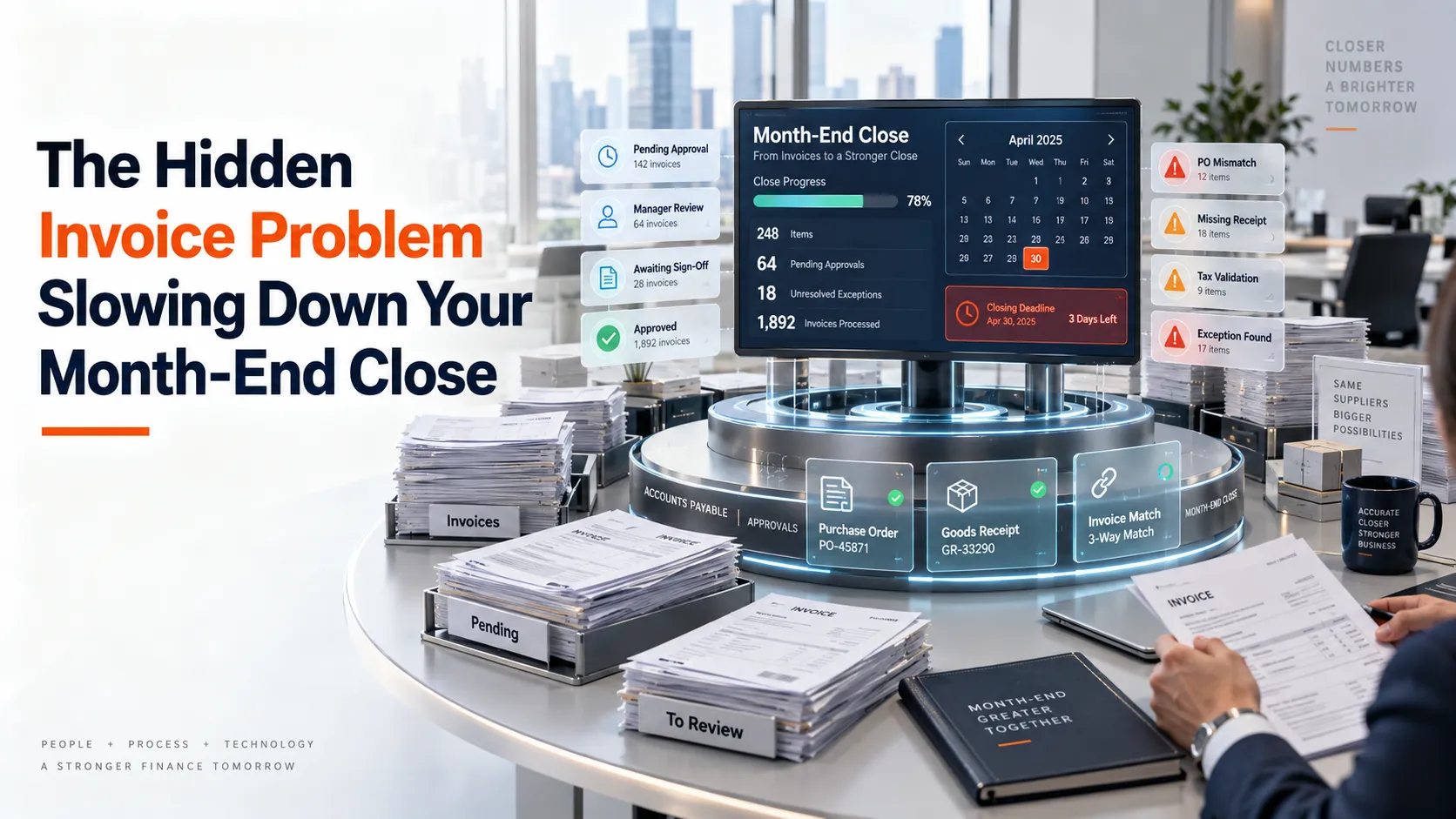
Month-end close is supposed to be a structured financial process. In reality, for many finance teams, it feels more like a race against unfinished work.
Invoices are still sitting in shared inboxes. Purchase orders do not match. Managers have not approved expenses. Supplier details need clarification. Goods receipts are missing. AP teams are trying to clear backlogs while accountants are simultaneously reconciling balances, preparing accruals, and finalizing reports.
The result is predictable: the close takes longer than expected.
What makes this frustrating is that the problem often does not begin at month-end at all. It starts much earlier, when invoices enter the business and spend days moving through inefficient workflows.
That is why improving invoice processing can have a much bigger impact on month-end performance than many organizations realize.
The Month-End Problem Often Starts Weeks Earlier
Imagine an invoice arriving on the fifth day of the month.
It reaches a shared email inbox but is not entered immediately. A few days later, someone opens it and discovers that the purchase order number is missing. The invoice is forwarded to another employee for clarification. That employee is busy and responds several days later.
Once the PO is identified, a quantity mismatch appears. The purchasing team then needs to verify whether all the goods were received.
Eventually, the problem is resolved.
But by then, the invoice has spent two or three weeks inside the organization without reaching the accounting system.
One invoice may not create a serious issue.
Multiply the same situation across hundreds of invoices and month-end suddenly becomes difficult.
The finance team now needs to determine which expenses have been captured, which invoices remain outstanding, and which costs should be accrued.
This is why invoice processing outsourcing and month-end close are more closely connected than they may initially appear.
Invoice Backlogs Create Financial Blind Spots
An invoice sitting in an inbox is more than an unfinished administrative task.
It represents financial information that may not yet be visible in the accounting system.
If invoices are not processed before the closing period, finance teams may not have a complete picture of liabilities and expenses.
That creates additional work.
Employees may need to search inboxes, contact departments, estimate accruals, and investigate transactions that could have been resolved earlier in the month.
The problem becomes even more noticeable in businesses processing large volumes of invoices.
What worked when a company received 200 invoices a month may become difficult when the same business starts handling 2,000 or 20,000.
At that point, simply asking employees to work faster is unlikely to solve the underlying issue.
The workflow itself needs to become more scalable.
Manual Data Entry Consumes Time at the Worst Moment
Traditional invoice processing involves a surprising amount of repetitive work.
Employees open documents, identify suppliers, copy invoice numbers, enter dates, capture totals, check tax amounts, locate purchase orders, assign accounting information, and send invoices for approval.
Each task may only take a few minutes.
Across thousands of invoices, those minutes become hundreds of hours.
This is one reason companies increasingly use document processing services to capture, structure, and validate information before it reaches downstream finance systems.
Reducing manual entry does more than improve processing speed.
It also reduces the amount of routine work that remains unfinished when the month-end deadline arrives.
Instead of spending the final days of the month entering invoice data, finance teams can spend more time reviewing accounts and resolving genuinely important financial issues.
Approval Delays Can Be Even Harder to Fix
Not every invoice delay comes from data entry.
Sometimes the invoice has already been captured correctly but is still waiting for approval.
A manager may be travelling. The invoice may have been routed to the wrong person. Nobody may be sure which department owns the expense.
These situations create what can be thought of as invisible queues.
The invoice exists.
The information exists.
But the transaction cannot move forward.
By the time month-end arrives, AP teams may be sending urgent reminders simply to get routine invoices approved.
Better workflows should therefore include clear approval ownership, escalation rules, and visibility into where invoices are waiting.
Without that visibility, finance teams often discover problems only when the closing deadline is already approaching.
Exceptions Are Where Most of the Complexity Lives
Many invoices are straightforward.
The supplier exists. The purchase order is correct. The price matches. The goods were received. The tax calculation is acceptable.
Those invoices should not require extensive manual attention.
The real workload comes from exceptions.
Perhaps the supplier charged a different price. The PO quantity does not match the invoice quantity. A duplicate document has been submitted. Goods receipt information is missing. The GL code is unclear.
Technology can identify many of these issues quickly.
But someone still needs to investigate them.
That is why effective accounts payable invoice processing should not focus only on data capture. Exception handling is equally important.
The strongest workflows allow routine invoices to move efficiently while directing unusual transactions to people who can resolve them.
This reduces unnecessary human involvement without removing human oversight.
Automation Helps, But It Is Not a Complete Solution
AP automation can remove a significant amount of repetitive work.
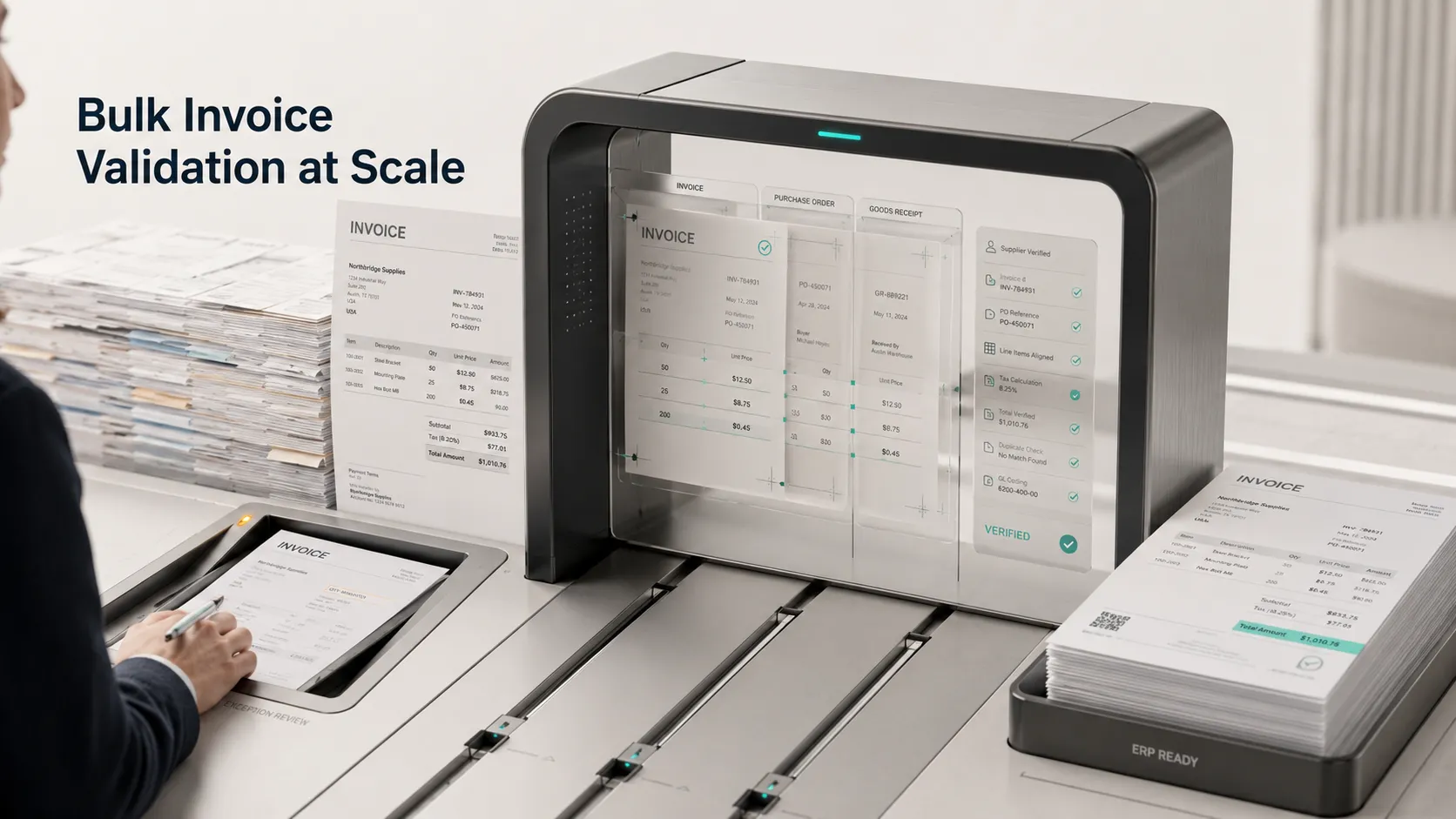
It can extract invoice data, identify duplicates, match documents, route approvals, and flag inconsistencies.
But automation still depends on good processes.
If approval responsibilities are unclear, software cannot decide organizational ownership. If suppliers submit incomplete documents, someone still needs to resolve the missing information. If exceptions consistently require judgment, human review remains essential.
This is why many businesses use a hybrid approach.
Technology handles predictable transactions. External specialists or internal processing teams handle repetitive operational work. Finance professionals retain control over policy, approvals, complex exceptions, and financial decisions.
This model can be particularly valuable for organizations experiencing recurring processing peaks around month-end.
When Outsourcing Starts to Make Sense
Businesses do not necessarily need to outsource because they have reached a specific invoice count.
The more useful question is whether internal processing capacity is keeping pace with the workload.
Repeated backlogs are one warning sign.
Heavy overtime during every closing period is another.
Long approval queues, growing exception volumes, seasonal spikes, and highly manual workflows can also indicate that the existing model is becoming difficult to scale.
Using outsourced invoice processing services can provide additional operational capacity without requiring businesses to continually increase their internal AP headcount.
The external team can support document capture, data validation, invoice matching, exception management, and preparation of accurate information for ERP or accounting systems.
However, outsourcing works best when responsibilities are clearly defined.
Simply moving a disorganized process to another team does not make it efficient.
Measure Where Invoices Spend Their Time
Many AP teams measure how many invoices they process.
That is useful, but it does not tell the whole story.
A more revealing question is:
How long does an invoice take to move from receipt to posting?
An invoice may require only five minutes of actual processing but spend five days waiting for approval.
Another may be captured immediately but remain in an exception queue for a week.
These waiting periods are often the real source of month-end delays.
Finance teams should therefore look at processing time, approval time, exception resolution, rework, and the number of invoices still outstanding when close begins.
Once these bottlenecks become visible, the organization can decide whether the solution is better automation, clearer internal workflows, additional resources, outsourcing, or a combination of all four.
A Faster Month-End Close Starts Before Month-End
The biggest mistake organizations can make is treating month-end close as a problem that only needs attention during the final few days of the month.
By then, many of the underlying issues have already happened.
A better close starts with a better invoice flow.
Invoices should enter through controlled channels. Routine information should be captured quickly. Purchase orders should be matched efficiently. Approvals should have clear owners. Exceptions should be identified early rather than discovered during the closing period.
When those things happen consistently throughout the month, the finance team enters month-end with fewer unresolved transactions and better visibility over outstanding liabilities.
That makes the close less dependent on overtime, manual searches, last-minute approvals, and rushed accrual decisions.
The goal is not simply to make accountants close the books faster.
It is to remove the unnecessary invoice-processing problems that slow them down in the first place.
Make Invoice Processing More Predictable with Computyne
If invoice backlogs, repetitive data entry, approval delays, or exception-heavy workflows are making month-end more difficult, Computyne can help businesses build a more scalable finance operation. Through its invoice processing services, document processing solutions, data entry services, and finance and accounting support, Computyne helps organizations manage high-volume invoice workflows with a combination of technology-assisted processing and experienced human review. By improving invoice capture, validation, matching, exception handling, and ERP-ready processing, businesses can reduce backlogs and create a more predictable path toward month-end close.



























Sign in to leave a comment.