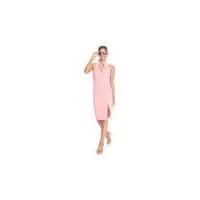
What the Category Actually Covers
A sleeveless spring dress is any dress without sleeves designed to perform well in the temperature range, occasion mix, and styling context that spring life demands. That sounds simple. In practice, the category spans everything from a structured Ponte sheath to a floaty chiffon midi, and the performance gap between those two ends is enormous.
Most buyers approach the sleeveless spring dress as a seasonal purchase: something light, something easy, something affordable enough that it does not matter if it gets worn twice and forgotten. That logic produces a wardrobe full of underwhelming options. The garments that actually earn long-term use are chosen differently, with fabrication, proportion, and occasion range as the primary criteria rather than print or color.
Why Fabrication Is the Decision That Matters Most
Spring dressing has a thermal problem that most fashion content ignores. The season does not have a single temperature. It has a range that varies by as much as 25 degrees Fahrenheit within a single day, and a sleeveless dress has no built-in insulation layer to buffer that shift. The fabric is the only thing managing the relationship between the dress and the body across those conditions.
Lightweight fabrics, chiffon, georgette, and tissue cotton, read as spring-appropriate but they offer almost no structure and very limited thermal performance. They work in warm conditions and struggle in cool ones. Mid-weight fabrics, stretch crepe, Ponte, and heavier cotton blends, hold their shape, photograph cleanly, and remain comfortable across a wider temperature range because they provide a consistent surface layer against ambient air.
The under-discussed truth about the sleeveless spring dress category is that mid-weight fabrications dramatically outperform lightweight ones in overall wearability, despite being counterintuitive for a warm-weather season. A stretch crepe dress worn in 60-degree weather with a light layer over it is more comfortable than a chiffon dress worn in 75-degree weather that becomes transparent in direct sunlight and loses its shape by mid-afternoon.
The fabrication hierarchy that consistently performs:
- Stretch crepe: Holds structure, photographs without reflections, and maintains its shape across a full day. The elastane content provides comfort without sacrificing the clean line.
- Ponte: Mid-heavy, sculpting, and wrinkle-resistant. Works across a wider temperature range than most spring fabrics. The best choice if the dress needs to go from morning to evening.
- Cotton poplin: Crisp, breathable, and structured. Works in warmer conditions. Wrinkles more than synthetic blends but reads as polished when properly pressed.
- Linen blends: Breathable and textural. More casual in register than crepe or Ponte. Better suited to relaxed outdoor settings than formal or semi-formal occasions.
- Chiffon and georgette: Beautiful in direct sunlight, fragile in wind and movement. Best reserved for occasions where you are largely stationary and the environment is warm and controlled.
The Neckline Variable: Why It Shapes the Whole Dress
Necklines are proportion tools. Most people treat them as aesthetic preferences, choosing what they like the look of without considering what the neckline is doing to the visual logic of the entire garment. In a sleeveless dress, the neckline takes on more weight than it would in a sleeved one because it is carrying the entire upper-body framing responsibility alone.
A structured neckline, a notched collar, a square neck, a high crew, creates a defined anchor point that gives the eye somewhere specific to land. It frames the face and shoulders with intention. An unstructured or deeply open neckline can read as unfinished without the counterweight of a sleeve or an accessory to complete the frame.
This is why the neckline choice in a sleeveless dress is one of the highest-leverage decisions in the garment's overall performance:
- Square neck: Creates clean horizontal geometry. Flatters a wide range of proportions. Reads as structured without being severe.
- Notched or contrast collar: Carries the visual authority of tailoring. Self-completing, meaning it requires no necklace or additional framing.
- Sweetheart: Adds curve and femininity. Works best when the rest of the dress is structured rather than fluid.
- Boat neck: Reads as elegant and wide-shouldered. Elongates the neck. Works well when the fabric has enough weight to hold the line.
- Deep V or plunge: Requires more accessory management to look polished. Works in social contexts; less reliable in professional ones.
The analytical point: the neckline determines how much accessory work the dress needs. A self-completing structured neckline reduces the number of decisions required to make the outfit work. That reduction in styling complexity is a practical advantage over a full day or evening of wear.
Occasion Range: Mapping Where Sleeveless Spring Dresses Actually Perform
The most honest assessment of any sleeveless spring dress is an honest occasion map: where it performs reliably, where it manages adequately, and where it does not work at all. Most content in this category avoids that clarity in favor of generic versatility claims. The reality is more specific.
A structured sleeveless dress in a mid-weight fabric with a defined neckline performs well across:
- Semi-formal events: Cocktail parties, corporate dinners, gallery openings. The structure reads as appropriate and the sleeveless cut does not undermine the formality level.
- Daytime professional settings: With a blazer or structured jacket over it. The dress provides the foundation; the layer manages the formality register.
- Spring and summer weddings (guest): Appropriate across a wide range of dress codes from garden party to cocktail attire, depending on the fabric and silhouette.
- Evening social events: The absence of sleeves reads as deliberate rather than casual when the rest of the dress is well-constructed.
Where sleeveless spring dresses struggle:
- Outdoor events with variable weather: No layer of fabric at the arm means the dress offers no insulation buffer. Wind and temperature drops are felt immediately.
- Strictly formal events: Most sleeveless silhouettes read as cocktail rather than black tie. The absence of a sleeve can read as casual at the highest formality levels.
- Conservative professional environments: In workplaces with formal dress codes, a sleeveless dress without a layer over it may not meet expectations.
The dress that works across five different contexts without modification is worth ten that each work once.
The Layering Question: When a Sleeveless Dress Becomes a System
One of the most underexplored dimensions of the sleeveless spring dress is its function as a layering base. When chosen with that purpose in mind, a well-constructed sleeveless dress becomes the foundation of multiple complete outfits rather than a single garment with a limited use window.
The logic works in both directions. A blazer or structured jacket over a sleeveless dress elevates the formality level and adds thermal coverage for cooler mornings. A lightweight cardigan or denim jacket brings the dress down to casual register for weekend wear. A tailored trench coat over it reads as complete and polished for transitional weather.
The sleeveless cut is what makes this system work. A sleeved dress under a jacket creates sleeve overlap that reads as awkward or bulky. A sleeveless dress under a jacket creates a clean, layered line with no visual interruption. This is a functional advantage that tends to be overlooked in favor of purely aesthetic considerations.
To maximize layering range, the dress should be chosen with the following in mind:
- Armhole depth and shape: A well-cut armhole allows a jacket to sit cleanly over it without pulling or bunching.
- Back construction: A fully lined dress with a clean back seam layers more neatly than an unlined one.
- Fabric weight: Mid-weight fabrics create less bulk under outerwear than lightweight fabrics, which tend to shift and bunch.
How the Sleeveless Dress Category Is Changing
The sleeveless spring dress has existed as a wardrobe category for decades, but the expectations placed on it are changing in ways that are worth understanding before making a purchase decision.
The most significant shift is in fabrication. Consumer experience with high-performance fabrics in other categories, activewear, travel clothing, and contemporary suiting, has raised expectations around what a dress should do. The demand for garments that hold their shape, resist wrinkling, and remain comfortable across long wear periods is now crossing into formal and semi-formal dressing. Stretch crepe, technical Ponte, and scuba-adjacent fabrics are meeting that demand in ways that traditional spring fabrics, silk, linen, and lightweight cotton, cannot reliably match.
The second shift is in occasion fluidity. The post-pandemic restructuring of work, social, and formal life has compressed dress code categories in most professional and social environments. Women are navigating more mixed-formality occasions than they were five years ago, and the pressure is on individual garments to perform across that wider range. A sleeveless spring dress purchased in 2026 is being asked to do more contextual work than one purchased in 2019.
The third shift, and the one with the longest runway, is the move toward investment-led purchasing. Fashion data from multiple retail analytics sources consistently shows that consumers are making fewer, more considered purchases across apparel categories. The metrics driving those decisions have shifted from seasonal relevance to cost-per-wear, longevity, and functional range. The sleeveless spring dress that survives in this environment will be the one that was designed for performance rather than seasonal novelty.
Looking ahead three to five years, the sleeveless dress category will likely consolidate around structured silhouettes in technical fabrics, with lightweight and trend-driven options losing market share to higher-performing alternatives. The visual language will remain spring-appropriate, but the underlying construction will look increasingly like the performance standards currently found in professional and travel clothing.
Chosen Well, a Sleeveless Spring Dress Earns Its Place Year After Year
The sleeveless spring dress is not a complicated purchase. But it is one that is made poorly more often than it should be, because the evaluation criteria most buyers use, print, color, price, and initial visual appeal, are the least predictive of long-term performance.
Fabrication determines how the dress feels and holds across real conditions. Neckline determines how much styling work it requires. Occasion range determines how often it actually gets worn. Construction determines how long it stays in the wardrobe.
The intelligent approach is to evaluate those four criteria first and treat everything else as secondary. A sleeveless spring dress that scores well on all four will not need to be replaced next season. It will not require three accessories to look finished. And it will not spend most of its life at the back of the wardrobe waiting for the one occasion it was designed for.
That is the standard worth holding any garment to.
























Sign in to leave a comment.