

Buying a home in Seattle requires a data-driven strategy.
With the "panic-buying" era now in the rearview mirror, success in Seattle’s real estate market depends on precise financial planning and the ability to act decisively when inventory matches your long-term investment goals.
While competition remains high within the Seattle city limits, buyers have a unique window to leverage stabilizing King County inventory. Buying a home in this market depends on monitoring the sale-to-list price ratio and timing your entry to maximize long-term investment returns.
The effective planning required for this begins with homebuyer education and financial precision. With the Purchase Price / Median Home Price currently averaging near $880,000, those undergoing relocation must think beyond basic lending products. To beat the all-cash offers that are being made in the area, you need a partner who analyzes interest reduction strategies, ensuring your mortgage functions as a high-performing asset.
The search for property in the Pacific Northwest is often a trade-off between "proximity premiums" and total space. No matter which Seattle neighborhoods you’re looking in, you’ll need a localized approach and a verified mortgage pre-approval to ensure speed.
This preparation allows your realtor in Seattle to put your offers forward knowing your financing can support a competitive bid.
Buying a home in Seattle rewards those who master the details, from a sewer scope on historic homes to navigating HOA dues. Leveraging down payment assistance (DPA) through the Washington State Housing Finance Commission (WSHFC) is one of the details that’s most important because it can help you preserve liquidity.
Acting now allows you to secure a foothold in a market that has historically rewarded early action.

Strategic Neighborhood Selection & Lifestyle Mapping
But finding the right home within this market starts with choosing a community that aligns with your daily needs.
Inside the Seattle city limits, you pay for proximity to high-density employment centers and transit, but for many, those higher prices are worth it.
Identifying the Right Neighborhoods
Seattle is a collection of micro-markets with distinct personalities and price points.
Whether you prefer a quiet residential street or a busy urban hub, narrowing your focus helps you act quickly. This clarity allows you to monitor new listings that fit your specific criteria.
Urban employment hubs
South Lake Union and Ballard cater to those who want short commutes and high walkability. These areas feature many modern condos and townhomes near major tech headquarters and nightlife.
Quiet residential enclaves
Leschi and North Admiral provide a slower pace with mature trees and views of Lake Washington or the Puget Sound. These communities typically offer larger lots and more privacy than the city core.
Eastside suburban options
Sammamish and Redmond are top choices for families who prioritize large floor plans and highly rated schools. These King County suburbs offer extensive park systems and easy access to major suburban employers.
Affordable commuter zones
Snoqualmie and Maple Valley attract buyers looking for more house for their money away from the city center. These areas provide a small-town feel while remaining within driving distance of the metro area.
Understanding the trade-offs between a short commute and a larger yard is a key part of the process. Use a comparative market analysis to see how prices vary across these different zones.
Professional Collaboration: The Realtor Seattle & Agent Roles
Successfully buying a Home in Seattle requires a team of experts to manage the complex paperwork and negotiations. You must understand who represents your interests and how they receive payment. This clarity helps you navigate the transaction without any surprises or conflicts of interest.
Fiduciary responsibility
Your agent guides you through making an offer and ensures all legal disclosures are reviewed before you sign. They protect your earnest money by managing the timeline of your contingencies.
Commission structures
In most local transactions, the seller pays the commission for both agents out of the final sale proceeds. This means professional representation for the buyer typically comes at no direct out-of-pocket cost.
Market strategy
A skilled agent analyzes the price ratio of a neighborhood to help you craft a winning bid. They can also advise you on when to use an escalation clause to beat out other buyers.
Closing coordination
Your team manages the communication between the lender, the title company, and the escrow officers. This ensures the final walkthrough and signing process happen on schedule.
Working with a local expert gives you a significant advantage in a fast-moving market. They provide the market context needed to make a confident and informed decision.
Strategic Neighborhood Selection and Lifestyle Mapping
If you are buying a home in Seattle, neighborhood selection should start with an analysis of local statistics. Citywide averages can often hide what is happening street by street.
The same budget can buy very different outcomes based on commute patterns, school zones, parking, noise, and access to daily essentials. This is even more important for relocation and for buyers who cannot tour every weekend in person.
Start Hyper-local with Seattle Neighborhoods
Hyper-local selection means you decide what you will and will not trade. This approach reduces wasted tours and helps you move faster when the right listing appears.
Lifestyle anchors
Write down the places you will use every week. Think about work, schools, gym, parks, and groceries. Map the driving time in real traffic windows.
Home type match
Some blocks skew toward condos and townhomes. Other blocks skew toward detached homes. This affects yard space, parking, and future maintenance.
Block-level reality checks
Visit at different times. Noise and parking can change by the hour. Safety perception can also change depending on lighting and foot traffic.
You set your non-negotiables first. Then you sort neighborhoods based on fit. Price comes after fit, not before.
Neighborhood Comparison: Seattle Urban Hubs and King County Suburbs
Choosing between an urban environment and a suburban retreat is a fundamental decision when buying a Home in Seattle. Your choice dictates your daily commute, access to local amenities, and the specific housing types available to you.
Exploring these diverse areas allows you to understand the market trade-offs and find a location that supports your long-term lifestyle goals.
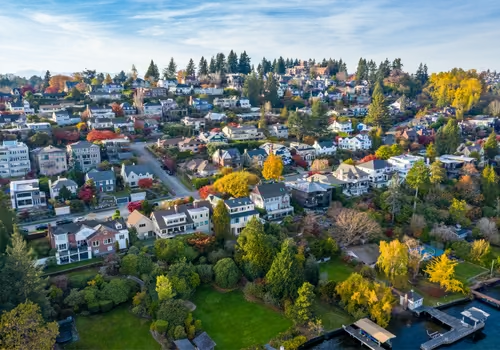
7 Popular Urban Hubs in Seattle Neighborhoods
These hubs can be a smart starting list. They each have a distinct feel. They also have different price points and housing mixes.
Ballard
Ballard is known for walkability and a strong local dining scene. Many buyers like its mix of older homes and newer townhomes.
South Lake Union
South Lake Union is close to major employers and has a dense urban feel. Expect more condos and newer buildings. Parking and HOA costs can matter.
Leschi
Leschi offers a quieter residential vibe in many pockets. Lake access and views can affect pricing. Street-by-street variation is common.
North Admiral
North Admiral has a neighborhood feel with easy access to West Seattle amenities. Housing mix and topography can change how “walkable” it feels.
Montlake
Montlake is centrally located near major corridors and the university area. Inventory can be limited. That can affect competition.
Redmond
Redmond is a major employment hub with parks and trail access. It has suburban patterns with pockets of density. Commute routes should be tested.
Greenwood
Greenwood is often chosen for its community feel and local shops. Housing stock varies. Some streets are quieter than others.
Tour at least two areas that fit your lifestyle, even if you think you already know your favorite.
Professional Collaboration: The Realtor Seattle & Agent Roles
Successfully buying a home in Seattle requires a team of experts to manage the complex paperwork and negotiations. You must understand who represents your interests and how they receive payment.
Each agent in a transaction has a specific legal duty to their client. The buyer’s agent works exclusively for you to find properties and negotiate the best possible terms. The listing agent represents the home seller and focuses on getting the highest price for the property.
Fiduciary responsibility
Your agent guides you through making an offer and ensures all legal disclosures are reviewed before you sign any documents. They protect your earnest money by managing the strict timelines of your contingencies throughout the escrow period.
Commission structures
In most local transactions, the seller pays the commission for both agents out of the final sale proceeds at the time of closing. This means professional representation for the buyer typically comes at no direct out-of-pocket cost during the search process.
Market strategy
A skilled agent analyzes the sale-to-list price ratio of a neighborhood to help you craft an offer that is both competitive and fair. They can also advise you on when to use an escalation clause to beat out other buyers without overpaying for the property.
Competing with all-cash offers
Your agent helps you navigate a market where roughly one-third of transactions involve all-cash offers that prioritize speed and certainty. They can suggest strategies like shortening inspection periods or providing an appraisal gap to make your financed offer more appealing to sellers.
Working with a local expert gives you a significant advantage in a fast-moving market. They provide the market context needed to make a confident and informed decision.
Buy Your New Seattle Home
Buying a home in Seattle is easier when you treat the process like a series of decisions you can verify. Start with hyper-local data. Track days on market and the sale-to-list price ratio in the exact areas you want.
When you pick Seattle neighborhoods that fit your daily life, you can then match your budget to what is actually selling nearby. If you are relocating, compare the Seattle city limits to King County suburbs with real commute tests and an AMI-aware budget.
Work with a buyer’s agent in Seattle who can explain tradeoffs in plain language and keep your offer competitive without adding unnecessary risk, even when all-cash offers show up.
If you stay prepared, buying a home in Seattle becomes less stressful and more predictable.
Frequently Asked Questions
1. What are the best neighborhoods for families in Seattle?
The best family neighborhoods depend on schools, commute, and the home type you want. Many families compare options inside the Seattle city limits and nearby parts of King County, then confirm fit by touring the same micro-areas at different times and checking recently sold prices.
2. Do I need a local lender for a Seattle home purchase?
No, but a lender with fast communication and reliable closing timelines helps in Seattle. What matters most is a strong pre-approval and the ability to deliver a clean loan estimate and rate lock plan on time.
3. How competitive is the Seattle housing market?
It can be highly competitive for well-priced homes, especially when all-cash offers are present. Watch days on market and the sale-to-list price ratio in your exact target area to gauge how fast you need to move.
4. What is a pre-inspection, and when should I do it?
A pre-inspection is an inspection done before you submit an offer. It is most useful when a home is likely to attract multiple offers, and you want to reduce surprise repair risk.
5. Is it better to buy a condo, townhouse, or single-family in Seattle?
Condos can lower entry costs but add HOA dues and resale certificate review, townhouses sit in the middle, and single-family offers the most control with more upkeep. The best choice depends on your budget, maintenance tolerance, and where you are buying a Home in Seattle.































Sign in to leave a comment.