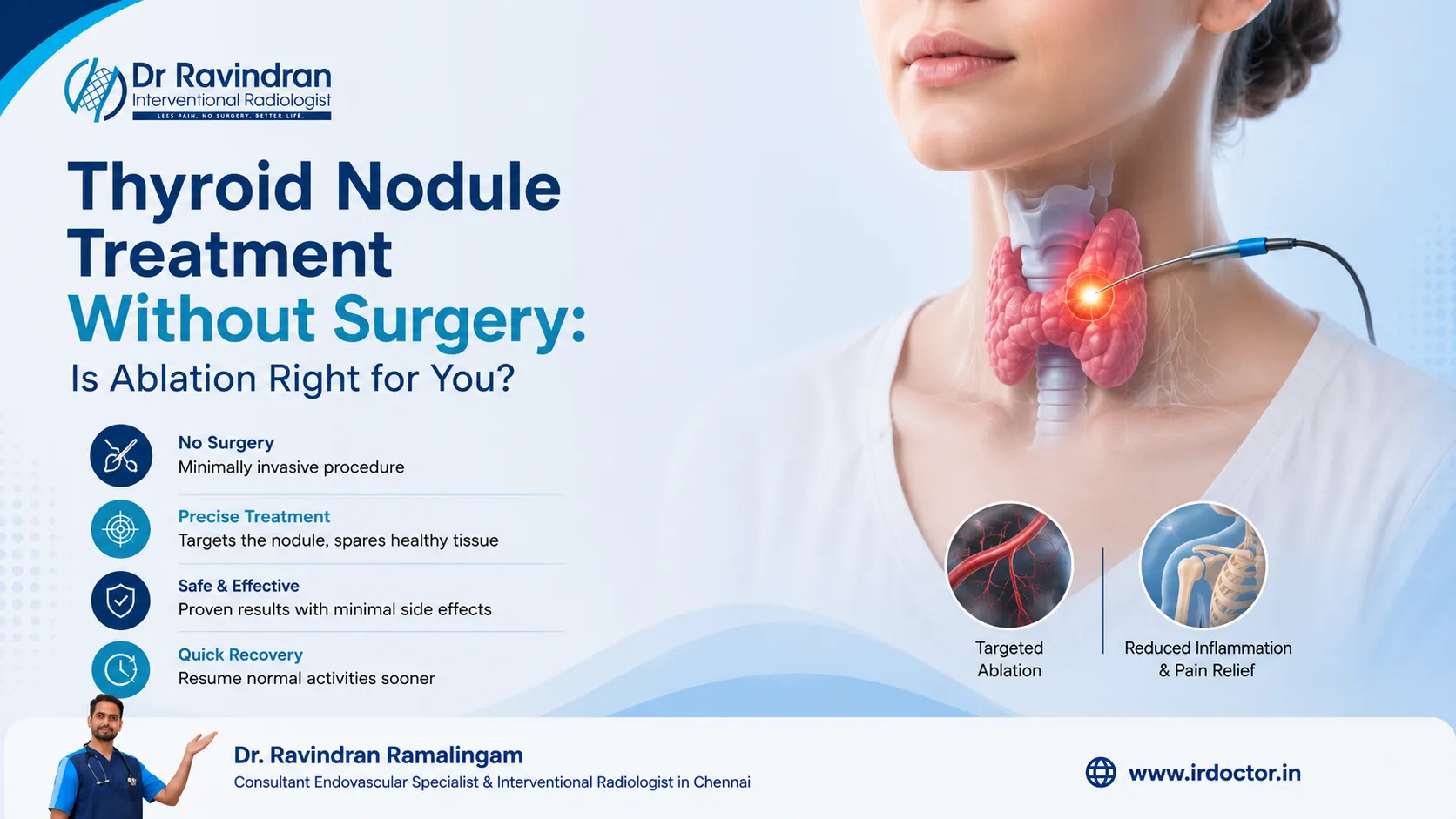

A patient came to me last year holding an ultrasound report. She'd been sitting on it for three months. Too scared to even bring it up.
She'd read the word "nodule" online. Then her mind jumped straight to the worst case. By the time she sat down in my clinic, she was convinced she needed surgery, maybe even chemotherapy.
Here's what I told her that day, and what I want to tell you, too. Most thyroid nodules are not cancerous. Even fewer need surgery anymore. There's a real non-surgical path now for the majority of patients. The problem is, almost nobody knows it exists until a doctor tells them directly.
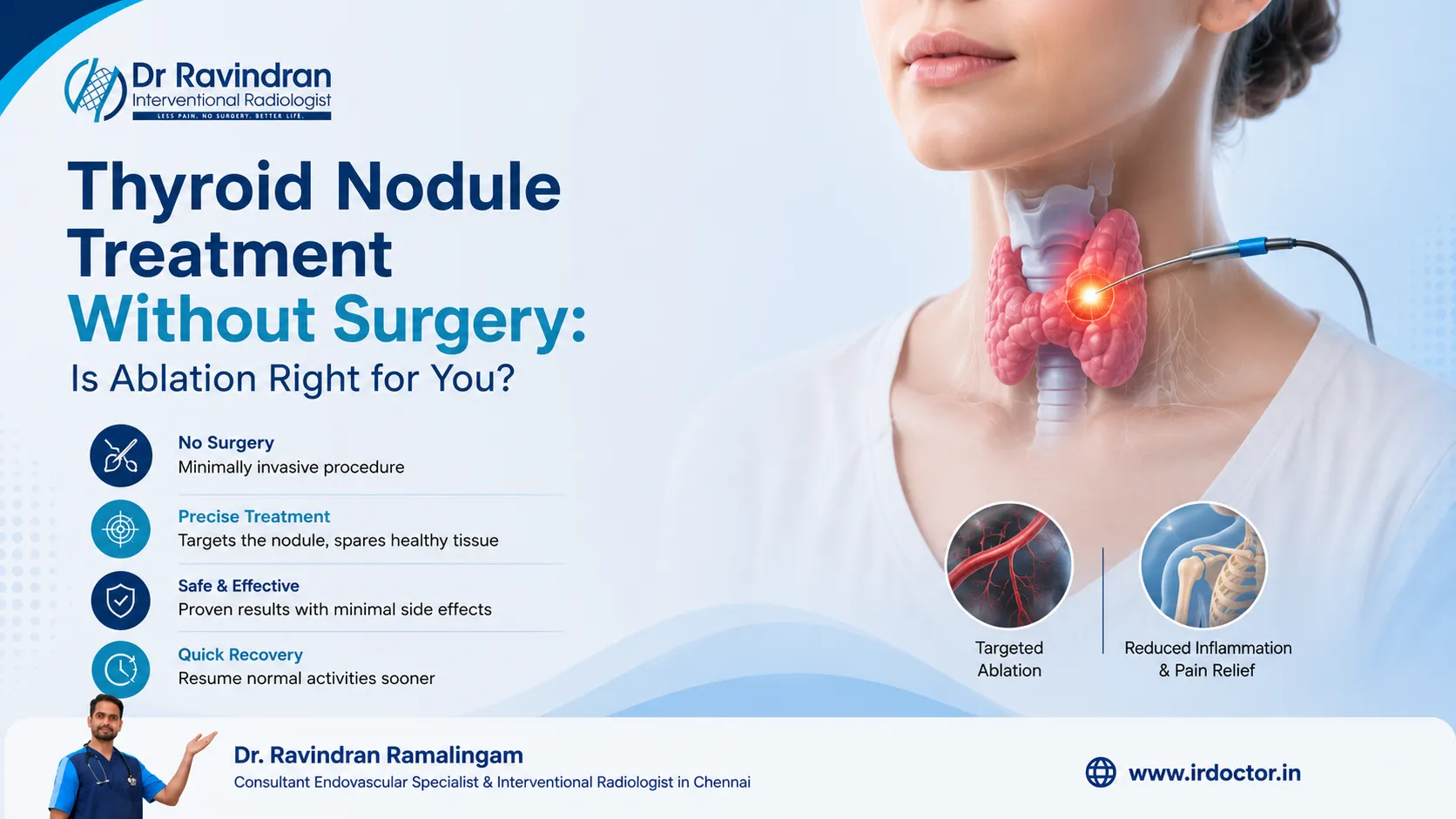
Let me walk you through it, the same way I would in my clinic.
Clinical Nodule Matrix: Surgical Removal vs Thermal Ablation
- Ideal for ablation: Confirmed benign nodules, TIRADS 3 or TIRADS 4 after a benign biopsy, and large cystic or colloid nodules
- Primary clinical benefit: 100% preservation of normal thyroid function, no lifelong hormone replacement pills required
- Gold-standard techniques: Radiofrequency Ablation for solid nodules, Ethanol Ablation for fluid-filled cystic nodules
Understanding Types of Thyroid Nodules and When They Need Action
Not every nodule is the same. And not every nodule needs the same response.
Before we even talk about treatment, let's understand what your scan report is actually telling you. This is usually the first thing I clarify, because most patients arrive confused by the terminology alone.
Decoding Your Scan: What Does TIRADS Actually Mean?
If you've had a thyroid ultrasound, your report probably includes a TI-RADS score. Think of this as a simple grading system. It tells your doctor how suspicious a nodule looks on imaging, nothing more.
Here's how the scale breaks down:
- TIRADS 1 — normal thyroid tissue, no nodule present at all
- TIRADS 2 — benign, essentially nothing to worry about
- TIRADS 3 — mildly suspicious, usually just monitored, or biopsied if it's growing
- TIRADS 4 — moderately suspicious, generally needs a biopsy to confirm what it actually is
- TIRADS 5 — highly suspicious, biopsy strongly recommended without delay
I want to be clear about something important here. This score alone does not diagnose cancer. It simply tells us how carefully to look further. A high number isn't a verdict. It's a signal to investigate properly.
Managing a TIRADS 4 Nodule: When to Move From Biopsy to Treatment
This is the classification I get asked about most. It sits in a genuinely uncertain zone for patients, and I understand why it causes anxiety.
Here's the honest breakdown:
- A TIRADS 4 nodule carries moderate suspicion based on imaging alone
- It needs a fine-needle aspiration biopsy to confirm whether it's benign or not
- Once the biopsy confirms it's non-cancerous, it becomes an excellent candidate for non-surgical ablation, especially if it's causing symptoms or growing
The biopsy step isn't a formality. It's the single deciding factor that tells us whether ablation is even appropriate for your case. Skip this step, and we're guessing. I never guess with something this important.
Symptoms of Thyroid Nodules: Solid, Cystic, and Colloid Types
Nodules aren't built the same way inside. That difference matters, because it affects both your symptoms and which treatment fits best.
- Solitary solid nodules are made of dense thyroid tissue. They tend to grow slowly, often over years.
- Cystic nodules are fluid-filled. They can refill after simple drainage, which is exactly why they tend to come back.
- Colloid nodules are benign overgrowths of normal thyroid tissue. These are extremely common, and rarely dangerous.
Larger nodules, no matter the type, can cause real physical symptoms. Visible neck swelling. A sensation of tightness when swallowing. A persistent cough that doesn't respond to cough syrup or antibiotics.
These are usually the symptoms that finally push someone to book an appointment, sometimes years after the nodule was first noticed on a routine scan.
Comparing Thyroid Surgery and Ablation: The Shift Toward Minimally Invasive Care
Traditional Thyroidectomy vs Non-Surgical Ablation
For decades, surgery was the only real answer for a bothersome thyroid nodule. That's changed, and it's changed significantly in just the last several years.
Traditional thyroidectomy means general anaesthesia. It leaves a visible scar across the neck. And because it often removes healthy thyroid tissue along with the nodule, many patients end up needing lifelong thyroid hormone pills afterward, just to keep their bodies functioning normally.
Radiofrequency Ablation works differently. It's done as an outpatient procedure. Local anaesthesia only. A tiny needle puncture, no incision. And critically, it targets only the nodule itself, leaving the rest of your healthy thyroid completely alone.
The Clear Advantages of Choosing Minimally Invasive Treatment
Patients are often surprised by how much this shifts the entire experience, not just the scar.
Here's what changes:
- Zero surgical scars, the whole procedure happens through a tiny needle puncture
- Healthy thyroid tissue stays intact, which avoids post-procedure hypothyroidism in most cases
- Only local anaesthesia is needed, never general anaesthesia
- Most patients are back to normal activity the same day, or the next morning at most
That last point matters more than people expect. No missed weeks of work. No lengthy recovery. Just a quick procedure and a return to your normal life.
Medical Procedures for Thyroid Nodules: RFA vs Microwave Ablation
Not every nodule gets treated with the exact same technique. The right choice depends on size, composition, and where exactly the nodule sits.
How Radiofrequency Ablation Shrinks Benign Nodules
RFA is the technique I reach for most often with solid, benign nodules. Here's what actually happens during the procedure:
- A microscopic electrode needle is passed into the nodule, guided continuously by ultrasound
- Targeted radio waves generate heat right at the needle tip, destroying the abnormal tissue cells directly
- Surrounding healthy tissue and your normal thyroid function stay completely untouched
- The treated tissue gradually shrinks over the following months, as your body naturally reabsorbs it
Most patients describe the sensation as mild warmth, nothing more. There's no incision to heal, because there never was one to begin with.
Microwave Ablation for Larger or Complex Nodules
For bigger or more complex nodules, microwave ablation offers a real advantage worth knowing about.
- It works on a similar principle to RFA, but uses electromagnetic waves instead of radio waves
- This creates a larger ablation zone, faster, often in a single session
- It's particularly effective for solid, solitary, or mixed solid-cystic nodules that might otherwise need multiple RFA sessions to fully treat
If your nodule is on the larger side, this is often the technique I'll recommend, simply because it gets the job done in fewer visits.
Ethanol Ablation: The Gold Standard for Cystic Nodules
If your nodule is fluid-filled, and keeps coming back after simple drainage, this is usually the right answer.
Here's how it works:
- Medical-grade alcohol is injected directly into the fluid-filled cyst, guided by ultrasound
- The alcohol causes the cyst walls to collapse and scar down, closing off the space that kept refilling with fluid
- No thermal energy is used at all, making this a very targeted, low-risk option specifically built for cystic disease
This procedure is often quicker than RFA, and for the right nodule type, remarkably effective at preventing the fluid from ever coming back.
Consulting a Specialist: Is Non-Surgical Nodule Ablation Right for You?
Eligibility Criteria: Who Is the Ideal Candidate?
I want to be honest with you here. Ablation isn't the right fit for every single nodule, and an honest evaluation matters more than pushing one treatment for everyone.
Good candidates generally include:
- Patients with a nodule confirmed benign through biopsy
- Patients experiencing compressive symptoms, such as difficulty swallowing, breathing discomfort, or persistent throat pressure
- Patients dealing with a visible cosmetic neck deformity from the nodule, who want to avoid a surgical scar entirely
If a nodule shows any suspicious features on biopsy, surgery remains the appropriate path. I'll tell you that directly, rather than push ablation where it simply doesn't belong. My job isn't to sell you a procedure. It's to get you the right one.
Consulting for Advanced Thyroid Care in Chennai
If you're holding an ultrasound report or a biopsy result and aren't sure what happens next, that uncertainty is exactly what the first consultation is for. You don't need to have all the answers before you walk in.
A few things that help speed up that first visit:
- Bring your ultrasound, your TI-RADS score, and any biopsy results you already have
- Image-guided execution during ablation ensures the delicate nerves and blood vessels surrounding your thyroid stay completely protected throughout the procedure
- In most cases, I can give you a same-visit opinion on whether ablation is appropriate for your specific nodule, or whether further evaluation is needed first
Most patients walk in expecting to be told surgery is inevitable. For a genuine majority of benign nodules today, that's simply no longer true. And I'd rather you hear that from someone who treats these every week, than spend three more months sitting on a report you're too anxious to open.
Consult Dr. Ravindra Ramalingam, Interventional Radiologist at Gleneagles Health City, Chennai, for image-guided thyroid nodule ablation


























Sign in to leave a comment.