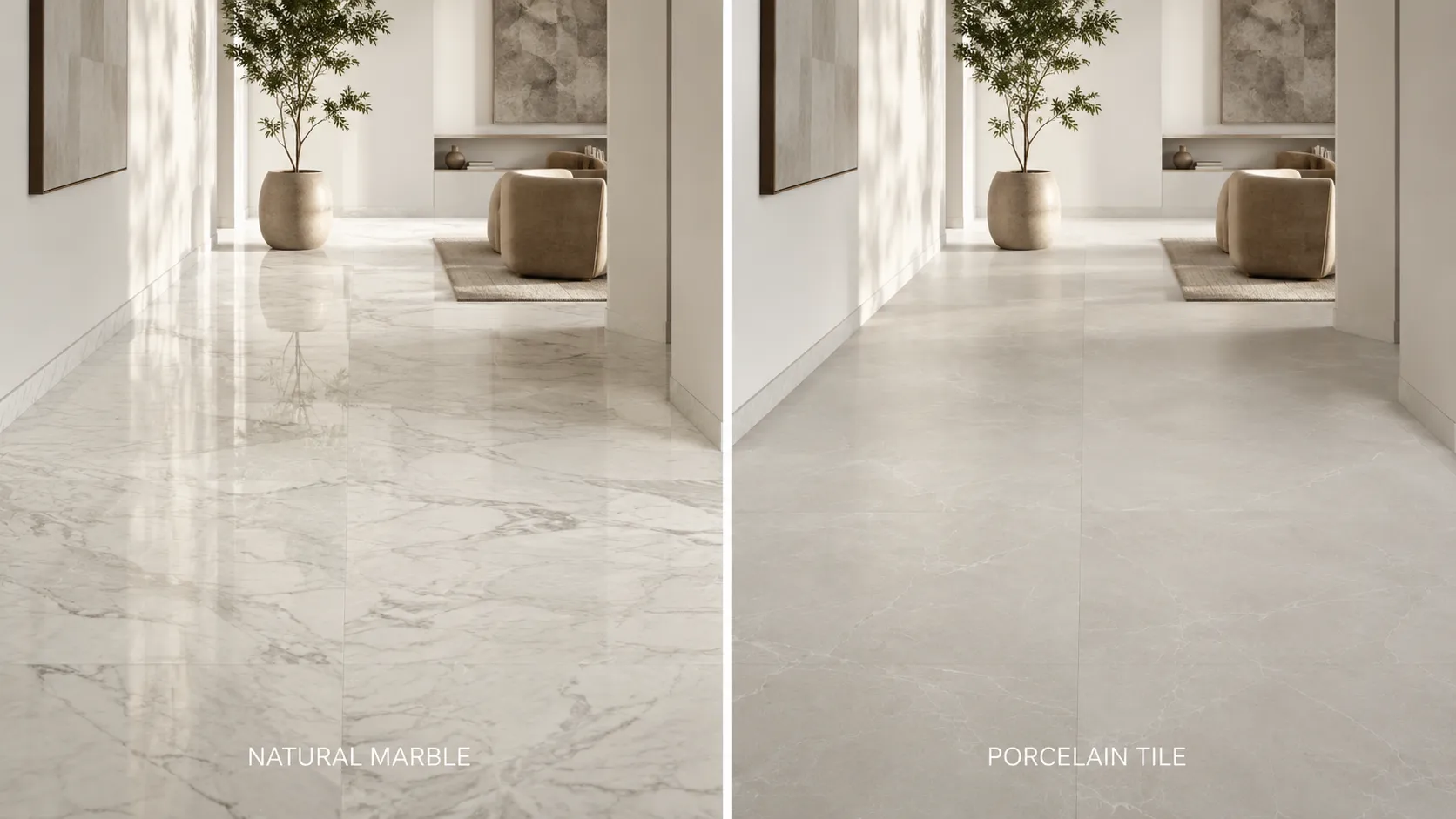

Natural stone has held a premium position in architecture and interior design for centuries. Marble, travertine, slate, and granite carry a material authenticity that manufactured products have historically struggled to replicate. Porcelain tiles have changed that equation considerably. The practical gap between quarried stone and engineered porcelain has narrowed to the point where the decision is no longer obvious, and for many applications, porcelain is the stronger choice.
Cost: Upfront, Installation, and Lifetime
Premium natural stone slabs, particularly Calacatta marble or bookmatched onyx, begin at several hundred pounds per square metre before installation. Labour costs are higher because stone requires skilled cutting, and wastage rates on natural material are significant due to veining irregularities. Porcelain alternatives that replicate these aesthetics to a high degree of accuracy typically cost 40 to 70 percent less per square metre at comparable quality tiers.
A 1200x1800 porcelain tiles supplier can supply large format tiles with digitally printed stone patterns that are consistent from batch to batch, which eliminates the matching challenges that arise when natural stone needs to be replenished after installation. Stone is inherently variable. Each slab is unique, and sourcing matching material years after original installation is often impossible.
Maintenance Commitment Over Time
Natural stone is porous. Marble, limestone, and travertine absorb liquids, which means they stain readily and require regular sealing, typically every 12 to 24 months depending on use intensity. Acid-based cleaners, including many common household products, etch the surface of calcareous stones permanently. Scratches on polished marble require professional regrinding and repolishing to correct. These are not minor considerations across a 20-year installation lifespan.
Porcelain tiles produced by quality porcelain tiles manufacturers require no sealing, resist acids and alkalis at the chemical resistance grades specified, and do not etch or stain under normal domestic or commercial conditions. The maintenance comparison is not close.
Sustainability and Sourcing Transparency
Natural stone extraction is resource-intensive. Quarrying operations produce significant waste material, and the carbon footprint of transporting heavy stone from quarries in Italy, Turkey, or Brazil to projects globally is substantial. Traceability of natural stone supply chains has improved but remains inconsistent, with sourcing from areas with poor labour standards remaining a risk in the sector.
Porcelain tiles are manufactured from abundant raw materials including feldspar, clay, and silica. Leading manufacturers have invested in kiln efficiency, waste heat recovery, and water recycling systems that significantly reduce the environmental footprint per square metre produced. A 1200x1800 porcelain tiles supplier operating under ISO 14001 certification can provide full documentation of the production process and material inputs, a level of transparency that natural stone sourcing rarely matches.
Aesthetic Accuracy: How Close Has Porcelain Come
Digital inkjet printing technology, now operating at resolutions above 1,200 DPI, combined with surface texture embossing that matches the printed pattern, allows porcelain manufacturers to produce tiles that are visually indistinguishable from natural stone in many applications. Vein matching across multiple tiles, anti-repetition pattern algorithms, and colour variation within a batch all contribute to a surface that, once installed, reads as genuinely material in photography and in person.
The practical answer is that for most residential and commercial applications today, porcelain tiles deliver equivalent aesthetics with superior durability, lower maintenance, and better cost control. Natural stone retains its position in projects where material provenance and unique variation are deliberate design values rather than incidental features.























Sign in to leave a comment.