
As businesses grow, CEOs spend less time managing day-to-day operations and more time making strategic decisions. Yet many executive teams still rely primarily on financial reports to measure business performance. While these reports show revenue, expenses, and margins, they often arrive after operational issues have already impacted profitability.
For service-based businesses, people are the primary revenue-generating asset. Understanding how time is invested across projects, clients, and teams provides an earlier view of operational health than financial statements alone.
The right key performance indicators (KPIs) help CEOs identify inefficiencies, improve resource allocation, and strengthen margins without increasing headcount. Instead of tracking individual employee activity, executives should focus on metrics that reveal how effectively the organization converts time into business value.
Why CEOs Need Data Beyond Financial Reports
Financial reports answer an important question: What happened? Operational data explains why it happened.
For example, declining project margins may result from poor resource allocation, excessive non-billable work, or inaccurate project estimates. These issues often emerge weeks before they appear in financial statements.
Modern time tracking software gives executives access to real-time operational insights that support faster decision-making. Rather than waiting for monthly reports, CEOs can monitor workforce utilization, project progress, and productivity trends as they develop.
This proactive visibility helps leadership teams respond quickly to operational challenges before they affect profitability.
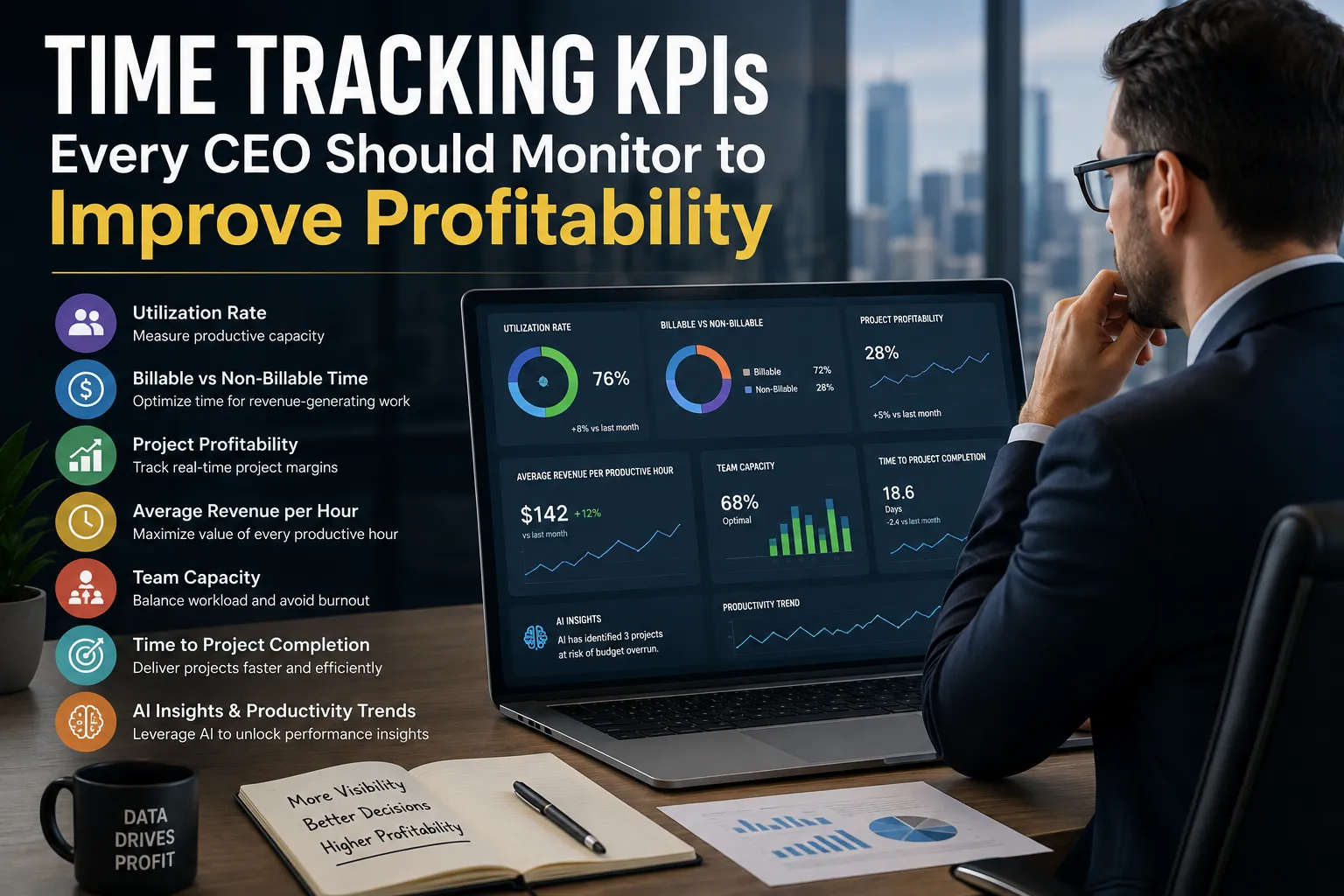
7 Time Tracking KPIs Every CEO Should Monitor
1. Billable Utilization Rate
One of the most important executive metrics is billable utilization, the percentage of available working hours spent on revenue-generating client work.
Using time tracking, CEOs can identify whether teams are spending enough time on billable projects or whether administrative tasks and internal activities are reducing overall productivity.
A consistently healthy utilization rate generally indicates that resources are aligned with client demand, while declining utilization often signals operational inefficiencies that require attention.
2. Billable vs. Non-Billable Time
Every organization needs non-billable work, including training, planning, meetings, and internal collaboration. However, when non-billable hours begin growing faster than billable work, profit margins gradually decline.
Monitoring this KPI helps executive teams understand whether internal processes are consuming excessive employee capacity.
Instead of focusing on individuals, CEOs should evaluate trends across departments to identify opportunities for workflow improvements and better resource allocation.
3. Project Profitability
Winning projects is only part of the equation, delivering them profitably matters even more.
Comparing estimated effort with actual time invested allows executives to identify projects that regularly exceed budgets or require more resources than anticipated.
Project profitability data also helps improve pricing strategies, proposal accuracy, and future project planning.
4. Average Revenue per Productive Hour
This KPI measures how effectively productive work translates into revenue.
Rather than simply increasing employee activity, CEOs should evaluate whether each productive hour contributes sufficient business value.
Tracking this metric over time helps leaders identify higher-value projects, optimize service pricing, and improve resource allocation.
Small improvements in this KPI can significantly increase profitability, particularly for organizations managing multiple client engagements.
5. Team Capacity Utilization
Resource planning becomes increasingly complex as organizations expand.
Capacity utilization measures how effectively available employee hours are being used across teams.
Consistently overloaded departments may experience burnout, quality issues, and employee turnover, while underutilized teams represent untapped revenue potential.
Monitoring capacity helps executives make informed hiring decisions, rebalance workloads, and improve workforce planning without relying on assumptions.
6. Time-to-Project Completion
Project delivery speed directly affects client satisfaction and operational efficiency.
Tracking the average time required to complete projects helps CEOs identify recurring delays caused by approval bottlenecks, inefficient workflows, or resource shortages.
Reducing unnecessary delays improves delivery capacity while enabling teams to complete more client work without extending working hours.
Over time, this contributes to stronger margins and improved customer relationships.
7. Productivity Trends Through AI Insights
Individual productivity numbers rarely tell the complete story. Trends over time provide far greater strategic value.
Modern AI powered time tracking for IT teams analyzes work patterns, utilization trends, workload distribution, and recurring operational bottlenecks that might otherwise go unnoticed.
Instead of reviewing dozens of reports, executives receive meaningful insights that highlight where teams consistently lose productive time, where workloads become unbalanced, or where projects are likely to exceed estimates.
These predictive insights help CEOs address operational risks before they affect business performance.
Turning KPIs Into Executive Decisions
The value of KPIs lies in the decisions they support.
Executives should use operational metrics to improve pricing strategies, refine staffing plans, prioritize profitable client engagements, and allocate resources more effectively across projects.
Weekly or bi-weekly reviews of these indicators allow leadership teams to identify emerging trends early rather than reacting after financial results have already declined.
Many organizations use platforms like Workstatus to consolidate utilization, productivity, and project performance into executive dashboards, giving leaders a high-level view of operational health without requiring them to monitor individual employee activity.
The focus should always remain on improving business performance, not supervising every hour employees work.
Build an Executive Dashboard That Focuses on Business Outcomes
Executive dashboards should highlight only the metrics that influence strategic decisions.
Rather than displaying dozens of operational reports, CEOs should monitor a concise set of KPIs that reveal utilization, project performance, resource capacity, profitability, and delivery trends.
Reviewing these metrics consistently creates a common understanding across operations, finance, and delivery teams. It also encourages proactive discussions about improving efficiency instead of reacting to problems after they have already affected financial performance.
A simple dashboard with actionable insights is often far more valuable than a complex report filled with unnecessary data.
Conclusion
Successful CEOs don't need visibility into every employee's daily activities, they need clear insight into how operational performance affects business outcomes.
By monitoring the right KPIs, leaders can identify inefficiencies earlier, improve project delivery, optimize resource allocation, and make decisions that strengthen long-term growth. Financial reports explain past performance, but operational metrics reveal the actions needed to improve future results.
With modern time tracking software providing real-time visibility into workforce performance, executives can move beyond assumptions and lead with confidence, building a business that is not only growing but becoming consistently more profitable.


























Sign in to leave a comment.