

For years, businesses relied on basic time tracking to understand employee work hours. It solved simple questions like: Who worked today? How many hours were logged? But modern workplaces are far more complex now. Remote teams, hybrid work, client billing, productivity analysis, and workload balancing require deeper insights than just timesheets.
That is where time intelligence is changing how organizations manage work.
Traditional time tracking focuses on recording hours. Time intelligence focuses on understanding outcomes, productivity patterns, utilization, and delivery performance. Companies are no longer asking only “How long did work take?” They are asking “Was that time productive?” and “Did it improve project results?”
According to discussions across productivity communities, many growing teams eventually realize that hours alone do not explain delays, burnout, or inefficiencies.
The Problem With Traditional Time Tracking
Basic tracking software works well for payroll and attendance. Employees clock in, log hours, and managers generate reports. For smaller teams, this may be enough.
But as organizations scale, cracks begin to appear.
Projects start running over budget even though timesheets look accurate. Teams appear busy, yet deadlines slip. Managers struggle to understand where productivity is dropping or why some employees feel overloaded while others have spare capacity.
Traditional time tracking tools usually answer:
- How many hours were worked
- When employees logged in
- Which task received time entries
But they rarely explain:
- Why projects are delayed
- Where time leaks happen
- Which workflows create bottlenecks
- Whether workloads are balanced
- How billable hours affect profitability
This gap is exactly why businesses are moving toward time intelligence software.
What is Time Intelligence?
Time intelligence transforms raw time data into actionable business insights.
Instead of simply counting hours, it connects time with:
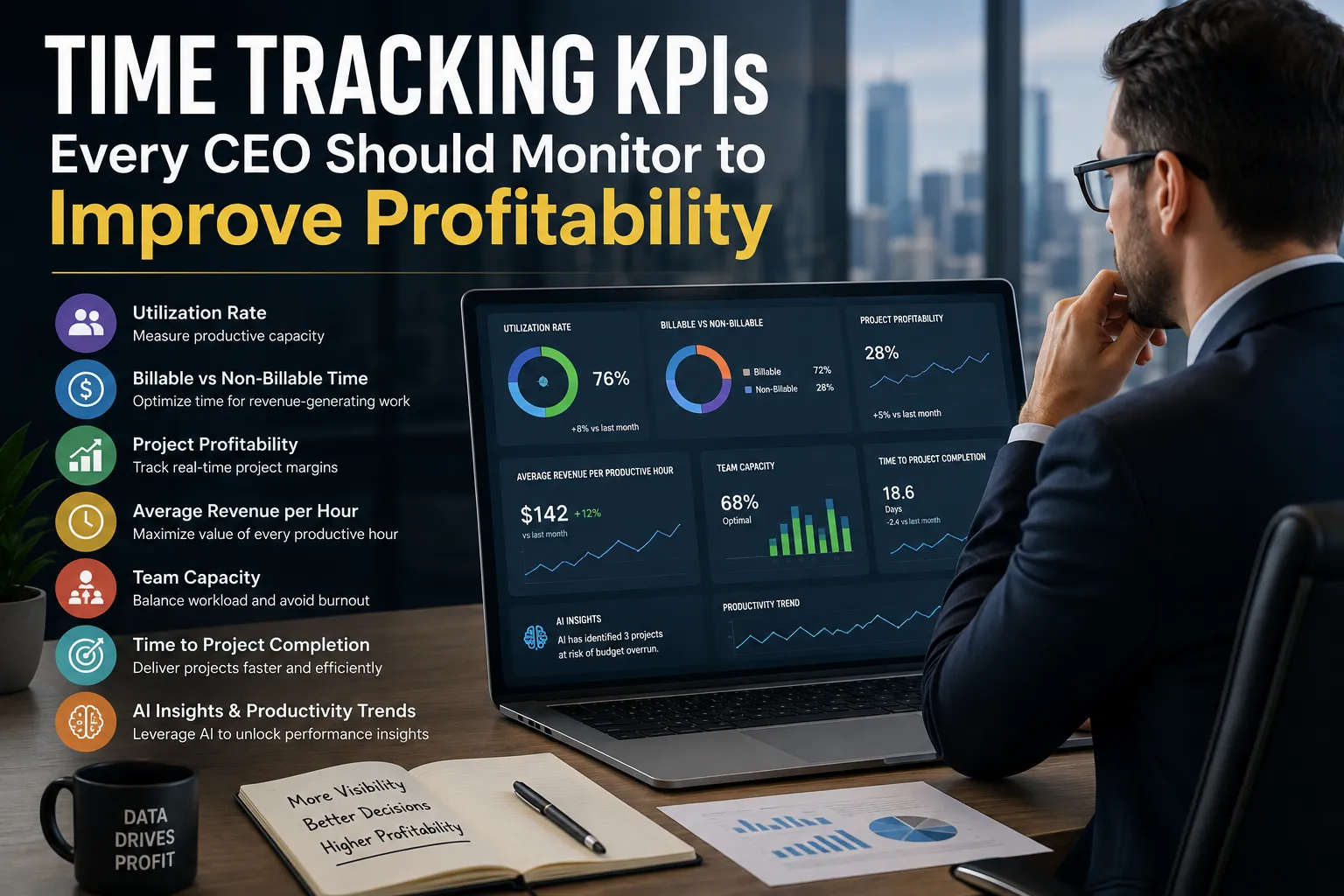
- Productivity trends
- Team utilization
- Project progress
- Billable vs non-billable work
- Capacity planning
- Delivery performance
Modern time intelligence software helps businesses understand how work actually happens across teams and projects.
For example:
- A designer logs 8 hours, but only 3 hours were deep focused work
- A project consumes more hours than estimated because of repeated revisions
- One department consistently experiences meeting overload
- High-performing employees are overloaded while others remain underutilized
These are insights traditional tracking software usually cannot reveal.
Industry discussions increasingly describe workforce intelligence as the next stage after simple time tracking because businesses now need decision-making data, not just visibility.
Why Businesses Are Upgrading to Time Intelligence Software
The shift toward smarter workforce analytics is happening because companies want measurable outcomes from work data.
Here are some major reasons organizations are adopting time intelligence software:
1. Better Utilization Visibility
Many businesses lose revenue because they cannot clearly identify billable and non-billable work.
Time intelligence helps managers understand:
- Which projects generate profit
- Where employee hours are wasted
- How team capacity is distributed
Platforms like Workstatus position time intelligence as a way to connect time directly with project delivery and utilization outcomes.
2. Early Detection of Project Risks
Basic time tracking often identifies problems too late.
Time intelligence systems can reveal:
- Projects exceeding estimated effort
- Scope creep patterns
- Delivery slowdowns
- Workflow bottlenecks
This allows managers to act before delays affect margins or client satisfaction.
3. Smarter Workforce Planning
Growing teams need better workload balancing.
Advanced tracking software now helps organizations:
- Detect burnout risks
- Forecast capacity
- Identify overworked employees
- Improve resource allocation
This becomes especially important for remote and hybrid teams where visibility is harder to maintain.
4. Improved Payroll and Billing Accuracy
Many companies still rely on spreadsheets or manual timesheets, which often create payroll disputes and reporting errors.
Reddit discussions around workforce management highlight that automated time systems reduce manual corrections, missed entries, and payroll inaccuracies significantly.
Time Tracking vs Time Intelligence: The Core Difference
The debate around time Intelligence vs time Tracking is becoming increasingly important as businesses look for smarter ways to improve productivity, optimize resources, and gain deeper visibility into how work impacts overall business performance.
The simplest way to understand the difference is this:
- Time tracking = recording hours
- Time intelligence = understanding work outcomes
Traditional tracking software shows what happened.
Time intelligence explains:
- Why it happened
- What slowed progress
- Where productivity improved
- How work patterns affect business performance
That additional layer of insight is becoming critical for agencies, IT companies, consulting firms, and service-based businesses where profitability depends heavily on how time is utilized.
The Future of Workforce Management
The workplace is shifting away from monitoring activity toward understanding work patterns.
Modern businesses want tools that combine:
- Time tracking
- Productivity insights
- Capacity planning
- Project intelligence
- Workflow analytics
This is why the market is rapidly evolving from standalone time tracking apps to integrated time intelligence software platforms.
AI-powered workforce analytics are also becoming more common. Teams now want to measure focus time, meeting overload, task switching, and productivity trends instead of simply counting logged hours.
Final Thoughts
Basic tracking software still has value, especially for payroll and attendance management. But for growing organizations, logged hours alone no longer provide enough clarity.
Businesses need deeper visibility into:
- Team productivity
- Project health
- Resource utilization
- Delivery efficiency
- Workflow bottlenecks
That is why time intelligence is quickly becoming the next evolution of workforce management.
Companies that move beyond simple time tracking gain more than reports — they gain the ability to make smarter operational decisions, improve profitability, and build more productive teams.























Sign in to leave a comment.