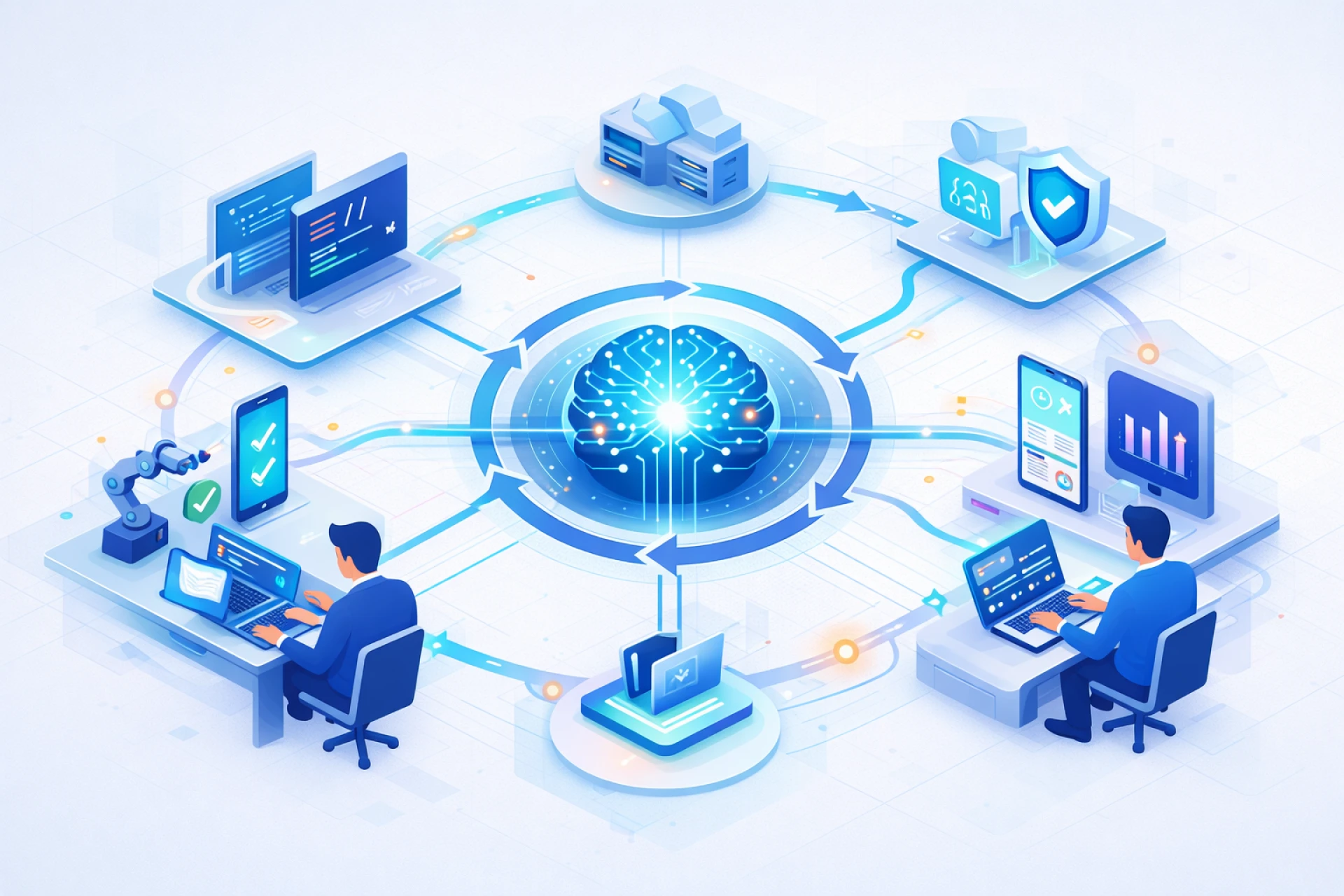

App development today is more complex, data-heavy, and time-sensitive than ever, while tolerance for delays and errors continues to shrink. Users now expect instant performance, personalized experiences, and near-perfect reliability, often delivered on shorter and more frequent release cycles.
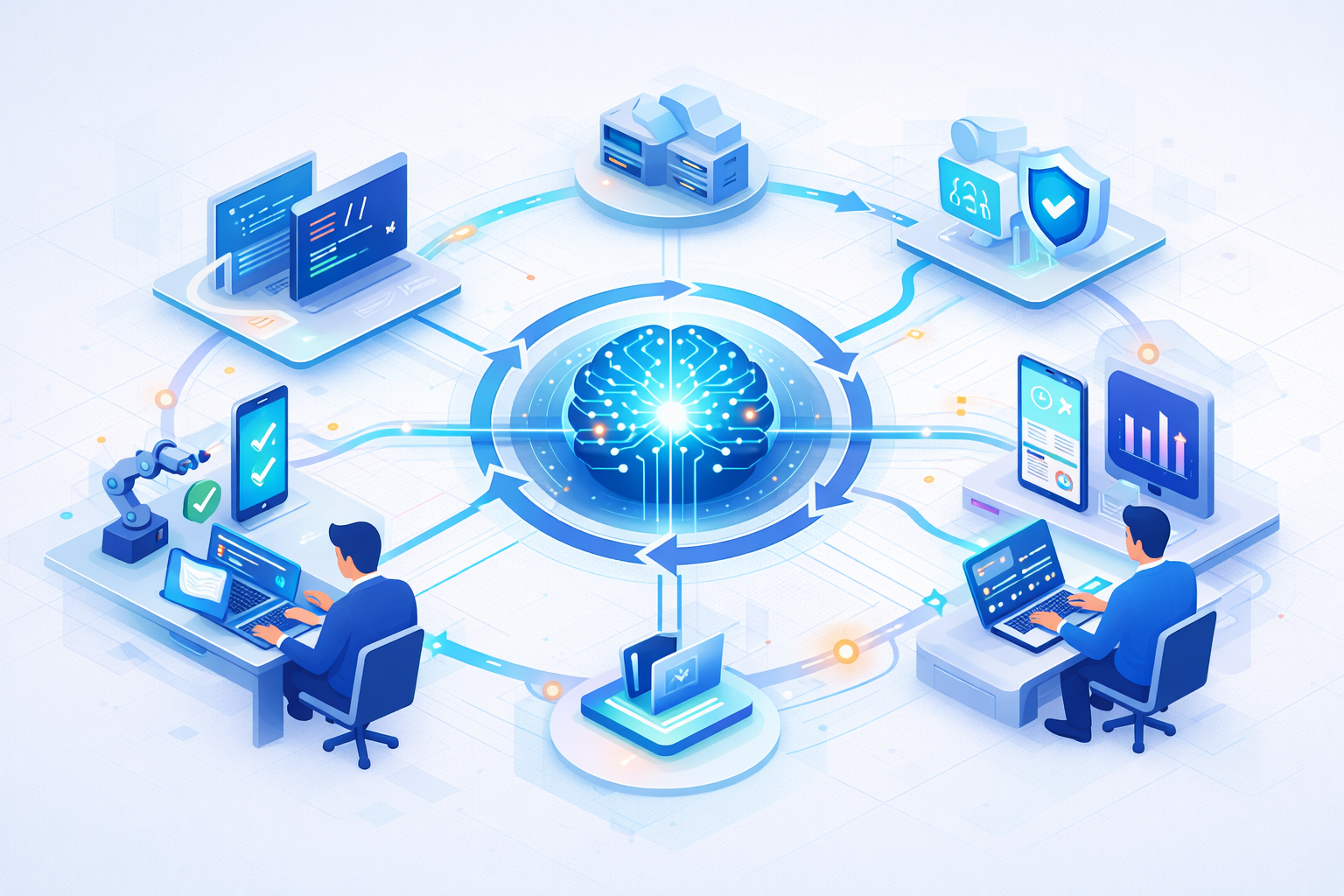
Yet many development teams still rely on manual or semi-automated workflows that struggle to keep pace with this pressure. A common misconception is that AI belongs only in end-user features like chatbots, search, or recommendations. In reality, the most meaningful transformation happens when AI integration reshapes how apps are built, tested, deployed, and scaled.
From accelerating development to improving security and decision-making, AI changes the fundamentals of app development, not just the surface experience. This shift is why advanced custom AI development services are embedding AI directly into their development processes, not treating it as an add-on feature.
This blog breaks down the most practical benefits of integrating AI across the entire app development lifecycle, and how it helps teams ship faster, smarter, and more resilient products.
Why AI Integration Matters in App Development Today
Modern app teams are under constant pressure to deliver AI development services faster while maintaining high standards for quality, security, and user experience.
At the same time, applications are becoming more data-intensive, personalized, and operationally complex. Traditional development workflows struggle to keep pace with these demands, which is why AI integration is no longer optional, but foundational.
Here’s why AI integration matters in today’s app development landscape:
1. Faster Development Cycles Through Intelligent Automation
Traditional app development often slows down not because of complexity, but because teams spend too much time on repetitive, low-value tasks. Manual coding patterns, debugging cycles, and long QA phases stretch timelines and delay releases. As apps grow, these inefficiencies compound, making speed difficult to maintain without sacrificing quality.
AI integration changes this dynamic by introducing intelligent automation across the development lifecycle. AI-assisted code generation helps developers scaffold features faster and refactor existing code with fewer errors.
Automated debugging tools detect anomalies early, reducing time spent tracing issues across environments. AI-driven testing accelerates validation by identifying edge cases that manual testing often misses.
The result is a shorter, more predictable SDLC where teams ship faster without increasing technical debt. Intelligent automation allows developers to focus on architecture and innovation rather than repetitive execution, making speed a sustainable advantage rather than a one-time gain.
2. Workflow Automation Improves Team Productivity
As applications grow, productivity challenges rarely come from a lack of skill. They come from fragmented workflows, manual handoffs, and repetitive operational tasks that quietly consume engineering time. Developers end up context-switching between coding, testing, reviews, and deployments, slowing overall momentum.
AI-driven workflow automation streamlines these processes by removing unnecessary manual steps and creating smoother handoffs across teams. Instead of reacting to bottlenecks, teams operate with systems that prioritize, validate, and move work forward intelligently.
How AI-powered workflow automation improves productivity:
- Automates build, test, and deployment pipelines to reduce release friction.
- Uses AI to flag high-risk changes and prioritize code reviews.
- Assists sprint planning by analyzing velocity, backlog health, and dependencies.
- Reduces manual coordination between development, QA, and DevOps teams.
By embedding intelligence into everyday workflows, teams spend less time managing the process and more time building value. Productivity improves not by working faster, but by removing the friction that slows teams down in the first place.
3. Enhanced User Experience Through Personalization
Modern users expect apps to adapt to them, not the other way around. Static interfaces and generic experiences quickly feel outdated, especially when users interact with multiple intelligent products every day. Without personalization, even well-built apps struggle to retain attention and long-term engagement.
AI integration enables apps to learn continuously from user behavior, preferences, and usage patterns. Instead of hardcoded rules, the app evolves dynamically, offering experiences that feel relevant and timely for each individual user.
How AI-driven personalization improves user experience:
- Delivers personalized content, recommendations, and feature suggestions.
- Adapts interfaces based on user behavior, context, and preferences.
- Learns from interactions to improve relevance over time.
- Enables real-time personalization without manual configuration.
Personalization powered by AI turns user experience into a living system rather than a fixed design. As users change, the app responds intelligently, driving higher engagement, better retention, and stronger product loyalty without increasing development complexity.
4. Smarter Decision-Making With Data-Driven Insights
Traditional app analytics tell teams what already happened, but they rarely explain what should happen next. Dashboards filled with historical metrics often lead to reactive decisions, delayed optimizations, and missed growth opportunities. As apps grow more complex, relying on manual analysis becomes both slow and insufficient.
AI integration transforms raw app data into actionable intelligence. Instead of static reports, machine learning models continuously analyze user behavior, feature usage, and performance trends to surface insights that guide product and engineering decisions in real time.
How AI enables smarter, data-driven decision-making:
- Predicts user needs, churn risks, and engagement patterns.
- Identifies underperforming features and optimization opportunities.
- Guides roadmap prioritization based on real usage data.
- Enables faster, evidence-based product and marketing decisions.
By embedding intelligence into analytics, teams move from guessing to forecasting. AI-driven insights allow app development decisions to be proactive, precise, and aligned with actual user behavior, resulting in better products and stronger long-term outcomes.
5. Improved App Security and Threat Detection
As apps handle more user data, transactions, and integrations, security risks increase sharply. Traditional security approaches rely heavily on predefined rules and manual reviews, which struggle to keep up with evolving threats, fraud patterns, and abnormal user behavior at scale.
AI integration strengthens app security by continuously monitoring activity and learning what “normal” looks like across users, devices, and workflows. Instead of reacting after incidents occur, AI enables early detection and automated response before damage is done.
How AI improves app security and threat detection:
- Detects anomalies and suspicious behavior in real time.
- Identifies fraud patterns that static rules often miss.
- Monitors access patterns to prevent unauthorized usage.
- Automates alerts and responses to reduce incident response time.
By embedding intelligence into security workflows, apps become more resilient without slowing down development or user experience. AI-driven security shifts protection from periodic checks to continuous defense, helping teams stay ahead of threats rather than chasing them after the fact.
6. Reduced Development and Operational Costs
App development costs often rise not because of ambition, but because of inefficiencies. Long development cycles, repeated bug fixes, manual testing, and reactive maintenance quietly inflate both engineering and operational budgets over time. These costs usually surface after launch, when fixing issues becomes significantly more expensive.
AI integration helps control costs by preventing inefficiencies rather than compensating for them later. By automating repetitive tasks and improving early decision-making, teams spend less time fixing avoidable problems and more time building value.
How AI integration reduces development and operational costs:
- Fewer bugs reach production due to automated testing and early detection.
- Reduced manual effort across QA, monitoring, and support workflows.
- Lower post-launch maintenance and hotfix overhead.
- More efficient use of infrastructure and engineering resources.
The result is predictable spending and stronger ROI. Instead of scaling costs alongside user growth, AI helps apps grow smarter, keeping expenses aligned with real business value rather than operational friction.
7. Intelligent Feature Integration Without Added Complexity
Modern apps are expected to offer intelligent features such as voice interfaces, recommendations, real-time translation, or visual recognition.
Traditionally, adding these capabilities meant longer development cycles, specialized teams, and significant architectural complexity. That effort often slowed delivery and increased technical debt.
AI integration changes this dynamic by making advanced capabilities accessible without rebuilding the app from scratch. Pre-trained models and modular AI components allow teams to introduce intelligence incrementally while keeping the core system stable.
How AI simplifies intelligent feature integration:
- Faster rollout of features like NLP, voice, vision, and recommendations.
- Reuse of proven models instead of building everything from scratch.
- Lower risk when experimenting with new intelligent capabilities.
- Easier iteration as features learn from real user behavior.
Instead of becoming a bottleneck, intelligent features become extensible building blocks. Teams can evolve functionality as user needs grow, without overengineering or destabilizing the app.
8. Better Scalability and Future-Readiness
As apps grow, scalability challenges often appear in unexpected ways, such as performance degradation, rising infrastructure costs, and systems that require constant manual tuning.
Traditional app architectures rely heavily on reactive fixes, which struggle to keep pace with changing usage patterns and user demand.
AI integration makes scalability proactive rather than reactive. By continuously learning from real-time data, AI-driven systems anticipate growth and adjust automatically, reducing the risk of failures as the app evolves.
How AI enables scalable, future-ready apps:
- Predictive scaling based on real usage and traffic patterns.
- Continuous performance optimization without manual intervention.
- Smarter resource allocation to prevent over-provisioning or bottlenecks.
- Systems that improve efficiency as data volume and users increase.
Instead of breaking under pressure, AI-enabled apps adapt. This future-ready approach ensures that scalability is built into the product’s behavior, not patched in after problems appear.
The Final Takeaway
AI integration has moved from an experimental advantage to a core requirement in modern app development. By embedding intelligence across the development lifecycle, teams gain speed without sacrificing quality, automate workflows that once slowed progress, and build products that continuously adapt as user needs evolve.
From faster releases and smarter decision-making to stronger security and scalable architectures, AI reshapes both how apps are built and how they perform over time. More importantly, AI shifts development from reactive problem-solving to proactive optimization, where issues are anticipated, not just fixed.
When paired with the right strategy, AI becomes a force multiplier rather than an added layer of complexity. Apps built with AI at the core scale more efficiently, evolve faster, and deliver consistently better user experiences over time.
Ready to integrate AI into your app development process? Partner with Quokka Labs for custom AI app development services and get a clear, phased roadmap to automate workflows, accelerate delivery, and build scalable, intelligent products.



























Sign in to leave a comment.