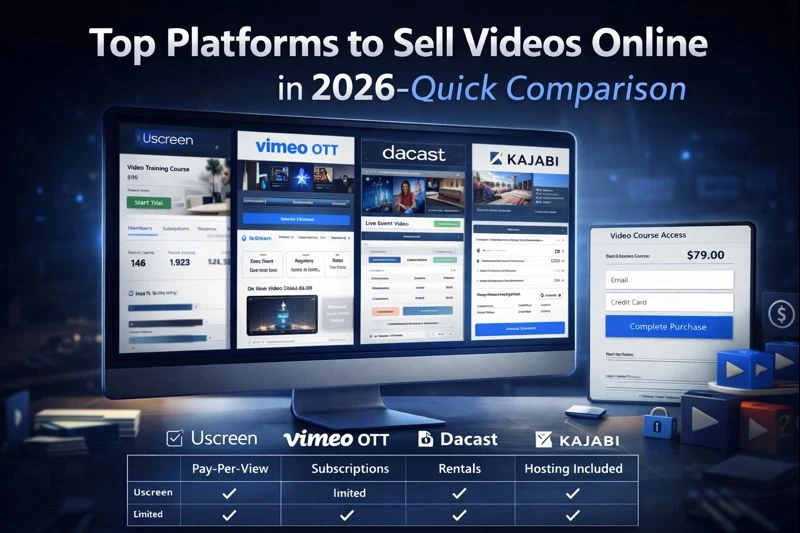

The top platforms to sell videos online in 2026 are services that let creators, educators, and businesses host videos, restrict access, and accept payments through one-time sales, subscriptions, or rentals.
These platforms are used to monetize on-demand videos, courses, live events, and subscription libraries without relying on ads or public video platforms.
Most modern video-selling platforms support multiple monetization models, allowing sellers to combine pay-per-view, subscriptions, and memberships in one system.
The best choice depends on your content type, audience size, and how much control you want over branding and customer data.
This article provides a quick comparison of the most popular video-selling platforms in 2026, focusing on features rather than opinions, for readers comparing different platforms to sell videos online.
How Selling Videos Online Works in 2026 (Quick Context)
Selling videos online in 2026 is no longer limited to single video downloads or basic paywalls. Most platforms now support hybrid monetization, where creators can sell individual videos, offer subscriptions, and gate premium content in the same account.
Another key shift is the move away from relying on public video platforms. Instead of monetizing through ads, creators increasingly use direct-to-audience platforms that handle hosting, payments, and access control.
Finally, platform choice has become a trade-off between simplicity and ownership. All-in-one platforms are faster to set up, while more advanced platforms offer greater flexibility and scalability.
Quick Comparison: Top Platforms to Sell Videos Online (2026)
The table below compares popular platforms used to sell videos online, based on their support for one-time sales, subscriptions, rentals, and built-in hosting.
| Platform | One-Time Sales | Subscriptions | Rentals | Hosting Included | Best For |
| Uscreen | Yes | Yes | Limited | Yes | Subscription-based creators |
| Vimeo OTT | Yes | Yes | Yes | Yes | Media brands & creators |
| Dacast | Yes | Yes | Yes | Yes | Live events & broadcasters |
| Muvi | Yes | Yes | Yes | Yes | OTT apps & enterprises |
| Kajabi | Yes | Yes | No | Yes | Coaches & educators |
| Brightcove | Yes | Yes | Yes | Yes | Large businesses & media teams |
Notes:
- “Rentals” usually mean time-limited access (e.g., 24–72 hours).
- Some platforms prioritize subscriptions, while others focus on events or enterprise video delivery.
- All platforms listed support paid access without relying on ads.
Platform Categories (Quick Explanation)
Most platforms used to sell videos online in 2026 fall into a few clear categories. Understanding these helps narrow choices quickly.
- All-in-one creator platforms
Combine video hosting, payments, landing pages, and basic marketing tools. Designed for speed and ease of use. - Membership and course platforms
Focus on subscriptions, structured content, and gated libraries rather than single video sales. - Video-first and OTT platforms
Built primarily for streaming performance, live events, and scalable delivery. - Enterprise video platforms
Designed for large teams, media companies, and organizations with complex requirements.
Each category prioritizes different trade-offs between simplicity, control, and scalability. For creators focused on events or one-time video access, pay-per-view video platforms are often used alongside subscription-based models.
Best Platform Type by Use Case
Different selling goals require different platform strengths. Below are common use cases and the platform types that typically fit best.
Beginners Selling Videos Online
All-in-one platforms work best for beginners who want to start selling quickly without managing technical setup.
Educators and Coaches
Membership and course platforms are suited for structured lessons, programs, and recurring access.
Live Events and Pay-Per-View
Video-first platforms are better for ticketed live streams, event replays, and high-traffic broadcasts.
Subscription Video Libraries
Platforms optimized for recurring billing and content libraries are ideal for ongoing memberships.
Businesses and Teams
Enterprise-oriented platforms suit organizations that need advanced controls, reporting, and integrations.
Choosing by use case is often more effective than choosing by feature lists alone.
Pricing and Fees Snapshot
Pricing models vary widely across video-selling platforms, but most follow similar patterns.
Common Pricing Structures
- Monthly or annual platform fees: Fixed costs for hosting, features, and access.
- Transaction fees: A percentage or flat fee charged per sale or subscription payment.
- Payment processor fees: Additional fees charged by payment gateways, separate from the platform.
Some platforms bundle costs into higher monthly plans, while others keep base fees low and rely on transaction-based pricing. Understanding the full cost structure is important, especially for subscription or high-volume sales.
Limitations to Know Before Choosing a Platform
While video-selling platforms simplify monetization, they also come with trade-offs that matter as your business grows.
Common limitations include:
- Platform lock-in when content, users, and payments are tightly coupled to one service
- Limited customization of checkout, branding, or user experience on all-in-one platforms
- Restricted access to customer data on some marketplace-style platforms
- Scaling constraints for high-traffic live events or large video libraries
These limitations do not affect all users equally, but they become more relevant for long-term or high-volume video businesses.
FAQ: Selling Videos Online in 2026
What is the best platform to sell videos online in 2026?
There is no single best platform for everyone. The best choice depends on whether you sell one-time videos, subscriptions, rentals, live events, or a mix of these models.
Can I sell videos without using YouTube?
Yes. Many platforms allow you to host and sell videos directly without relying on public video platforms or ad-based monetization.
Do I need a website to sell videos online?
No. Most video-selling platforms include hosted pages and checkout, though having your own website can provide more control.
Which platforms support both subscriptions and pay-per-view?
Most modern video monetization platforms support hybrid models that include subscriptions alongside pay-per-view or rentals.
Are platforms to sell videos online profitable?
They can be profitable when pricing, audience size, and content value are aligned. Profitability depends more on the business model than the platform itself.
Creators who want more control over pricing and access often compare video platforms with other Patreon alternatives before choosing a monetization approach
Conclusion
The top platforms to sell videos online in 2026 support multiple monetization models, including one-time sales, subscriptions, and rentals. Rather than choosing based on popularity alone, it is more effective to compare platforms based on use case, pricing structure, and long-term flexibility.
A quick comparison approach helps narrow options and identify platforms that match how you plan to sell and scale video content.
























Sign in to leave a comment.