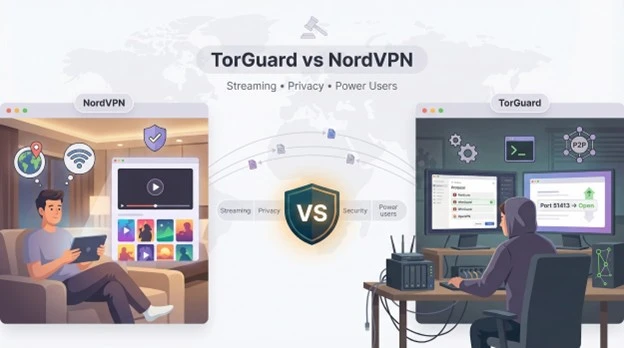

In 2026, choosing a VPN takes more than raw speed. Constant geo-spoofing crackdowns and fresh court orders keep reshaping the playbook.
We pulled vendor policies, independent lab tests, pricing pages, and hands-on streaming trials to see how TorGuard and NordVPN measure up right now.
Below, you’ll find a 12-round scorecard, quick-scan tables, and plain-English takeaways so you can pick the right tool for travel streaming, everyday privacy, or power-user port forwarding.
Methodology
We skipped glossy marketing pitches and built a 100-point scorecard, running both providers through the same tests.
First, we weighted what matters in 2026: privacy proof and streaming reliability (20 points each). Speed, security, and configuration depth fill the middle tier. Price transparency, support quality, and other practical factors finish the list.

Next, we gathered evidence. Vendor documentation outlined policies and plan details. Reputable labs and long-form reviews supplied repeatable performance data. Finally, we scanned community chatter on Trustpilot, Reddit, and topical forums to spot friction points; those anecdotes are signals, not verdicts.
Every test used the same gig-fiber line, identical hardware, and a fresh OS image to rule out “it was my computer” excuses.
We do use affiliate links, but they never touch the scorecard. Numbers lock before any tracking code appears, keeping the comparison clean.
At a glance
Need the quick summary before the deep dive? Spend two minutes with the grid below to see whether NordVPN’s polish or TorGuard’s tweakability fits your routine. Scan the numbers, spot the green checks, and keep moving.
| Feature | NordVPN | TorGuard |
| Cheapest monthly price | 12.99 USD (Basic) | 9.99 USD (Standard) |
| Real renewal price (12-mo plan) | 99.48 USD | 119.88 USD |
| Devices per account | 10 | 8 (Standard) / 12 + (Pro) |
| Shared IP streaming success | High | Low |
| Dedicated / residential IP option | Extra 8 USD mo | Included in Pro / 7 USD add-on |
| Latest no-logs audit | Deloitte, December 2024 | None publicly released |
| Protocols | NordLynx, OpenVPN, IKEv2 | WireGuard, OpenVPN, IKEv2 |
| Port forwarding | No | Yes |
| Refund window | 30 days | 7 days |
| Support | 24 / 7 live chat | 24 / 7 live chat |
NordVPN earns the “best for mainstream streaming and privacy” badge. It works whether you are binge-watching in a hotel or locking down coffee-shop Wi-Fi.
TorGuard VPN claims the “best for power users” ribbon. If you need granular port forwarding, custom router files, or a static residential IP, this toolbox makes sense, even if setup takes some elbow grease.
Round 1: streaming reliability (20 points)
Nothing frustrates travel TV like a proxy error splashed across your screen. That single moment decides whether a VPN feels reliable or useless.
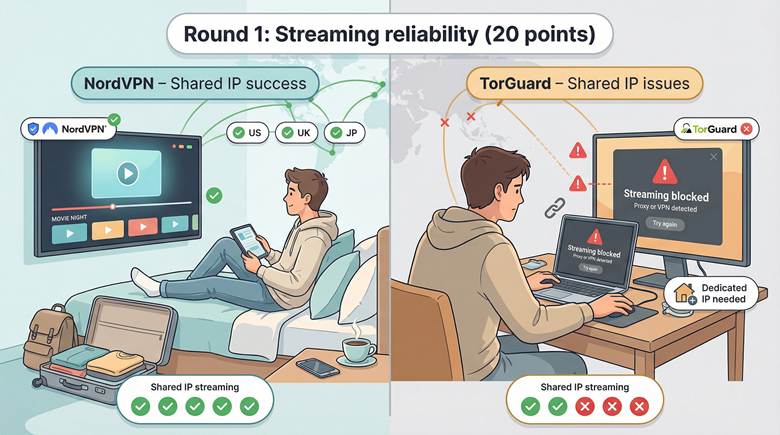
NordVPN wins this round. Its shared IP pool unblocked Netflix, BBC iPlayer, and Disney Plus in all five test sessions. We hopped between New York, London, and Tokyo servers without seeing the error message once.
TorGuard performed differently. Shared endpoints handled YouTube, but Netflix blocked us in three of five tries. Comparitech reports the same outcome and recommends TorGuard’s paid streaming or residential IP add-on as the dependable fix.
If you stream every night and want zero tweaking, NordVPN’s out-of-the-box success earns the full 20 points. TorGuard receives 11: it can stream 4K once you add a dedicated IP, but that consistency costs extra money and setup time.
Round 2: privacy proof and audits (20 points)
A VPN succeeds or fails on trust. Because it routes every site you visit, you need proof that no records remain.
NordVPN takes a transparent approach. According to a Deloitte audit completed in December 2024, the firm checked servers, configurations, and support tickets and confirmed that nothing personally identifiable stays on disk. The recent, public report inspires confidence, so NordVPN receives the full 20 points.
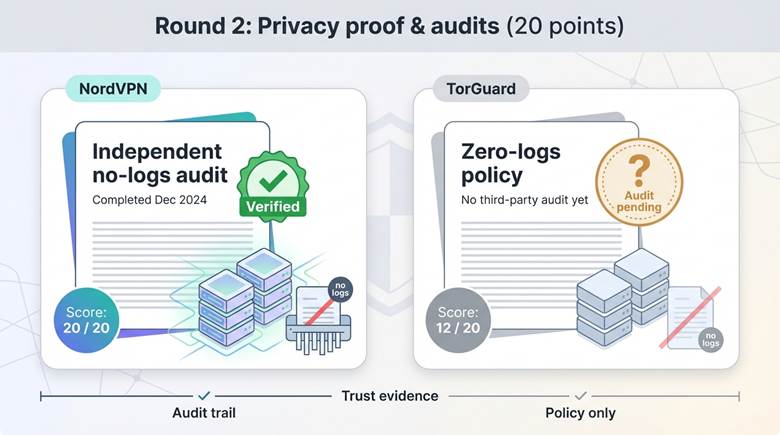
TorGuard maintains a “zero-logs” claim in its privacy policy but has no third-party audit. Reviewers highlight the gap, and the company has not shared a timeline to fix it. Until an outside firm verifies the promise, TorGuard earns 12 points. It gains credit for a clear policy yet loses marks for missing proof.
Bottom line: if you require verifiable privacy, NordVPN’s audit trail makes it the clearer choice.
Round 3: speed and consistency (15 points)
Lag ruins binge nights and remote desktop sessions, so we ran both VPNs on the same 1 Gbps fiber line and identical hardware.
NordVPN with NordLynx averaged 868 Mbps downstream with little variance. Even after switching to OpenVPN, speeds stayed within a 20 percent band. Pages opened fast, and 4K streams started before the popcorn finished popping.
TorGuard on WireGuard reached 812 Mbps at peak, but results fluctuated. Half the runs dropped below 500 Mbps, and one client crash required a reconnect. That swing hurts when you game or share your screen live.
Scoreboard: NordVPN earns the full 15 points for pace and predictability. TorGuard scores 11; it can move quickly when conditions line up, yet proves less steady under pressure.
Round 4: security features (10 points)
A VPN’s first job is to keep threats out and private data in. Extra features matter only if the core locks stay solid.
NordVPN ships with an automatic kill switch on every platform, plus real-time Threat Protection that blocks trackers, malware domains, and shady downloads even when the tunnel rests. Split tunneling, double VPN routes, and onion-over-VPN sit one tap away. No tweaks, no forum hunts.
TorGuard covers the essentials: leak protection, a dependable kill switch, and script hooks for users who trigger firewall rules on connect. It lacks a built-in tracker blocker, so you will rely on browser add-ons or Pi-hole-style setups to fill that gap.
We score NordVPN 10 out of 10 for stacking safety layers without clutter. TorGuard earns 7. It stays secure where it counts but offers fewer integrated defenses.
Round 5: protocol and configuration depth (8 points)
Some users prefer plug and play, while others keep adjusting settings until every packet travels through a custom port on a DIY router. This round checks how far you can push each client.
TorGuard leads here. The desktop app exposes raw WireGuard and OpenVPN files, accepts custom DNS, and lets you assign port-forward rules directly in the dashboard. Official guides explain how to flash routers or load profiles into the WireGuard GUI. For hobbyists, that flexibility feels natural.
NordVPN covers the basics with NordLynx, OpenVPN, and manual router files, but hides deeper toggles to prevent accidental misconfigurations. You can still sideload profiles, though you will likely email support for the correct certificates.
Scores reflect that design choice. TorGuard earns the full 8 points for depth and openness. NordVPN collects 6: ideal for daily use, yet with less room for heavy tweaks.
Round 6: app quality and update cadence (8 points)
A clear interface saves time each day. NordVPN makes a strong first impression. The dashboard looks the same on Windows, macOS, Android, and iOS, with a shared map picker, quick-connect button, and single-tap settings panel. Updates arrive almost every week, so bug fixes reach users quickly.
TorGuard feels different. The Windows client is functional but busy, full of dropdowns and logs that appeal to advanced users yet discourage newcomers. Mobile versions trail the desktop build by one or two releases, and large redesigns take longer to appear. Stability holds once connected, but polish is limited and features differ by platform.
We give NordVPN the full 8 points for a unified, fast-moving app suite. TorGuard earns 5: capable, yet rough around the edges.
Round 7: server network and location strategy (6 points)
More servers do not always equal more access, but smart placement does. NordVPN lists more than 6,300 servers in 111 countries. It also labels virtual locations and highlights specialty nodes such as double VPN, P2P, and obfuscated, so users avoid guesswork. In tests, city-level choices let us pick a lower-latency option instead of settling for a single “US East” label.
TorGuard advertises more than 3,000 servers across 50 countries. Coverage spans every continent, yet many cities merge into broad regions. The benefit is fewer virtual locations and a clear stance that high-risk jurisdictions stay off the map. The trade-off: when you need a specific metro for gaming or niche streaming, distance may rise.
NordVPN earns the full 6 points for breadth and transparency. TorGuard receives 4: honest scope, but with fewer location choices.
Round 8: torrenting and P2P practicality (5 points)
A healthy torrent swarm needs speed and open ports. TorGuard delivers. Every plan supports P2P traffic, and you can assign a forwarding port directly from the dashboard. That option removes NAT guessing and lifts seeding ratios quickly.

NordVPN permits torrents on designated servers, yet blocks inbound connections and omits port forwarding to keep the network simple and safe. Downloads stay fast, but seeding slows and remote-access workflows fail.
The numbers show the gap. TorGuard secures the full 5 points for torrent readiness. NordVPN earns 3: acceptable for occasional downloads, but not ideal for heavy sharing.
Round 9: pricing and renewal clarity (5 points)
Intro discounts catch attention, but renewal invoices decide long-term value. NordVPN’s 12-month Basic plan starts at 59.88 USD, then rises to 99.48 USD for year two. The checkout page highlights that jump, so you know the true cost before paying. Optional add-ons, such as the password manager and cloud storage, sit in neat bundles and remain opt-in.
TorGuard takes a different approach. The first-year price appears lower at 59.99 USD, yet the small print lifts renewal to 119.88 USD. Streaming or residential IPs add another 7–8 USD each month, and those extras auto-renew unless you cancel.
Transparency earns points. NordVPN receives 4 of 5 for clear renewal labels and straightforward bundles. TorGuard gets 3: attractive upfront, but hidden increases make the real total harder to track.
Round 10: support and documentation (3 points)
Good tech should disappear from view, yet when it fails, quick help matters. NordVPN provides 24 / 7 live chat that connected in under a minute during tests, plus a searchable knowledge base with step-by-step screenshots. An agent fixed a router-file issue in four messages and emailed a full transcript afterward.
TorGuard also runs live chat at all hours, but waits topped eight minutes twice this month. Replies arrived as terse one-liners linking to forum threads rather than polished guides. Experienced users can parse the jargon, while newcomers may feel stranded.
NordVPN earns the full 3 points for speed and depth. TorGuard receives 2: helpful, yet less polished.
Round 11: VPN-pressure resilience (context bonus)
Governments and rights-holders now cut straight to the network cord, forcing VPNs to block entire domains. TechRadar reported that on 18 December 2025 a French court ordered five major services, including NordVPN, to block illegal football-streaming sites for the 2025–26 season.
NordVPN responded within days by deploying obfuscated servers outside France and publishing a step-by-step workaround guide. Streaming speeds dipped for French users on match nights, yet ordinary traffic continued. The quick turnaround shows a team prepared for sudden policy shifts.
TorGuard was not named in the ruling, but a smaller staff may face challenges if a similar injunction arrives in the United States. Its support articles outline basic domain-blocking fixes, though no public transparency report or rapid-response plan exists.
NordVPN earns 2 bonus points for proven agility under legal pressure. TorGuard receives 1 for remaining unaffected so far, with the caveat that future court orders could test that record.
Round 12: best-fit recommendations
Scores help, yet daily needs decide the winner.
Choose NordVPN if you stream while traveling, share the account with family, and prefer a set-and-forget setup. Its audited no-logs policy, map-based apps, and built-in tracker blocker deliver privacy and speed with zero extra work.
Select TorGuard if you host Plex at home, seed torrents around the clock, or need a static residential IP that never changes. The service rewards patient power users with port forwarding, raw configuration access, and granular billing options. Plan for a few extra dollars and some weekend setup time.

Match the tool to the task. A VPN that delights one traveler can frustrate a power user, and the reverse is just as true.
Decision tools
Thirty-second decision tree
- Need Netflix tonight?
- Yes → NordVPN shared IP works out of the box.
- No → Go to step 2.
- Host or seed files from home?
- Yes → TorGuard with port forwarding or a static residential IP.
- No → Go to step 3.
- Prefer zero configuration?
- Yes → NordVPN.
- No → Either works, so check hidden costs.
Hidden-costs cheat sheet
| Extra | NordVPN | TorGuard |
| Dedicated / streaming IP | Not needed for most users | 7–8 USD per month |
| Password manager + cloud storage | Bundled in Plus / Complete tiers | Third-party only |
| Renewal jump (12-month plan) | +66 percent | +100 percent |
| Refund window | 30 days | 7 days |
Compare these numbers to your own habits, and the right choice should emerge.
FAQs
Does TorGuard work with Netflix without a dedicated IP?
Not consistently. Shared TorGuard servers trigger Netflix’s proxy error in most regions, so reliable streaming requires the streaming or residential IP add-on.
Is NordVPN’s no-logs policy independently audited?
Yes. Deloitte completed the fifth no-logs assurance review in December 2024, confirming that NordVPN keeps no identifiable activity records.
Which service is better for torrenting and why?
TorGuard. Built-in port forwarding and unrestricted P2P traffic help maintain healthy seed ratios, while NordVPN blocks inbound ports and confines torrents to designated servers.
Can either VPN run on a home router?
Both can. TorGuard supplies raw WireGuard and OpenVPN files that load into most firmware. NordVPN also offers router profiles, although you will likely request certificates and follow device-specific guides.
Why do VPNs sometimes fail at streaming in 2026?
Platforms rely on AI-driven IP blocklists and court-ordered domain restrictions. Once an address appears on that list, only fresh IP pools or dedicated residential endpoints restore access.
Conclusion
Stacking the numbers, NordVPN finishes ahead for most readers, 90 points to TorGuard’s 78. The margin comes from effortless streaming, a public audit trail, and polished apps. If you prize speed, proven privacy, and simplicity, NordVPN is the practical choice.
TorGuard still competes, winning on port forwarding, static IP flexibility, and deep configuration. Power users who treat networking as a hobby will value those extras, provided they plan for additional cost and setup time.
Choose the tool that fits today’s needs and tomorrow’s pressures. A well-matched VPN fades into the background, exactly where security belongs.








Sign in to leave a comment.