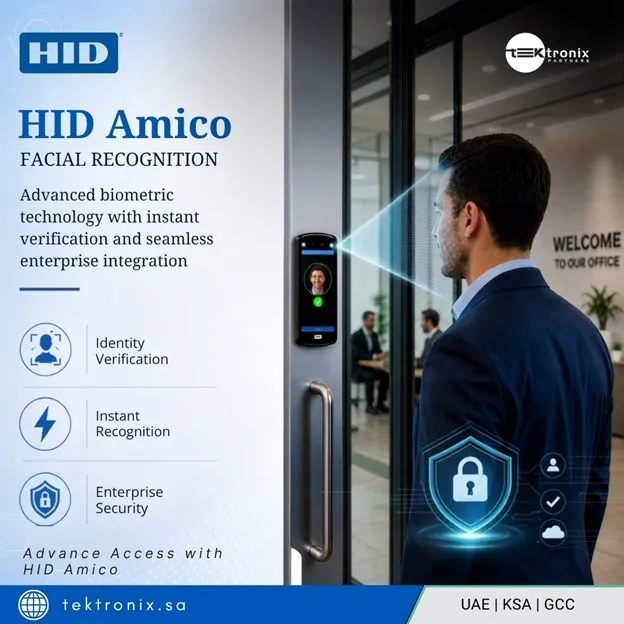

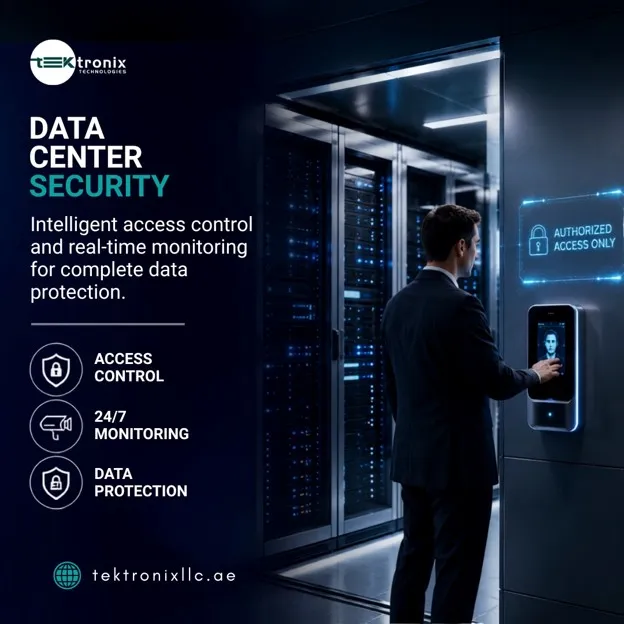
Saudi corporate offices, banks, and government facilities are rethinking how they verify identity at the door, moving decisively away from cards and PINs toward biometric verification that cannot be lost, shared, or borrowed. HID Amico is central to that shift — a facial recognition reader that confirms exactly who is entering a building in under a second, giving Saudi security teams a faster and considerably more reliable alternative to traditional credential-based access.
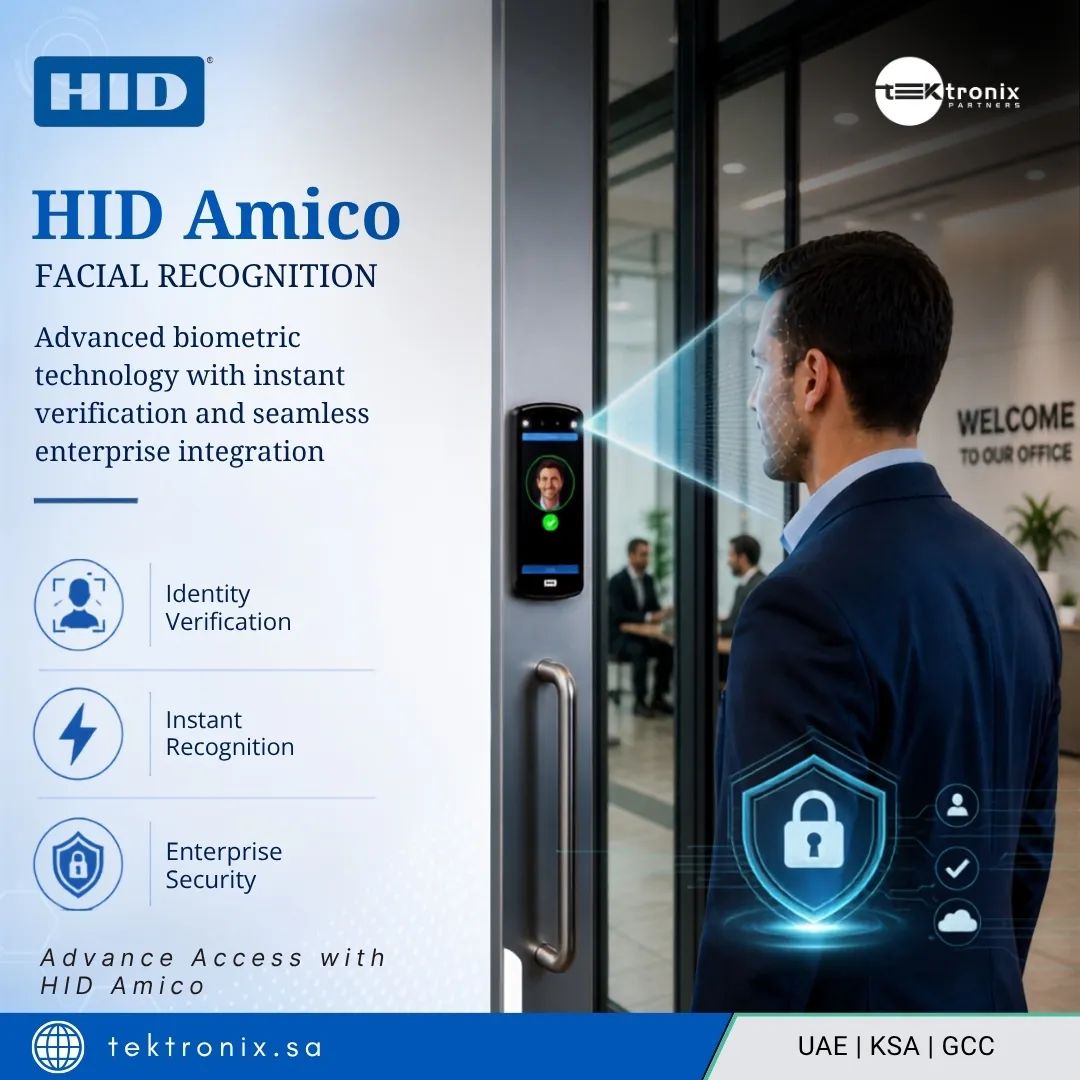
As the Kingdom's Vision 2030 agenda continues to drive investment in smart infrastructure and digital government services, physical security technology is being held to the same modernization standard as everything else in Saudi Arabia's rapidly evolving business environment. HID Global's latest reader platform gives organizations a proven, enterprise-grade path forward rather than an unproven biometric start up product.
Why Saudi Organizations Are Moving Beyond Cards and PINs
Card-based access control carries a structural weakness regardless of how strictly it is enforced: a card only confirms that someone is holding a valid credential, not that the individual holding it is actually authorized to use it. Lost cards, shared badges between colleagues, and occasional cloning remain some of the most common ways unauthorized individuals gain entry to secured buildings.
Facial recognition closes this gap directly by tying access to a verified individual rather than a physical object they carry. For Saudi banks, government ministries, and corporate headquarters where identity assurance carries genuine financial and reputational weight, this shift from verifying a credential to verifying a person represents a meaningful upgrade in security posture rather than a purely cosmetic technology refresh.
HID Amico Facial Recognition: The Technology Behind the Reader
At the core of the platform sits HID Amico Facial Recognition, built on AI-driven recognition technology licensed from Paravision, a specialist in biometric matching algorithms. This partnership allows HID to concentrate on hardware reliability and building system integration while relying on a proven recognition engine for the speed and accuracy that make the reader practical for busy corporate and government entrances.
Reported deployments describe recognition speeds under a second, with reader models supporting enrolled databases scaling from a few thousand faces to considerably larger organization-wide directories — making the platform equally suited to a single Riyadh corporate office and a large multi-building government campus with thousands of daily badge holders.
HID Amico Facial Recognition Reader: Built for the Kingdom's Climate and Lighting
At the hardware level, the HID Amico Facial Recognition Reader combines a touchscreen display, integrated camera module, and infrared sensing to maintain reliable recognition across variable lighting conditions — a relevant consideration for Saudi office lobbies with large glass facades and strong desert sunlight. Beyond facial recognition itself, the reader typically supports multiple credential types simultaneously, including RFID cards, PIN entry, QR codes, and mobile credentials, allowing organizations to run a phased rollout rather than an abrupt, all-or-nothing switch.
AI-Powered Anti-Spoofing and Liveness Detection: Addressing the Core Weakness of Facial Recognition
Any biometric reader is only as trustworthy as its ability to tell a genuine person apart from an imitation. AI-Powered Anti-Spoofing handles this by analyzing subtle depth, texture, and motion cues to detect whether a printed photo, video replay, or mask is being presented to the camera instead of an actual face.
Working alongside this is Liveness Detection, which confirms the individual in front of the reader is physically present and actively engaging with the system in real time rather than a static image. Together, these safeguards address one of the most common criticisms of earlier-generation facial recognition systems — that a photograph alone could sometimes fool the reader — giving Saudi security and compliance teams a credible answer when auditors or insurers ask how spoofing risk is being managed.
HID Aero Controller: The Networked Intelligence Behind Every Door
A reader alone cannot secure a building — it needs a controller processing access decision and managing door hardware. The HID Aero Controller line provides this networked intelligence, positioned as the successor to HID's long-running VertX controller family and built on the same Mercury panel technology used across millions of installations worldwide. Its open architecture allows integrators to connect Aero controllers to a variety of access control software platforms without locking an organization into a single vendor's closed ecosystem.
For facilities teams in Saudi Arabia, this openness matters in practice — it means a building's access control backbone can evolve over time, adding new readers, software platforms, or building integrations without a full replacement of the underlying controller hardware. Aero controllers also support encrypted communication between controller and reader, along with configurable threat-level responses that can automatically tighten access rules across a facility during a security incident.
HID Access Control: A Complete Ecosystem for Long-Term Security Planning
HID Amico and HID Aero exist within a much broader HID Access Control ecosystem spanning readers, controllers, credentials, and software. This matters for Saudi organizations weighing long-term vendor risk — rather than committing to a niche biometric supplier with an uncertain product roadmap, standardizing on HID's platform means investing in a manufacturer with decades of continuous development and a global installed base spanning corporate, government, healthcare, and critical infrastructure sectors.
This ecosystem approach also simplifies vendor management for facilities teams. Rather than sourcing readers, controllers, and mobile credentials from separate, loosely compatible suppliers, an organization can standardize on a single manufacturer's roadmap while retaining flexibility to choose from multiple certified software and integration partners for the access control platform running on top.
HID Mobile Access: Extending Credentials to Employee Smartphones
Alongside facial recognition, HID Mobile Access lets employees carry their building credential directly on their smartphone rather than a physical card, using Bluetooth or NFC to communicate with compatible readers. For Saudi organizations managing hybrid workforces and periodic staff turnover, mobile credentials are considerably faster to issue and revoke than physical cards, since access can be granted or removed instantly through the management platform without waiting for a replacement badge to be printed.
Pairing mobile credentials with facial recognition also gives organizations a practical fallback path — an employee who has forgotten their phone can still be verified by face, while a visitor without an enrolled facial profile can be issued temporary mobile access instead, keeping reception areas moving smoothly regardless of which credential type an individual has on hand that day.
Key Benefits Saudi Organizations Are Realizing from HID Amico Deployments
Security teams adopting HID Amico and its supporting hardware report improvements across several practical areas:
- Faster, touchless entry that reduces bottlenecks at busy corporate and government lobbies
- Stronger identity assurance compared to card-only or PIN-only access
- Reduced risk from lost, shared, or cloned physical credentials
- Lower long-term administrative burden through instant remote credential management
- Flexible authentication options supporting a phased rollout across a workforce
- An open controller architecture that protects long-term technology investment
HID Amico KSA: Adapting the Platform to Local Deployment Requirements
Rolling out HID Amico KSA-wide involves considerations specific to the Kingdom — multilingual touchscreen interfaces suited to a diverse workforce, hardware built to handle high ambient temperatures and strong desert sunlight in glass-heavy lobby designs, and integration with the visitor management and turnstile systems increasingly common across the country's Grade A office towers and government facilities.
Local certified integrators play an important role here, since a facial recognition deployment involves considerably more than plugging in a reader — it requires careful enrollment planning, privacy-conscious data handling practices, and configuration tuned to each building's specific lighting and traffic patterns.
HID Amico Riyadh: Meeting the Capital's Security and Compliance Standards
Riyadh's concentration of government ministries, financial institutions, and multinational corporate headquarters creates particularly demanding requirements for physical security technology. A HID Amico Riyadh deployment typically needs to demonstrate not just strong recognition accuracy but also clear data governance around how biometric templates are stored, encrypted, and retained, in line with the compliance expectations common among the capital's most regulated organizations.
HID Amico Jeddah: Supporting the Kingdom's Commercial Gateway
As Saudi Arabia's principal commercial port city and a major logistics and trade hub, Jeddah presents its own specific security requirements, often centered on port-adjacent commercial facilities, regional corporate offices, and a growing hospitality sector tied to religious tourism. A HID Amico Jeddah deployment often needs to balance high-volume, fast-throughput verification with the kind of robust anti-spoofing protection expected of any serious commercial security upgrade in the city's competitive business environment.
Typical Deployment Process for HID Amico in a Saudi Corporate Building
Introducing HID Amico into an existing building generally follows a structured rollout designed to minimize disruption to daily operations.
1. Site assessment: reviewing lobby lighting, entrance layout, and existing access control infrastructure.
2. Hardware selection: choosing reader models and Aero controller configurations suited to door count and traffic volume.
3. Enrollment planning: scheduling employee facial enrollment sessions with clear privacy communication.
4. Software integration: connecting readers and controllers to the organization's chosen access control platform.
5. Phased rollout: running facial recognition alongside existing card access before fully retiring older credentials.
Most single-building deployments can move through this process within a few weeks, with the enrollment and phased rollout stages typically taking longer than the physical hardware installation itself.
Choosing the Right Integration Partner for HID Deployments in Saudi Arabia
Because HID's controller and reader ecosystem is intentionally open, the quality of a deployment depends heavily on the integrator configuring it. Organizations evaluating partners should look for demonstrated experience with Aero controller configuration, established relationships with major access control software vendors, and a track record of facial recognition enrollment projects specifically, since enrollment quality has a direct impact on day-to-day recognition accuracy.
This is where Tektronix's HID readers and controllers’ expertise stands out for Saudi organizations — the team has direct, hands-on experience configuring HID Amico readers and Aero controllers across corporate towers, government facilities, and commercial buildings throughout the Kingdom, handling everything from initial site assessment through enrollment and long-term maintenance support.
Why Saudi Organizations Trust Tektronix for HID Access Control Deployments
Tektronix has deployed HID reader and controller infrastructure across a wide range of facilities throughout Saudi Arabia, giving the team practical, on-the-ground experience with the enrollment, integration, and compliance considerations unique to biometric access control projects across the Kingdom. Every deployment is supported end-to-end, from initial consultation and hardware selection through installation, staff enrollment, and ongoing local maintenance.
For organizations across Riyadh, Jeddah, and the wider Kingdom evaluating HID facial recognition and controller solutions, this regional deployment experience translates into a smoother rollout, fewer integration surprises, and a support team already familiar with how Saudi corporate and government security teams operate day to day.
Conclusion
HID Amico transforms access security across Saudi Arabia through HID Amico Facial Recognition and the HID Amico Facial Recognition Reader, enforced by the open-architecture HID Aero Controller and protected by AI-Powered Anti-Spoofing and Liveness Detection, while broader HID Access Control and HID Mobile Access extend flexible verification across the workforce, driving growing HID Amico KSA, HID Amico Riyadh, and HID Amico Jeddah deployment demand throughout the Kingdom.
FAQs
1. What is HID Amico and how does it improve on traditional card access?
It is a biometric facial recognition reader that verifies a person's identity directly, rather than simply checking whether they hold a valid card, reducing the risk posed by lost, shared, or cloned credentials.
2. How does liveness detection prevent spoofing attempts?
Liveness detection analyzes depth, texture, and motion cues in real time to confirm a live person is present at the reader, rather than a printed photo or video replay of someone's face.
3. What is the role of the HID Aero Controller in an access control deployment?
The Aero Controller processes access decisions, manages door hardware, and communicates securely between readers and the building's access control software, using an open architecture that supports multiple software platforms.
4. Can employees use their smartphone instead of a facial scan or card?
Yes. HID Mobile Access lets employees carry their credential on their phone using Bluetooth or NFC, and can be used alongside facial recognition as a flexible authentication option.
5. How long does it take to deploy HID Amico across a Saudi office building?
Timelines vary by building size and door count, but a typical deployment including enrollment and a phased rollout period can usually be completed within a few weeks once the site assessment is finished.
For more information contact us on:
Tektronix Technology Systems
+966 5021 04086
Building No. 8194, Additional No. 4368, Office No. 21, Third Floor
King Abdul Aziz Road, Al Rabie District
Riyadh 13315, Saudi Arabia





























Sign in to leave a comment.