
Shenzhen Tsingyan dry battery electrode dbe technology Co., Ltd. owns innovative dry electrode technology coming from the advanced Energy Storage Materials and Devices Laboratory of the Research Institute of Tsinghua University in Shenzhen. The dry electrode coating technology (dry film-forming) has gone through laboratory-scale testing, pilot-scale expansion, and then industrialization and commercialization. After ten years of technological accumulation, it has currently reached the same level as international products.
Incubated by Research Institute of Tsinghua University in Shenzhen, boasting advanced technology.
Professional team with substantial strength.
Patented technology for outstanding performance for energy storage in China.
Diverse products are available to provide one-stop solutions.
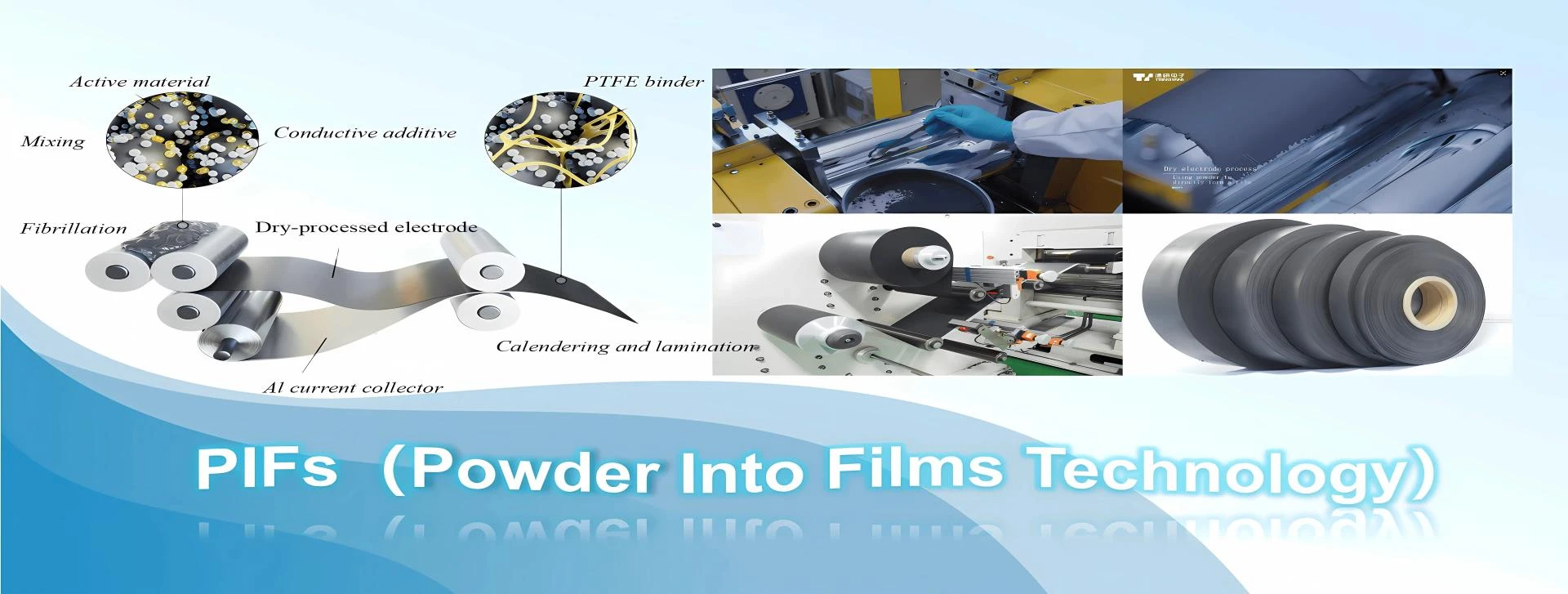
1. Raw Material Preparation
The dry battery electrode manufacturing process begins with the dry blending of three core components:
Active material (e.g., NCM for cathodes, graphite for anodes) determines energy density.
Conductive additives (carbon black, CNTs) compensate for PTFE’s insulation.
PTFE binder (3–5% by weight) replaces solvents, forming a fibrillated network.
Critical requirement: Homogeneous mixing to prevent agglomeration, typically using high-shear planetary mixers.
2. PTFE Fibrillation
During blending or subsequent roller shearing, mechanical force induces PTFE fibrillation—where the binder forms a 3D fibrous mesh. This:
Enhances electrode mechanical strength.
Eliminates the need for solvents (unlike wet slurry processes).
Maintains thermal stability (−200°C to +260°C).
3. Calendering: Dry Powder Compression
The dry mixture is fed into a calender (heated rollers at 80–120°C) under high pressure (10–50 tons) to:
Compress the powder into a freestanding electrode film.
Optimize density (e.g., ~3.4 g/cm³ for anodes).
Challenge: Balancing pressure to avoid cracking the Al/Cu current collectors.
4. Lamination to Current Collectors
The calendered film is thermally bonded to:
Aluminum foil (10–20 µm, cathodes) or copper foil (anodes).
Surface treatments (e.g., laser texturing) improve adhesion.
Key parameter: Precise temperature/pressure control to prevent delamination.
5. Final Assembly & Validation
The dry electrodes are:
Slit to required dimensions.
Integrated into battery cells (e.g., stacked or wound).
Validated for conductivity, porosity, and cycling performance.
Simplify the production process
Dry electrode technology eliminates the complex procedures of traditional wet methods, improving production efficiency.
Better performance
Dry electrode processing has high conductivity and good mechanical strength, enhancing the overall performance of electrodes.
Environmentally friendly
Without using solvents, dry electrode processing reduces pollution and conforms to the concept of sustainable development.



























Sign in to leave a comment.