
Three years ago, I attended a budget review where the IT team from a hospital had successfully shut down an eight-month application development project that almost no one used. At first glance, it looked like a good idea. Patients would receive notifications, physicians would have easier access to information, and the front office would receive less phone traffic. However, the problem was that the team developed one application to address three different issues, and none of the parties received what they were looking for.
This meeting stuck with me as I have seen the same thing happen several times at other healthcare organizations since then. The solution is not adding more and more features to a single application. The solution is understanding which type of numerous healthcare apps is appropriate for solving a particular problem even before writing one line of code. Here is a list of ten types of healthcare apps that matter the most today along with their descriptions.
Why Healthcare Organizations Build More Than One Type of App
Health systems rarely plan out every one of the types of healthcare apps they will eventually need in one sitting. Most do not set out to build ten apps at once. The need grows over time as patients, clinicians, and administrative staff each hit a different gap in how care gets delivered. Firms that offer Healthcare Mobile App Development Services often work with the same client on three or four separate app categories across several years, and that pattern says a lot about how real demand actually forms inside a hospital or clinic network.
One App Cannot Serve Every User in a Health System
A patient who wishes to send a message to a nurse requires something different from what a doctor needs when he requires lab test results instantly. The administrators who record the rate of bed turnovers require an application whose requirements fall outside those of the above-mentioned users. Because each category uses the healthcare service under a different perspective, an interface design that will try to satisfy all the above-listed categories falls short of satisfying any. That is why healthcare IT professionals often have a collection of applications rather than one application.
Example: A cardiologist's network whose design I was considering for this article has an application that reminds patients about their appointments and a totally different tool used by doctors in their rounds when they require instant ECG data.
Choosing the Right Category Starts With the Problem, Not the Feature List
The first question to be asked, even before the specs documents are opened, would be what specific problem needs solving? The team that starts working with a features wish list instead of a problem would end up developing a generic solution that would never be used. The team that started from a problem would end up developing a highly specific solution.
Example: The diabetes clinic I once met with chose the remote monitoring application instead of a generic well-being application because the problem they were trying to solve was not a lack of motivation or education but rather a lack of insulin readings between the visits to the clinic.
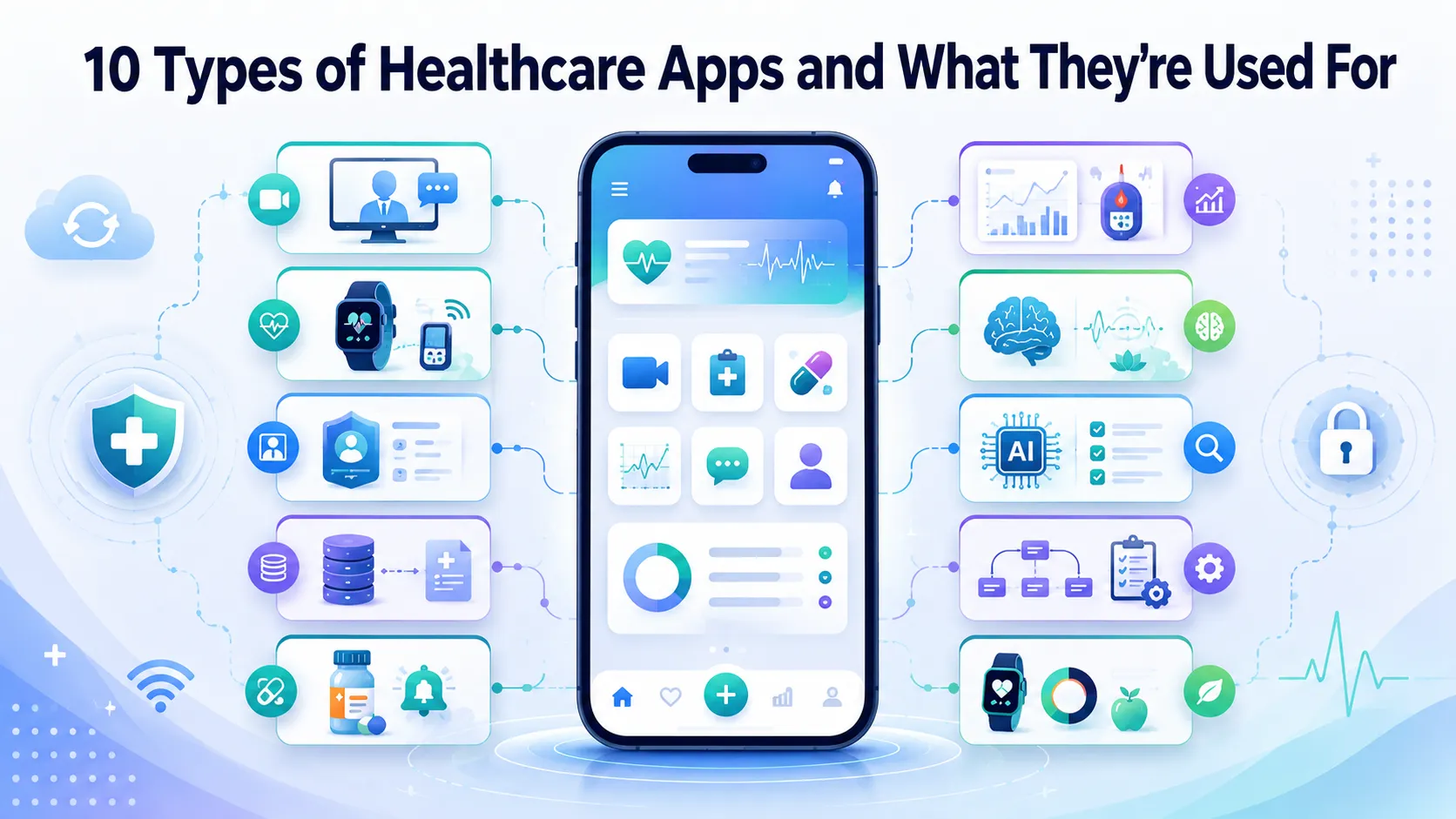
10 Types of Healthcare Apps and What They're Used For
There are different people and different points in the care process that healthcare applications can be developed for. In the following sections, I will discuss the types of applications that I have seen mentioned the most in relation to their value.
Telemedicine Apps
The applications of telemedicine allow the patient and the provider to meet via live video or audio, rather than through a physical encounter. Applications for telemedicine play an important role where there is a problem of distance, mobility, or scheduling. These include applications for primary care providers, specialists, and increasingly for therapists requiring a private virtual space.
Example: In a rural health care facility I examined, the use of a telemedicine application has reduced the rate of missing visits for follow-ups from two-hour drives to zero in just one year.
Remote Patient Monitoring Apps
The remote patient monitoring app gathers patient health data outside the clinical setting through a connection with a device and sends the data to the care team in almost real-time. This information is then used by nurses and other members of the care coordination team to detect issues that might eventually lead to ER visits.
Example: A remote patient monitoring technology is being implemented at the dialysis center where my project is being implemented. In this center, the patients have a scale and a blood pressure monitor that connect directly to the monitoring app between their treatment sessions.
Patient Portal Apps
With a patient portal application, a user has one location in which to access lab test results, request a refill on their medication, and communicate with their medical team.
Example: The multi-specialty group that I observed implemented a portal application where five separate departments all had their own login page, and now a patient can see their cardiologist and endocrinologist and have only one account for all lab results.
EHR/EMR Integration Apps
The applications for EHR/EMR integration will be developed between current hospital technology and mobile devices to get the clinical information transmitted without any extra typing. Integration applications are designed by IT specialists either from scratch or purchased in order to integrate some new piece of software into the current record system.
Example: One of the ambulatory surgical centers that I analyzed made their own application for EHR integration; therefore, pre-operative and post-operative records are automatically synchronized with the hospital’s core EHR system.
Medication Management Apps
Apps for medication management are applications that keep a record of the prescribed medications and send reminders on time. These are critical for patients on treatment regimens in which missing a dose is clinically important.
Example: One oncology facility that I have encountered uses a medication management app to monitor a difficult chemotherapy protocol in between infusions at home, and the nurses receive an alert when a dose is missed.
Chronic Disease Management Apps
Disease management applications for chronic diseases assist a patient in monitoring their symptoms, vital signs, and triggers related to their chronic illness in the long run, that is, in weeks, months, and even years. The care team can adjust a treatment plan using trend data rather than the patient’s memory during a brief visit to the clinic.
Example: A community health care organization with many people suffering from diabetes and hypertension uses an application that combines both chronic illnesses so that a single care manager can monitor patients whose numbers are going in the wrong direction before the problem becomes critical.
Mental Health Apps
A mental health app links a user to therapy, medicine management, or self-management solutions for issues such as anxiety and depression. The mental health app caters to patients who require continuous help after a therapy session or who are not ready for face-to-face therapy sessions yet.
Example: The behavioral health practice that I evaluated uses an app together with its therapy sessions whereby a patient enters mood triggers every day, and during the therapy session, the therapist views the entry before proceeding to conduct the session.
AI-Based Symptom Checker Apps
The symptom checker mobile applications employ algorithms that ask the patient questions regarding his/her symptoms in a structured manner, offering the appropriate care levels in return. The purpose is to decrease unnecessary trips and direct the patient to the right destination.
Example: An urgent care facility chain I reviewed implemented a symptom checker in its app for patients to answer predefined questions before arrival and for staff to determine the triage level before arrival.
Hospital and Staff Workflow Apps
Workflows help in supporting the processes inside a hospital, such as hand-off for nurses, assigning beds, and tracking of equipment. The workflows are designed for use by the staff rather than the patients, and their goal is to reduce the time taken for manual coordination among different departments.
Example: In the pediatric hospital I observed, the workflows reduced the average time to assign a patient a bed by more than half compared with the manual bed board.
Fitness and Wellness Apps
The fitness and wellness apps help the patient exercise or have good nutrition or lifestyle practices in line with a greater health strategy. The use of these apps by the providers aims at prevention and future benefits and not the management of the disease.
Example: One of the fertility clinics I happened to come across uses a wellness app for their patients who will undergo some treatment in a certain cycle. This is because there are certain factors involved.
How to Decide Which Type of App Your Organization Actually Needs
Looking through the types of healthcare apps presented above may provide you with an impression that all of them are equally worthy of development. However, the actual choice should be made based on the alignment of one of the categories with a particular need you currently have.
Match the App Category to the Workflow Gap, Not the Trend
The selected category should help solve a care delivery process or workflow problem identified through documentation. A leadership team that selects the category on the basis that a competitor has done so usually ends up developing an application that is press release-worthy but fails to solve any actual problem.
Example: I have seen a specialty network of clinics that was about to develop a symptom checker application because of a similar application developed by their competitor, before identifying the actual problem as their patients skipping their appointments. They then developed an application focused on reminders, which reduced no-shows in two quarters.
Weigh Integration and Compliance Load Before You Scope the Build
All categories come with different integration effort and different amounts of regulatory compliance burden. An app dealing with protected health information and EHRs needs a lot more security analysis and testing than a simple wellness tool, which needs to be reflected both in planning and budget from the very beginning.
Example: A regional hospital system I've worked with scoped their project to build a seemingly simple patient app but realized mid-project that EHR integration and HIPAA analysis were going to take three times more time than originally planned.
Conclusion
Healthcare apps are far from a monolith, and the types of healthcare apps addressed in this paper each serve different purposes and target different stakeholders, such as patients dealing with chronic illness and nurses assigning beds on a crowded floor. The key to successful implementation and use of an app is identifying a specific need within a care process or workflow and not coming up with a list of features based on what others seem to be using.

























Sign in to leave a comment.