
Introduction
I once spent an afternoon with the leaders of a mid-size clinic. They wanted to add virtual care and open a second site. At the same time, two coders had just quit, the billing backlog would not shrink, and a compliance deadline sat weeks away. Every plan they liked pulled staff away from patients. Every shortcut raised a fresh risk. The room felt stuck between growth and the daily grind.
Here is the part many providers miss. You need not execute all the functions internally. The various types of outsourcing address varied problems, which is reflected in the current market scenario. The US healthcare outsourcing market size was valued at approximately $69 billion in 2025. This article walks through the main Types of Healthcare Outsourcing and when each one makes sense.
Why Healthcare Providers Choose to Outsource
Many providers now lean on specialized technology partners to move digital work forward. In my experience, the aim is rarely to hand off control. It is to keep internal teams on patient care while outside experts carry the technical load. This is where Healthcare IT Outsourcing services fit, as a way to add skill and capacity so clinical staff stay on their core work.
The Challenges That Push Providers Toward Outsourcing
Certain pressures repeatedly emerge. Cost is rising. Experienced personnel are difficult to hire and retain. New technologies are coming out faster than they can be implemented. Regulations become stricter every year. Patients demand the same ease and convenience that they experience with other industries. Once all of these fall on an organization, many leaders seek external help because they need this expertise quickly.
Example: A community hospital wants to develop telehealth but cannot hire experienced healthcare information technology professionals while performing regular operations. An external partner bridges this gap by circumventing the hiring process.
Choosing the Right Work to Outsource
Not every task belongs with a vendor. The best candidates need specialized skills or heavy volume. Core patient care stays in-house. Each choice should map back to a clear business goal, not just a wish to offload work.
Example: For a multiple-site orthopedic practice, the care is delivered in-house, while the appointment management systems and communications for patients are outsourced to a partnering company. As a consequence, all processes go seamlessly at each site.
The Main Types of Healthcare Outsourcing
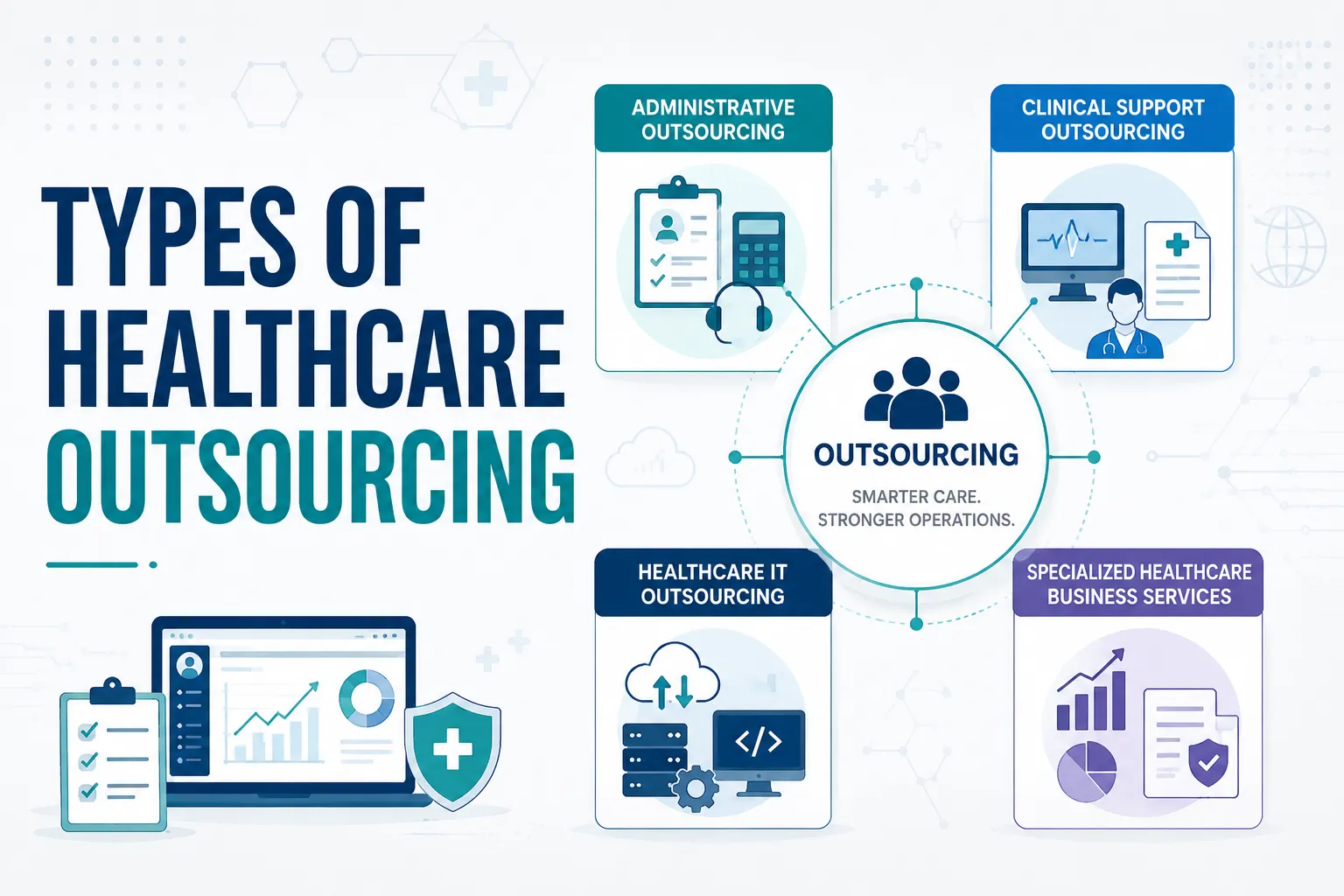
This is the heart of the decision. Four broad categories cover most of what providers use today. Each one fits a different need.
Administrative Outsourcing
Administrative outsourcing takes care of the paperwork machine. Here you can see such things as medical billing, claim processing, revenue cycle assistance, scheduling, and customer service provided by an external provider.
Example: A behavioral health clinic outsources insurance verification and claims work. Staff then spend more hours with patients and less time on forms.
Clinical Support Outsourcing
Clinical support services outsourcing includes only the tasks related to patient care and not actually delivering patient care. This includes medical transcription, clinical documentation, coding, telehealth services support, and remote monitoring services support. Patient care decisions remain entirely within the hands of healthcare providers.
Example: Radiology specialists outsource transcription of the results of their imaging tests. The specialists can read more scans per day because of that.
Healthcare IT Outsourcing
Healthcare IT outsourcing covers the technology backbone. It spans software development, system integration, cloud migration, cybersecurity, application upkeep, and interoperability. Digital demands have risen fast, and this category has grown with them.
Example: A multi-specialty hospital wants to launch a remote patient monitoring platform. Rather than build an internal team, it outsources development and EHR integration to move faster while it stays compliant.
Specialized Healthcare Business Services
Some outsourcing targets long-term performance rather than daily tasks. This group includes healthcare analytics, regulatory compliance support, quality reporting, financial consulting, and population health support. These services help an organization plan and improve over time.
Example: An accountable care organization outsources population health analytics. The insight helps it flag patients at high risk of readmission and act earlier.
How to Choose the Right Type of Healthcare Outsourcing
Knowing the categories is one thing. The right fit is another. A few simple filters turn the Types of Healthcare Outsourcing into a clear decision.
Match Your Challenges With the Right Outsourcing Model
Start with the problem, not the vendor. Operational strain, technology gaps, compliance pressure, and growth plans each point to a different model. Name the biggest challenge first, then match it.
Example: A growing urgent care network picks Healthcare IT outsourcing to connect patient records across new sites. Billing runs fine, so interoperability is the real problem to solve.
Balance Cost, Compliance, and Long-Term Goals
Cost consideration by itself is inadequate. Consider cost in relation to security issues, compliance concerns, flexibility for future growth, and expertise of the supplier. The right selection should be based on plans for the organization’s development over the next three years.
Example: When selecting a vendor, a children’s health network decides to go with a HIPAA-compliant one despite its higher price.
Choose a Partner With Healthcare Industry Experience
Healthcare is not generic software work. A strong partner knows the regulations, the existing systems, and the clinical workflows. That background counts more than broad outsourcing experience alone.
Example: A cardiac center picks a partner that has integrated cardiovascular imaging systems before, over a general vendor new to healthcare. The head start shows in the result.
What Makes a Healthcare Outsourcing Strategy Successful
The Types of Healthcare Outsourcing matter less than how you run the partnership. A few habits separate a strong result from a costly one.
- Define clear business goals before you outsource. Know what success looks like in numbers. A vague goal leads to a vague result.
- Keep communication steady between internal and external teams. Set a regular rhythm of updates and one clear point of contact. Silence is where projects drift.
- Protect patient data at every step. Confirm HIPAA terms, access limits, and a signed agreement before any data moves. Security is not a later add-on.
- Measure outcomes often, not just cost. Track quality, speed, and patient impact next to the invoice. Cheap work that fails helps no one.
- Review the partnership as needs change. What fit last year may not fit now. Revisit scope and vendors as the organization grows.
Conclusion
It should be noted that there is no one way to go about healthcare outsourcing. The specific solution addresses certain problems and therefore depends on the aims and objectives of the particular company. The best providers are those that use the Types of Healthcare Outsourcing for solving the problem, not following a trend. Begin by identifying your challenges and selecting a proper type and a provider.



























Sign in to leave a comment.