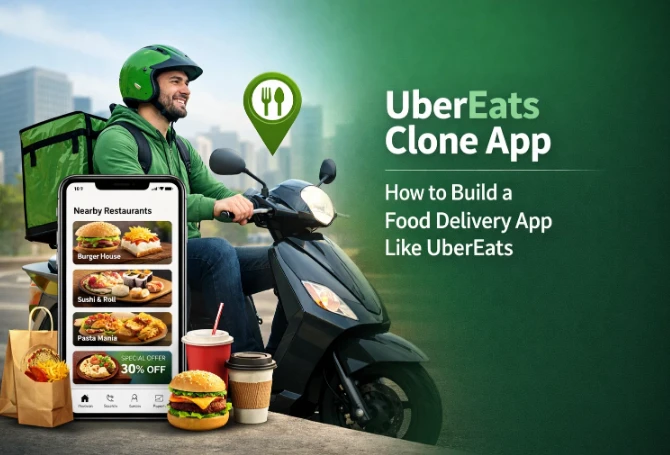

Food delivery has become a natural extension of daily life. What once felt like a convenience is now an expectation, driven by on-demand platforms that combine logistics, payments, and real-time communication into a single experience. UberEats is one of the clearest examples of how sophisticated engineering can power something that feels simple to the user. Building an UberEats Clone is less about copying features and more about understanding how such systems actually work under the hood. It involves designing scalable architectures, handling real-time data, and coordinating multiple user roles at once. This article walks through the technical foundations of ubereats clone app development, focusing entirely on engineering decisions, system design, and application architecture.
Understanding the Architecture of an UberEats-Style Platform
At a glance, an UberEats Clone may look like a single mobile app. In reality, it is a distributed system made up of several independent applications and backend services. Each part plays a specific role, and all of them must work together without friction.
Typically, the platform includes a customer app, a restaurant interface, a delivery partner app, and an administrative dashboard. These applications communicate through APIs and event-driven services. Because demand can spike at any moment, the system must be built to scale without breaking under pressure.
Modern Ubereats-like development almost always relies on microservices. Instead of one large backend, the system is broken into smaller services that handle tasks such as orders, payments, users, or notifications. This approach makes the platform easier to scale, update, and maintain over time.
Key Applications Within an UberEats Clone Ecosystem
Every ubereats clone app ecosystem is built around clearly defined user roles. Each role interacts with the platform differently, which is why separate applications are usually required.
The customer application is where users browse restaurants, explore menus, place orders, and track deliveries. The restaurant application focuses on menu management, order acceptance, preparation updates, and availability settings. Delivery partners use their own app to receive assignments, navigate routes, and confirm pickups and drop-offs. Overseeing all of this is the admin panel, which provides operational control and system visibility.
This separation is a hallmark of on demand app development. It allows teams to optimize each app for its specific users while keeping the overall system flexible.
Frontend Development and User Experience Design
Frontend development for an UberEats Clone is about more than visuals. It is about speed, clarity, and responsiveness. Users expect the app to react instantly, whether they are scrolling through restaurants or tracking a delivery in motion.
Mobile applications are often built using native technologies for performance reasons, although cross-platform frameworks are also common. Regardless of the technology stack, the frontend must handle frequent API calls and real-time updates without slowing down the interface.
Live order tracking, instant status changes, and smooth transitions all depend on efficient communication with the backend. When done well, the complexity disappears, and the experience feels effortless to the user.
Backend Systems and API Architecture
The backend is where most of the complexity in ubereats clone app development lives. It is responsible for managing users, processing orders, handling payments, and coordinating communication between applications.
APIs form the backbone of this system. They allow different apps to interact with backend services in a secure and structured way. Many platforms adopt REST or GraphQL APIs, supported by authentication layers that control access based on user roles.
A microservices-based backend allows each part of the system to scale independently. For example, order processing can scale during peak hours without affecting user authentication or notifications. This flexibility is critical for maintaining performance as usage grows.
Database Design and Data Storage Strategy
An UberEats Clone manages a wide range of data, from user profiles and menus to orders, payments, and location updates. Designing the database layer requires careful planning to avoid performance issues later.
Transactional data such as orders and payments is usually stored in relational databases to ensure consistency. At the same time, unstructured or high-volume data may be stored in NoSQL databases for better scalability. Caching layers are often introduced to reduce load on primary databases and speed up common queries.
Good data modeling improves performance and simplifies analytics. Separating operational data from reporting data also helps keep the system responsive under heavy traffic.
Real-Time Location Tracking and Delivery Management
One of the defining features of any UberEats Clone is real-time delivery tracking. Customers expect to see where their order is at every stage, which means the system must process frequent location updates from delivery partners.
This requires efficient handling of GPS data and real-time messaging. Location updates are sent continuously, but only meaningful changes are transmitted to avoid unnecessary load. Mapping services calculate routes, estimate arrival times, and adapt to changing conditions.
From a technical standpoint, this is one of the most demanding parts of Ubereats-like development. Accuracy, performance, and battery efficiency all have to be balanced carefully.
Managing the Order Lifecycle
Order management sits at the heart of every ubereats clone app. Each order moves through a series of states, starting with placement and ending with delivery confirmation. Every state change triggers updates across multiple applications.
To handle this reliably, many platforms use event-driven architectures. Instead of tightly coupling services, events are published when something changes, and other services react accordingly. This makes the system more resilient and easier to scale.
Consistency is critical. Customers, restaurants, and delivery partners must all see the same order status at the same time, even when services are distributed across multiple servers.
Payment Processing and Financial Workflows
Payments are a sensitive and essential part of an UberEats Clone. The system must handle multiple payment methods, failed transactions, refunds, and settlements without exposing sensitive data.
Most platforms rely on tokenization so that payment details are never stored directly. The backend coordinates payment authorization, confirmation, and reconciliation while handling edge cases such as partial refunds or canceled orders.
Security and compliance are non-negotiable here. Payment systems must be designed with strong encryption, access controls, and auditability from the start.
Notifications and Real-Time Communication
Timely communication is what keeps an UberEats Clone feeling alive. Users expect instant updates when an order is accepted, prepared, picked up, or delayed.
Notification systems are typically event-driven. When something changes in the system, a notification is triggered and sent through the appropriate channel. Push notifications are the most common, but email and SMS may also be used as backups.
Managing notification frequency and relevance is just as important as delivery speed. Too many alerts can overwhelm users, while too few can leave them uncertain.
Admin Panel and Platform Operations
Behind every ubereats clone app is an admin panel that keeps everything running smoothly. This interface allows administrators to monitor orders, manage users, resolve disputes, and adjust system settings.
The admin panel is usually built as a web application connected to backend services through secure APIs. Role-based access ensures that sensitive operations are limited to authorized users only.
Operational dashboards often include real-time metrics and logs. These tools help teams identify issues quickly and respond before they affect users.
Scalability and Performance Engineering
Scalability is a core requirement in on demand app development. Usage patterns are unpredictable, with sharp spikes during meal times, weekends, or promotions.
Cloud infrastructure makes it possible to scale resources dynamically. Load balancers distribute traffic, while auto-scaling systems adjust capacity based on demand. Performance monitoring tools track latency and error rates so bottlenecks can be addressed early.
A well-architected UberEats Clone is designed to grow without requiring constant rework.
Security and Data Protection
Security must be built into every layer of ubereats clone app development. User data, payment information, and location data all require strong protection.
Encryption is used for data in transit and at rest. Authentication systems ensure that users can only access what they are permitted to see. Regular security reviews help identify vulnerabilities before they become serious issues.
Privacy regulations also influence how data is handled. Compliance is not an afterthought but a design consideration from day one.
Deployment and DevOps Practices
Modern Ubereats like development relies heavily on automation. Continuous integration and deployment pipelines allow teams to release updates safely and frequently.
Containerization helps maintain consistency across environments, while orchestration tools manage scaling and availability. Monitoring and logging are tightly integrated so that issues can be detected and resolved quickly.
These practices reduce downtime and make long-term maintenance more manageable.
The Role of an UberEats Clone Script
An ubereats clone script is often used as a starting point or reference during development. It can speed up early stages by providing basic workflows and structures.
However, scripts are rarely production-ready without significant customization. They may lack scalability, security hardening, or architectural flexibility. Teams must carefully evaluate any script before relying on it for a live system.
In most cases, a script serves best as a foundation rather than a finished solution.
Testing and Quality Assurance
Testing is essential for maintaining reliability in an UberEats Clone. Unit tests validate individual components, while integration tests ensure services work together correctly.
Load testing helps teams understand how the system behaves under stress. Real-world scenarios such as payment failures or network interruptions must also be tested.
Continuous testing reduces the risk of outages and improves overall platform stability.
Ongoing Maintenance and Evolution
Launching an ubereats clone app is only the beginning. Ongoing maintenance includes fixing bugs, improving performance, and adapting to changing user behavior.
Analytics play a key role in identifying what works and what does not. Over time, new features and optimizations are introduced based on data rather than assumptions.
A strong technical foundation makes this evolution smoother and more cost-effective.
Conclusion
Building a food delivery platform like UberEats is a demanding technical challenge. An UberEats Clone requires thoughtful architecture, scalable infrastructure, and reliable real-time systems. Every component, from frontend design to backend services, plays a role in the overall experience.
By focusing on the technical realities of ubereats clone app development, teams can create platforms that are robust, secure, and ready to grow. Success ultimately comes from treating the system as a long-term product, not just a one-time build.





















Sign in to leave a comment.