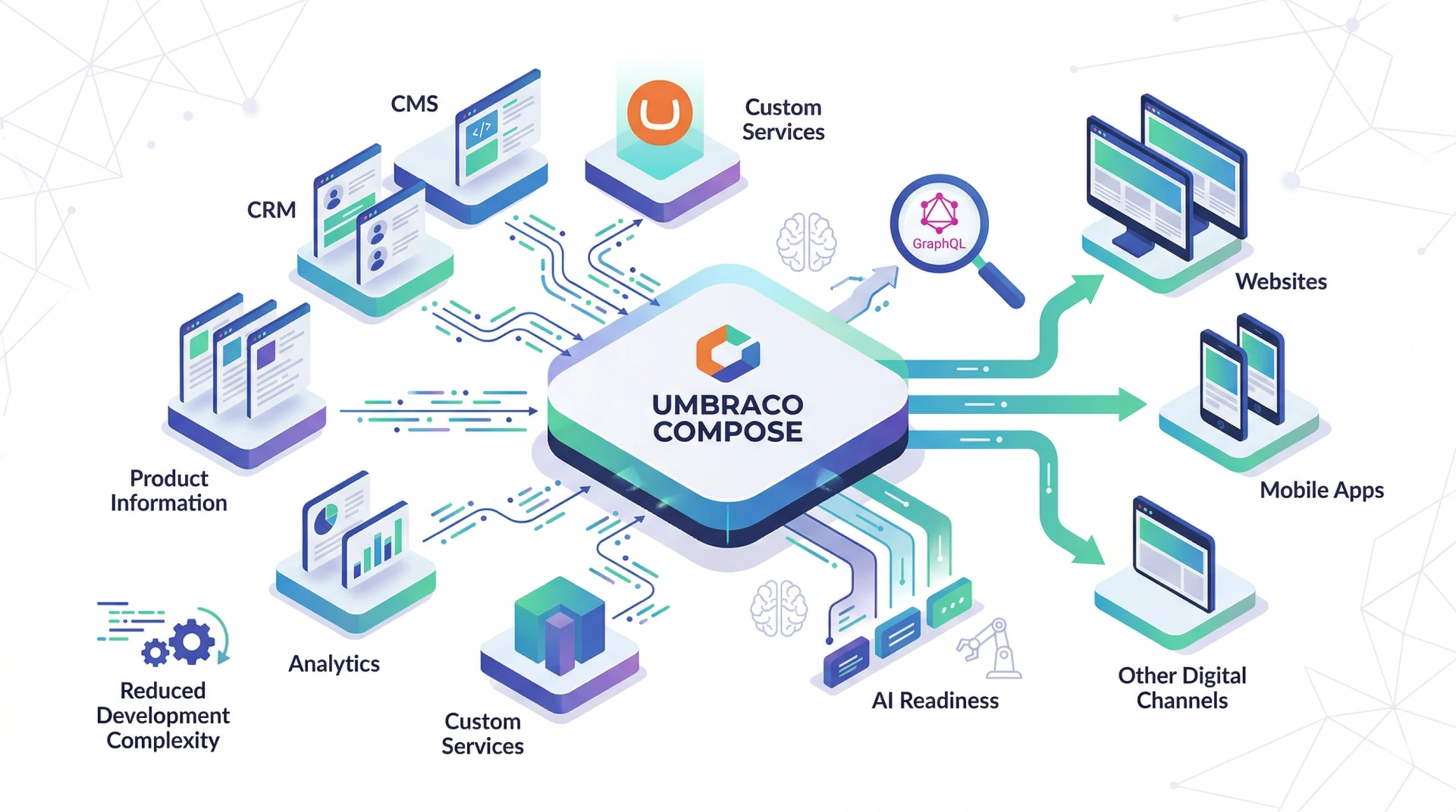

Nowadays, digital platforms depend on a variety of systems. A standard technology stack might consist of a CMS, a CRM, a product information system, analytics tools, and quite a few custom services. Linking all these systems usually involves complicated integrations and custom development work. To meet this challenge, Umbraco Compose has come up with a new concept that can make digital tools easily collaborate with each other other.
Compose is designed to assist organizations in handling data coming from different sources and presenting the data in a neat and well-ordered manner to the sites, apps, and other digital platforms. The main point of it is to simplify integration and, at the same time, limit the need for developers to write custom code.
A Platform Built for Composable Architecture
Nowadays, many digital experiences are built around composable architectures. Such an approach gives businesses the freedom to pick the most appropriate tools for different functions rather than outsourcing everything to one platform. However, even though this pattern is very flexible, it at the same time raises issues with integration because each system generates its own data format and API.
Compose serves as a central layer that connects and organizes data from these systems. It functions as the orchestration layer between backend systems and front-end applications. Instead of developers spending a lot of time building separate connections for each tool, they can rely on Compose to manage the flow of information across the entire stack. Businesses looking to implement such solutions often partner with experts offering Umbraco development services to ensure smooth deployment and performance.
Connecting Multiple Data Sources
Many organizations have a variety of business systems in their operations. They might include product databases, customer relationship platforms, digital asset management tools, and enterprise resource planning systems. Each of these systems contains important data, but most of the time, they are kept in isolated environments.
Compose provides a way for data from these systems to be gathered and merged into one comprehensive model. This comprehensive model can be made available to websites, apps, and other digital channels via a single API endpoint.
This method significantly lessens the necessity to create separate APIs or custom integrations for each service.
GraphQL at the Core
One important aspect of Compose is the fact that it employs GraphQL as the primary way to deliver data through APIs. GraphQL empowers applications to pull only the data they require instead of having to get huge volumes of irrelevant data.
It leads to enhanced performance, lowered system data transfer, and only the necessary data arriving at applications, which can result in quicker loading times and more effective user experiences.
GraphQL increases the flexibility of the system as well. Developers can modify queries for various front-end applications without having to change backend integrations again.
Reducing Development Complexity
Handling integrations between services is one of the biggest challenges in large digital projects. Traditionally, developers usually create custom backend layers or middleware systems to handle these connections.
Compose tries to simplify things drastically. It offers a fully managed framework where, through pre-built APIs and tools, it covers the processes of data ingestion, modeling, and delivery. Thus, developers will have less work in creating and keeping their own integration layers.
AI and Structured Data
Another factor driving Compose to concentrate on structured data is the increasing reliance on artificial intelligence tools in digital platforms. AI systems and large language models achieve better results if their input data is well-organized and reliable.
Because Compose organizes data using preset schemas and APIs, it generates a data environment that AI tools can utilize more efficiently. Such an environment is conducive to supporting processes that are dependent on automated content handling, personalization, and intelligent suggestion systems.
Seamless Integration with Umbraco CMS
While Compose can handle various technologies, its most natural integration is with Umbraco CMS. This integration not only makes it easy for content editors to get data from different systems but also brings everything right inside the CMS interface.
For instance, editors can pick up content or data from other sources just like it was placed in the CMS itself. It makes the workflow easier and also limits the need for manual transferring of data from one system to another. Organizations that also prioritize compliance and governance in content operations often explore solutions related to Umbraco enterprise content governance and security to strengthen their digital infrastructure.
A Scalable SaaS Solution
Compose is delivered as a cloud-based software service. So, infrastructure management, updates, and scaling are performed by the platform automatically. Organizations also do not have to manage servers or maintain the manual integration layer.
Due to the system's nature of automatic scaling, it is capable of supporting smaller projects as well as large enterprise environments. The platform is able to accommodate increased workloads as the number of data sources and digital channels rises.
Conclusion
The company directly responds to the rising demand for easier ways to integrate different parts of digital ecosystems with the introduction of Umbraco Compose. Businesses usually depend on a variety of expert tools, but are often faced with the problem of how to connect these tools effectively and without a hassle.
Working as a single orchestration layer, Compose lets the data from various systems be integrated and served through a well-organized API. As a result, it also cuts the complexity of integration, promotes a composable architecture, and offers the development teams new ways of building digital experiences.
As organizations keep on scaling up their digital platforms, it is also expected that solutions that make integrations and data management easier will be among the main features in content and application development in the future.























Sign in to leave a comment.