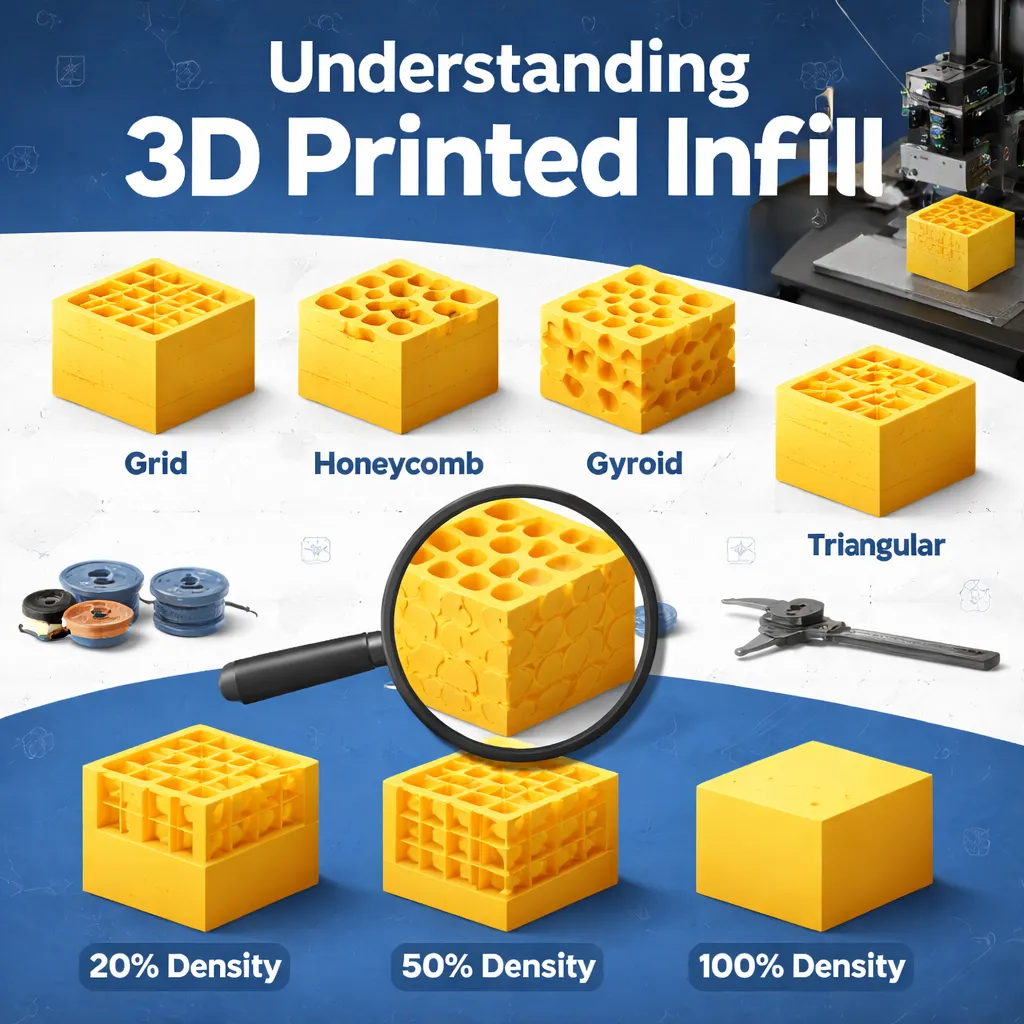

3D printed infill is a crucial aspect of additive manufacturing that directly impacts the strength, weight, and material usage of a printed object. Instead of being completely solid, most 3D printed parts have an internal structure known as infill, which provides support while reducing material consumption and print time. By adjusting infill settings, users can optimize their prints for different applications, from lightweight prototypes to durable functional parts.
What is 3D Printed Infill?
3D printed infill refers to the internal lattice structure inside a 3D printed object. It is generated by slicing software and printed layer by layer along with the outer walls. The infill pattern and density determine how strong or lightweight the final product will be.
Common infill patterns include:
- Grid
- Honeycomb
- Triangular
- Gyroid
- Cubic
Each pattern offers unique advantages. For example, honeycomb provides excellent strength, while gyroid offers a balance between flexibility and durability.
Importance of Infill Density
Infill density is measured as a percentage, typically ranging from 0% to 100%. A lower density, such as 10–20%, is ideal for visual models and prototypes where strength is not a priority. Higher densities, such as 50–100%, are used for parts that require durability and load-bearing capabilities.
Choosing the Right Density
Selecting the right infill density depends on the intended use:
- Low density (10–20%): Lightweight models, faster printing
- Medium density (20–50%): Balanced strength and material usage
- High density (50–100%): Strong, functional parts
Optimizing infill density helps reduce material costs while maintaining performance.
Infill Patterns and Their Benefits
Different infill patterns affect strength, flexibility, and print time. For instance, grid patterns are simple and fast to print, while gyroid patterns offer uniform strength in all directions. Triangular patterns are strong and stable, making them suitable for structural components.
How Infill Affects Print Performance
3D printed infill plays a key role in:
- Structural integrity
- Print speed
- Material efficiency
- Weight reduction
By choosing the right combination of pattern and density, users can significantly improve the performance of their 3D printed parts.
Applications of 3D Printed Infill
3D printed infill is widely used across industries. In product design, it allows for rapid prototyping with minimal material usage. In engineering, it supports the creation of lightweight yet strong components. Even in medical applications, infill structures can be customized for specific needs.
Future of Infill Optimization
With advancements in software and materials, infill design is becoming more sophisticated. Adaptive infill and variable density structures are enabling smarter, more efficient prints tailored to specific load conditions.
Conclusion
3D printed infill is a fundamental element of 3D printing that balances strength, cost, and efficiency. By understanding different patterns and densities, users can optimize their prints for any application. Whether for prototypes or functional parts, mastering infill settings is key to achieving the best results in modern additive manufacturing.



























Sign in to leave a comment.