Understanding Flange Connections: Sealing Principles, Key Factors, and Maintenance Best Practices
Leading China Wheel Excavator Manufacturer Providing High-Quality Mini Wheeled Excavators, Construction Machinery, and Related Attachments.
Flange connections are a fundamental component in industrial piping systems, commonly used to connect pipelines, valves, pumps, and various equipment. These connections provide a reliable method for assembling and disassembling systems, and most importantly, they ensure a leak-proof seal for fluid transmission. This article explores the sealing mechanisms, influencing factors, and maintenance considerations vital for the effective application of flange connections in industrial settings.
Sealing Principle of Flange Connections
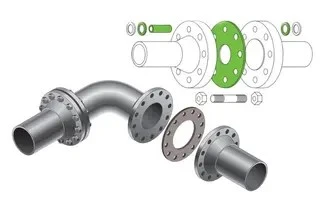
At the core of flange connections is the concept of sealing, which is achieved through the combined action of bolts, flanges, and gaskets. The gasket is the key sealing element. When bolts are tightened, they generate a pre-tension force that compresses the gasket between the flange faces. This compression causes the gasket to deform and fill the microscopic irregularities on the flange sealing surfaces, creating a tight seal.
The minimum force required to maintain this seal is known as the specific pressure. When the system is pressurized during operation, internal forces act to separate the flanges, reducing the bolt tension and, in turn, the gasket’s clamping force. If this force drops below a critical threshold—the effective clamping force—leakage can occur, and the gasket may even be expelled.
Initial sealing relies on the gasket’s plastic deformation, while long-term sealing depends on its elastic recovery. Therefore, both the initial assembly and the operating conditions must be optimized to ensure lasting performance.
Types and Characteristics of Flange Connections
Different flange types are selected based on the operating pressure, temperature, medium properties, and required sealing performance. Here are the most common types:
- Flat Face (FF) Flange
- Simple and cost-effective design
- Requires high bolt force and robust components
- Lower sealing performance, suitable for pressures up to 2.5 MPa
- Not ideal for hazardous or flammable media
- Raised Face (RF) Flange
- Improved sealing due to reduced contact area
- Easier alignment and less gasket extrusion
- Suitable for high-pressure applications
- Gasket replacement can be more difficult
- Tongue and Groove (T&G) Flange
- Interlocking design with gasket seated in the groove
- High sealing efficiency and reduced gasket extrusion
- Used for high-pressure and toxic media
- More complex design and challenging gasket replacement
- Ring Type Joint (RTJ) Flange
- Excellent sealing for high-temperature and high-pressure conditions
- Requires precision-machined sealing surfaces
- Often used with butt-welded and integral flanges
Factors Affecting Flange Sealing Performance
Flange sealing effectiveness is influenced by a combination of design, material, and operational factors:
- Operating Conditions
- Temperature and pressure fluctuations, especially in combination, increase the risk of seal failure.
- The chemical nature of the medium also affects gasket compatibility and performance.
- Gasket Design and Specific Pressure
- The effectiveness of a gasket depends on its width, material, compression ratio, and the surface roughness of the flanges.
- There is no universal formula for gasket selection—field-specific adjustments are necessary.
- Bolt Pre-Tension Force
- Adequate bolt force enhances sealing, but excessive tightening can damage the gasket or flange.
- Proper tightening procedures are critical to avoid deformation and ensure uniform load distribution.
- Gasket Material
- Gasket materials must balance elasticity and plasticity to maintain a durable seal.
- High-quality materials are essential for withstanding mechanical stress and chemical exposure.
- Flange Stiffness and Surface Integrity
- Poor stiffness or improper surface finish can lead to flange warping and leakage.
- Flange face flatness and perpendicular alignment are vital for maintaining uniform gasket compression.
Common Leakage Paths and Solutions
Flange leakage typically occurs through one of two paths:
- Gasket Permeation – Once a major concern, now largely resolved through advanced gasket materials.
- Seal Surface Leakage – The more prevalent issue, caused by micro-gaps between the gasket and flange surfaces.
Leakage occurs when the sealing resistance is lower than the pressure difference across the flange. To prevent leakage, the flange must maintain an optimal compressive force on the gasket, even under variable operating conditions.
The Role of Flanges and Bolts
Flange systems are subjected to complex forces during operation, including those from bolts, internal pressure, and thermal expansion. While structurally sound, these forces can induce deformation that compromises sealing.
From a design perspective, both strength and stiffness must be considered. Simply increasing bolt force is not always effective due to material limits. Therefore, flanges should be designed to minimize deformation while ensuring consistent sealing performance.
Correct bolt tightening sequence—such as cross-patterned or star-shaped tightening—is also essential to achieving uniform compression and preventing uneven loads that can lead to leaks.
Maintenance and Inspection Guidelines
Routine maintenance is critical to ensure the long-term sealing integrity of flange connections. Recommended practices include:
- Bolt Tightness Checks
- Monitor and re-tighten bolts periodically to counteract loosening from thermal cycling or vibration.
- Gasket Condition Monitoring
- Inspect for signs of wear, hardening, or deformation, and replace gaskets as needed.
- Flange Surface Inspection
- Clean and examine flange faces for dirt, corrosion, or deformation.
- Flange Deformation Monitoring
- Detect and correct flange warping early to prevent sealing failures.
- Operating Condition Surveillance
- Track pressure, temperature, and medium changes, adjusting sealing strategies accordingly.
Conclusion
Flange connections are a critical part of industrial systems, ensuring safe and leak-free fluid transmission. A thorough understanding of the sealing principles, flange types, and influencing factors is essential for selecting the right components and maintaining system integrity.
By combining proper design, material selection, installation procedures, and regular maintenance, engineers can significantly improve the reliability and lifespan of flange connections—reducing downtime, preventing accidents, and minimizing operational losses.Know more about Google SEO Directory























Sign in to leave a comment.