

Forex trading allows traders to participate in currency markets, but understanding leverage and margin is essential before opening a position. These two concepts determine how much market exposure a trader can control and how much money must be available in a trading account. While leverage can increase potential returns, it can also magnify losses when the market moves in the opposite direction.
Whether you are new to currency trading or comparing platforms to find the best forex broker, learning how leverage and margin work can help you make more informed decisions.
What Is Leverage in Forex Trading?
Leverage allows traders to control a position larger than the amount of money they deposit in their trading account. Brokers commonly express leverage as a ratio, such as 10:1, 30:1, or 50:1, depending on the product and applicable regulations.
For example, with 10:1 leverage, a trader could control a position worth $10,000 with $1,000 in available funds, subject to the broker's margin requirements. This increases market exposure without requiring the full position value as an initial deposit.
However, leverage works in both directions. A small movement in the currency market can produce a significant gain or loss relative to the trader's invested capital.
The CFTC's forex trading advisory explains that leverage can amplify losses and that traders may lose their entire margin and, in some circumstances, more than their initial deposit.
What Is Margin in Forex Trading?
Margin is the amount of money a broker requires a trader to maintain or set aside to open and support a leveraged position. It is not the same as a trading fee, and it should not be confused with the total value of the position.
For example, if a broker requires a 5% margin on a $10,000 position, the required margin would be $500. The remaining exposure comes from leverage.
Margin requirements can differ between brokers, currency pairs, account types, and regulatory jurisdictions. Traders should also understand the difference between used margin, free margin, and equity:
- Used margin: Funds allocated to support open positions.
- Free margin: Available equity that is not currently being used as margin.
- Equity: The account balance adjusted for the unrealized profit or loss on open positions.
Monitoring these figures can help traders understand how much room their accounts have to withstand market movements.
How Are Leverage and Margin Connected?
Leverage and margin are closely related. Generally, a higher leverage ratio requires a smaller percentage of the position's value as margin, while lower leverage requires more margin.
For illustration, consider a position worth $20,000:
- At 10:1 leverage, the required margin is $2,000.
- At 20:1 leverage, the required margin is $1,000.
- At 50:1 leverage, the required margin is $400.
These examples assume a simple margin calculation and do not include transaction costs, changing equity, or broker-specific requirements. Actual leverage limits may be lower because of local regulations or the particular financial product being traded.
Importantly, lower margin requirements do not mean lower market risk. A larger leveraged position can expose an account to greater losses if the market moves unfavorably.
What Is a Margin Call?
A margin call occurs when an account's equity falls to a level that triggers the broker's margin requirements. Depending on the broker's terms and applicable rules, the trader may need to add funds, reduce exposure, or close positions.
Some platforms also use automatic stop-out procedures to close positions when the account no longer meets the required margin level. These procedures can help manage exposure, but they do not guarantee that losses will be limited to a specific amount in every market condition.
The FCA's guidance on contracts for difference explains regulatory requirements that apply to relevant CFD providers, including leverage limits and margin close-out rules for retail clients within its jurisdiction.
Before trading, read the broker's margin policy carefully and understand how positions may be closed during volatile markets.
How to Evaluate a Forex Broker's Leverage and Margin Policies
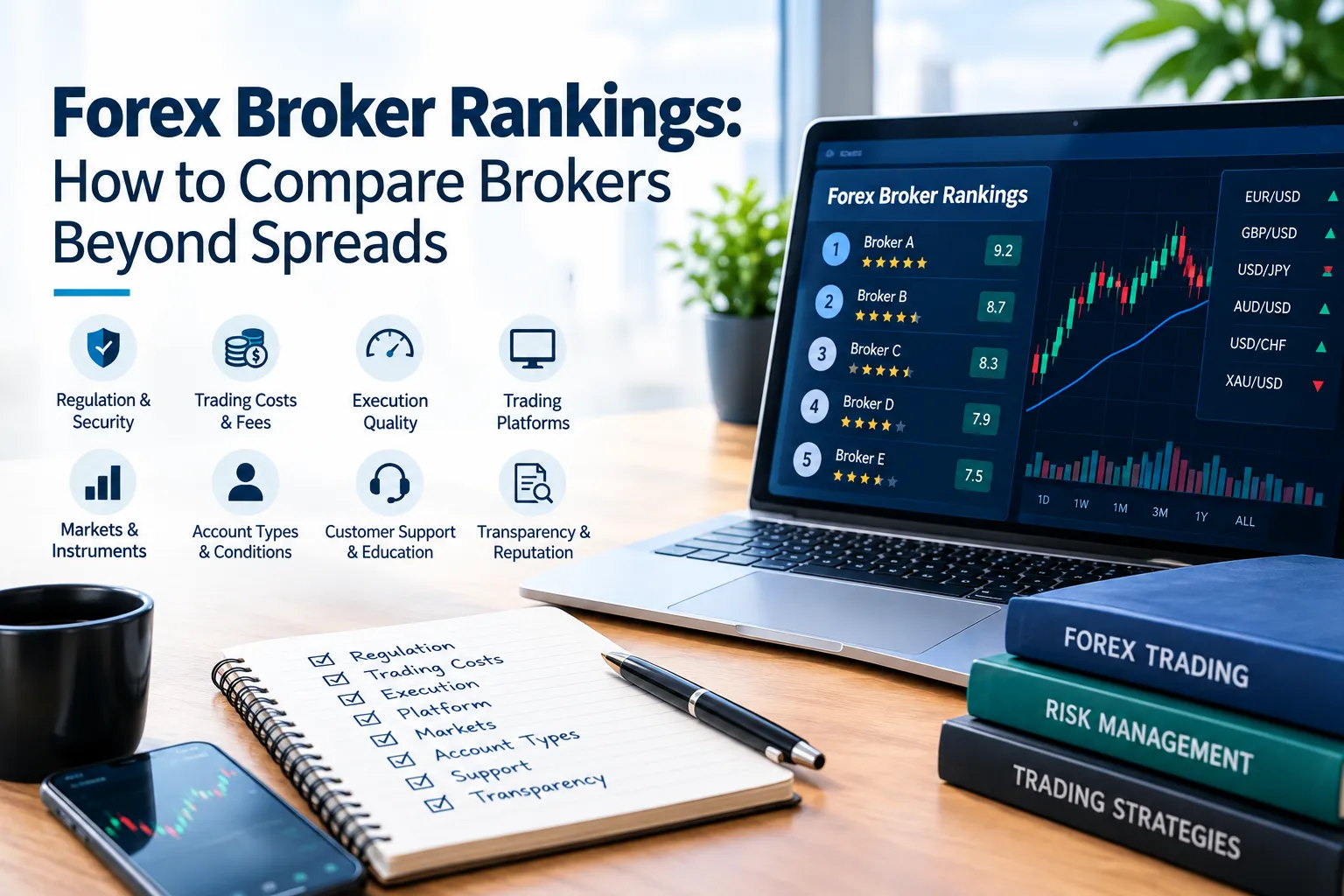
When comparing platforms, do not focus on the highest advertised leverage alone. Instead, examine the overall trading conditions and the protections available to you.
Consider these factors:
- Regulatory status: Check the broker's legal entity and licence through the relevant regulator's official register.
- Leverage limits: Confirm the leverage available for your intended currency pairs and account type.
- Margin requirements: Review initial margin, maintenance requirements, and stop-out levels.
- Negative balance protection: Check whether this protection applies to your account and jurisdiction.
- Trading costs: Consider spreads, commissions, overnight financing, and other applicable charges.
- Risk disclosures: Read the broker's warnings about leveraged trading and the possibility of losing money.
These checks can help you assess whether a best forex broker candidate offers trading conditions that suit your experience, risk tolerance, and location. Broker comparisons should rely on verifiable terms rather than promotional claims.
Practical Ways to Manage Leverage Risk
Traders can take several steps to manage exposure when using leverage:
- Use position sizes that match your available capital and risk tolerance.
- Avoid using the maximum available leverage simply because it is offered.
- Consider stop-loss orders while recognizing that execution prices may differ during gaps or volatile conditions.
- Keep sufficient free margin to handle unfavorable price movements.
- Understand overnight financing costs and the possibility of rapid market changes.
- Test your trading approach in a demo account before committing real money.
No method eliminates market risk, and a demo account cannot fully reproduce live trading conditions.
Conclusion
Leverage and margin are fundamental concepts in forex trading. Leverage determines how much exposure a trader can control relative to available capital, while margin represents the funds required to support that exposure. Both can affect account performance, particularly during periods of high volatility.
Before selecting the best forex broker for your needs, compare its regulatory status, margin rules, leverage limits, trading costs, and risk protections. A clear understanding of these factors can help you evaluate trading platforms more carefully and avoid taking on more exposure than you can afford.




























Sign in to leave a comment.