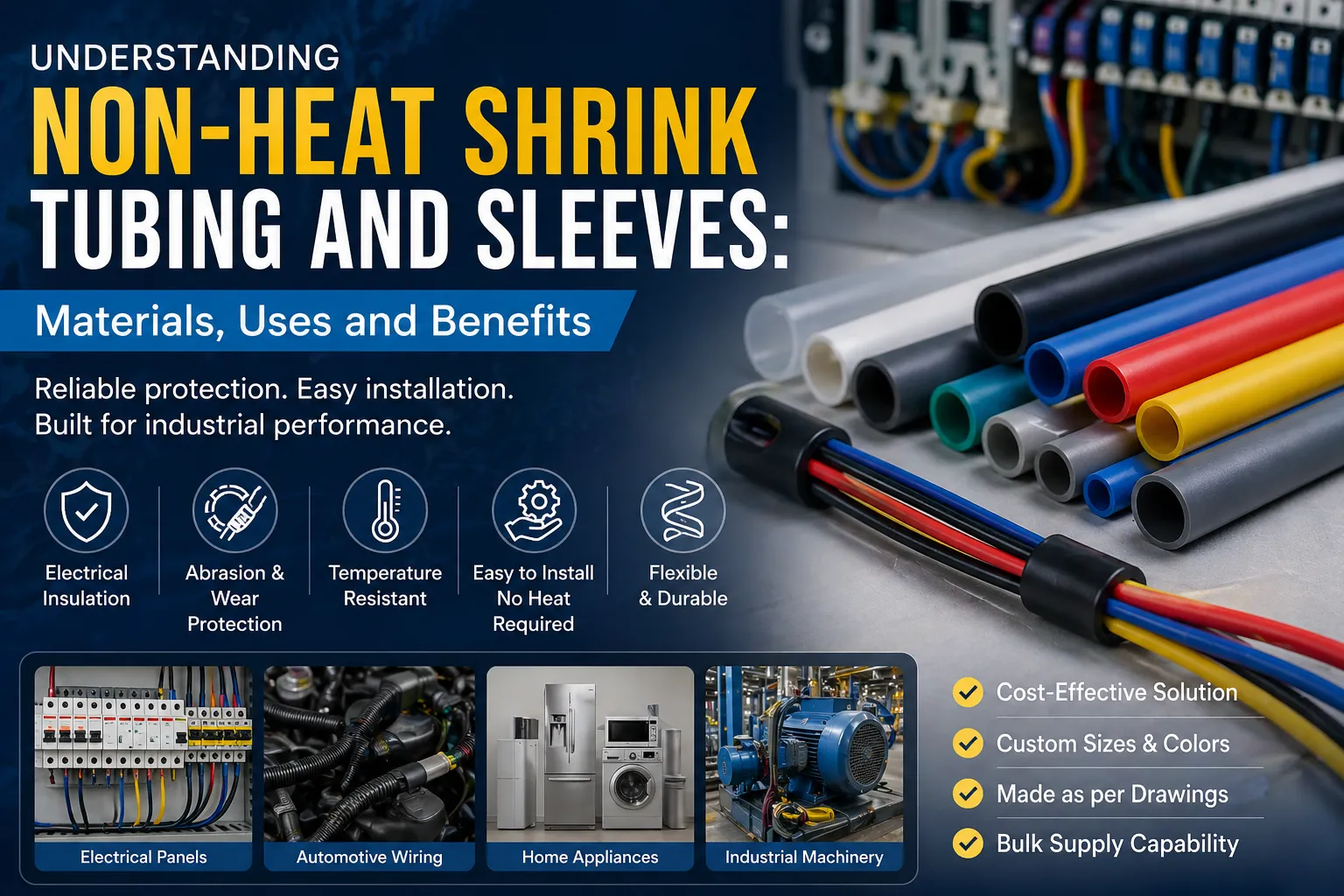

Walk into any electrical panel room or industrial assembly line and you will see wires everywhere. Some are bundled. Some are exposed to vibration. Some run close to heat sources. What protects them is not always heat shrink.
In many cases, non-heat shrink tubing and sleeves do the job better. They are simple, reliable, and cost-effective. For businesses looking for a practical non-heat shrink tubing and sleeves solution in India, extrusion-based options often make more sense than heat-activated products.
Let’s break this down properly, without marketing fluff.
What Are Non-Heat Shrink Tubing and Sleeves?
Non-heat-shrink tubing refers to protective plastic tubes that do not require heat to tighten or seal around cables. They are pre-sized and installed directly over wires, pipes, or components.
Unlike heat shrink products:
- No heat gun is required
- No risk of overheating sensitive components
- Installation is faster in bulk assembly
They are widely used as:
- electrical insulation tubing
- cable protection sleeves
- plastic insulation tubing
- flexible insulation sleeves
If heat shrink is about tight sealing, non-shrink solutions are about consistent protection and easy handling.
Materials Used in Non-Heat-Shrink Tubing
Material choice matters more than most buyers realise. I’ve seen projects fail simply because someone chose the cheapest material instead of the right one.
Here are the most common materials:
1. PVC Non-Heat-Shrink Tubing
This is the most popular option.
Why it works:
- Flexible
- Good insulation properties
- Cost-effective
- Easy to extrude in bulk
PVC non-heat-shrink tubing is widely used in control panels, appliance wiring, and automotive harness protection.
For most indoor electrical applications, PVC performs perfectly well.
2. Polyolefin (Non-Shrink Grade)
Less common than PVC in non-shrink form, but useful where higher temperature resistance is required.
3. Polyethylene (PE)
Used where chemical resistance is needed. Slightly stiffer compared to PVC.
4. Custom Compounds
In industrial environments, sometimes standard material fails. Oil exposure, UV, chemicals, or extreme vibration demand custom formulations.
That is where custom non-heat-shrink tubing becomes critical.
Key Differences: Heat Shrink vs Non-Shrink Tubing
| Feature | Heat Shrink | Non-Heat Shrink |
|---|---|---|
| Installation | Requires heat | No heat required |
| Speed | Slower in bulk | Faster |
| Risk | Overheating possible | No heat damage risk |
| Cost | Higher | More economical |
| Rework | Difficult | Easier |
From experience, in high-volume manufacturing, non-heat-shrink sleeves save time and labour cost.
Heat shrink looks neat. But non-shrink often wins in practicality.
Where Industrial Non-Heat-Shrink Tubing Is Used
1. Electrical Panels
Used as electrical insulation tubing for:
- Bus bar insulation
- Control wiring
- Terminal protection
Short answer for buyers:
If you need simple insulation without sealing, non-shrink tubing works perfectly.
2. Automotive Harnesses
In vehicles, non-shrink cable sleeves protect bundled wiring from:
- Abrasion
- Vibration
- Dust
Here, flexibility matters more than shrink ratio.
3. Appliances & Consumer Electronics
Used for:
- Internal wire insulation
- Edge protection
- Light-duty bundling
PVC works best here because it balances cost and performance.
4. Industrial Machinery
Industrial non-heat-shrink tubing is used where wires move constantly. Heat shrink can crack over time under repeated bending. Non-shrink sleeves handle flexing better.
Why Manufacturers Prefer Extruded Non-Shrink Solutions
In real manufacturing, precision matters.
Many manufacturers prefer sourcing from a reliable plastic extrusion company in India that can produce non heat shrink tubing and sleeves as per technical drawings and bulk production requirements.
Because:
- Standard sizes do not always fit
- Wall thickness must match voltage ratings
- Colour coding may be required
- Bulk consistency reduces rejection rates
This is where extrusion expertise becomes more important than the product itself.
Benefits of Non-Heat Shrink Tubing and Sleeves
Let’s simplify this.
1. Faster Installation
No heating process. No waiting. Just cut and install.
In bulk production, this saves hours.
2. Lower Cost
No heat tools required. Less labour time.
For large-scale manufacturing, the savings add up quickly.
3. Safe for Sensitive Components
Heat shrink can damage nearby connectors if applied carelessly. Non-shrink avoids that risk entirely.
4. Flexible and Reusable
If wiring needs adjustment, non-heat-shrink sleeves can be removed more easily.
5. Customisation Options
With custom non-heat-shrink tubing, you can specify:
- Inner diameter
- Wall thickness
- Colour
- Hardness
- Flame retardant grade
This level of control improves performance consistency.
What Usually Works (From Practical Experience)
After working with multiple industrial clients, here is what I have observed:
- PVC non-heat-shrink tubing works for 70% of standard applications.
- Slightly thicker wall thickness reduces field failures.
- Colour coding improves installation speed.
- Buying from extrusion specialists gives better dimensional accuracy.
What Often Fails
Let’s be honest.
Problems usually happen when:
- Buyers choose the lowest price supplier
- Tubing diameter tolerance is ignored
- Voltage rating is not checked
- UV exposure is underestimated
In outdoor environments, standard PVC without UV stabiliser will crack over time. That mistake is common.
Choosing the Right Non-Shrink Cable Sleeves
When selecting non-heat shrink tubing and sleeves, ask these questions:
- What temperature range will it face?
- Is it indoor or outdoor use?
- Is flexibility critical?
- What voltage rating is required?
- Is flame retardant grade needed?
If you cannot answer these, do not order yet.
Applications in India: Growing Demand
Across India, demand for reliable plastic insulation tubing is rising due to:
- Expansion of EV manufacturing
- Growth in electrical panel production
- Increased appliance manufacturing
- Infrastructure projects
Companies now look for a dependable non-heat shrink tubing and sleeves solution in India that supports bulk supply, consistency, and custom sizing.
That shift is visible across OEM sectors.
Why I Personally Prefer Non-Shrink for Bulk Industrial Use
If sealing is not mandatory, I almost always recommend non-shrink over heat shrink for large-scale industrial production.
Why?
Because in real factories:
- Speed matters
- Labour cost matters
- Rework happens
- Mistakes happen
Non-shrink gives flexibility.
Heat shrink gives tight sealing.
Choose based on purpose, not appearance.
How M3 Extrusion Supports Industrial Requirements
For businesses needing consistent quality, M3 Extrusion manufactures PVC non-heat-shrink tubing, custom profiles, and industrial sleeves tailored to technical drawings.
Their strength lies in:
- Dimensional accuracy
- Bulk production capability
- Custom extrusion development
- Industrial-grade material options
This makes them suitable for OEMs looking for long-term supply partnerships.
FAQs on Non-Heat Shrink Tubing and Sleeves
1. What is non-heat-shrink tubing used for?
Non-heat-shrink tubing is used for electrical insulation, cable bundling, and abrasion protection. It does not require heat for installation. It is commonly used in control panels, appliances, automotive wiring, and industrial machinery where simple and reliable insulation is required.
2. Is PVC non-heat-shrink tubing safe for electrical applications?
Yes, PVC non-heat-shrink tubing is widely used for electrical insulation. It offers good dielectric strength and flexibility. However, you must choose the correct wall thickness and voltage rating to ensure safe performance in your specific application.
3. What is the difference between non-shrink cable sleeves and heat shrink sleeves?
Heat shrink sleeves contract when heated and provide tight sealing. Non-shrink cable sleeves do not change size and are installed directly. Non-shrink options are faster to install and better suited for high-volume manufacturing environments.
4. Can non-heat-shrink tubing be customised?
Yes. Custom non-heat-shrink tubing can be manufactured in specific diameters, colours, wall thicknesses, and material grades. This is common in OEM production where exact specifications are required for consistent assembly performance.
5. Is non-heat-shrink tubing suitable for outdoor use?
It can be, but only if UV-stabilised material is used. Standard PVC may degrade under prolonged sunlight exposure. Always confirm weather resistance and material grade before using it outdoors.
6. Why is industrial non-heat-shrink tubing preferred in bulk manufacturing?
It reduces installation time, lowers labour cost, and avoids heat-related risks. In large-scale assembly lines, these advantages improve productivity and reduce operational delays significantly.
Final Thoughts
Non-heat shrink tubing and sleeves are not flashy products. But they are essential.
They protect wiring. They improve safety. They reduce production time.
If you focus on the right material, correct dimensions, and reliable extrusion manufacturing, they will quietly perform for years without problems.
In industrial manufacturing, that kind of reliability is worth more than anything fancy.























Sign in to leave a comment.