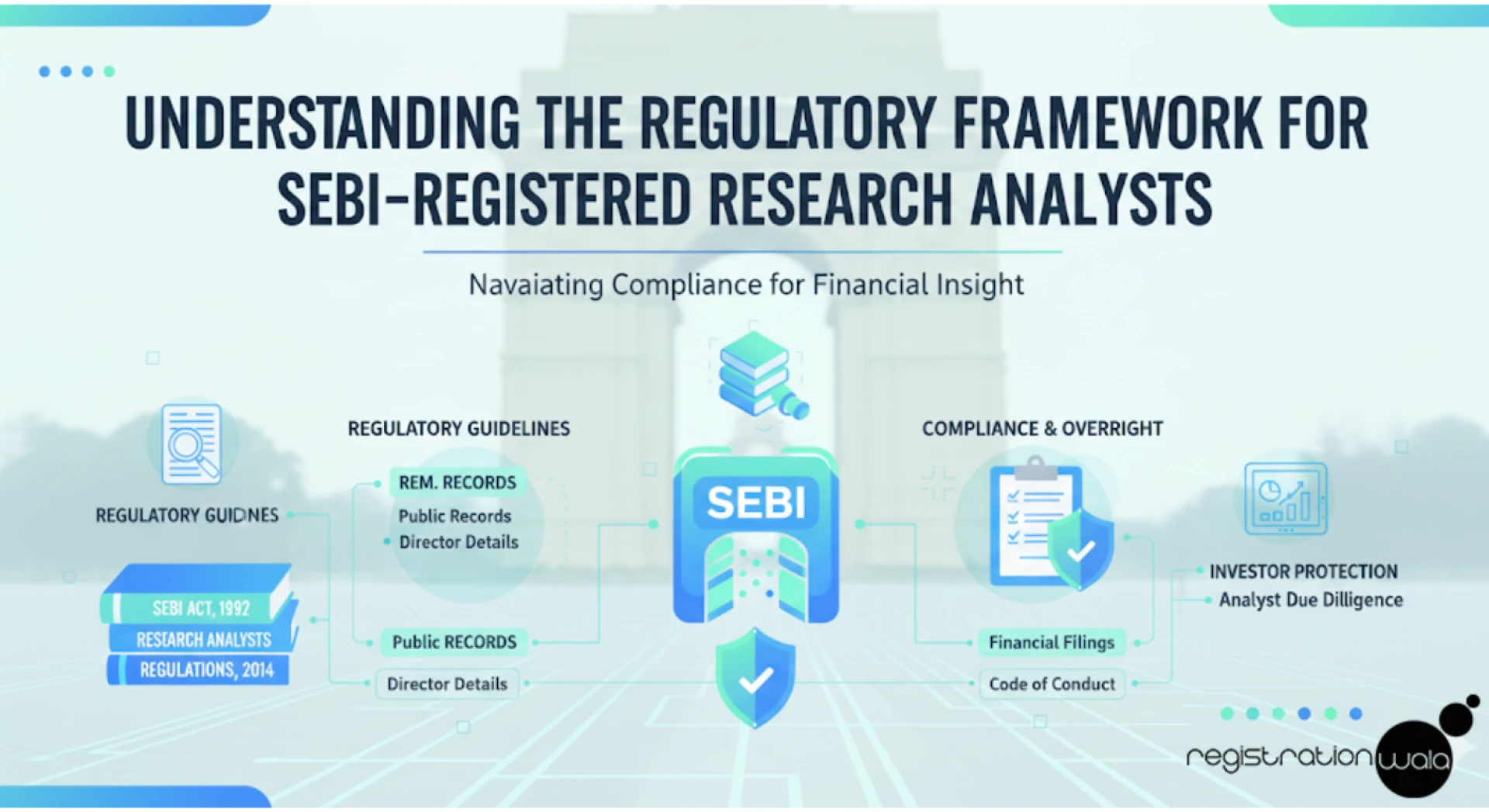

In the Indian financial markets, the credibility of an investment recommendation is as important as the recommendation itself. With the rise of retail participation in the stock market, the Securities and Exchange Board of India (SEBI) has tightened the ropes to ensure that only qualified and regulated professionals provide investment advice.
If you are an investment professional or a stock market researcher, obtaining a SEBI Research Analyst Registration is no longer just an option, it is a legal mandate under the SEBI (Research Analysts) Regulations, 2014. This blog post will guide you through the regulatory framework, the importance of being a SEBI Registered Research Analyst, and the ongoing compliance requirements.
Who is a Research Analyst Under SEBI?
According to the 2014 Regulations, a "Research Analyst" is an individual or entity primarily responsible for:
- Preparation or publication of the content of a research report.
- Providing an investment recommendation.
- Offering an "opinion" concerning securities or public offers.
Whether you are an independent professional, an intermediary, or part of a large broking house, if you are influencing the buy/sell/hold decisions of investors through reports, you require a Research Analyst License in India.
Why is SEBI Registration Mandatory?
SEBI introduced these regulations to eliminate "unregistered influencers" and protect investors from biased or unverified advice.
- Legal Validity: Operating without registration can lead to heavy penalties and a ban from the securities market.
- Investor Trust: A SEBI Registered Research Analyst carries a badge of credibility, showing they meet the minimum standards of education and ethics.
- Market Integrity: It ensures that research reports are based on facts and sound logic, not on "pump and dump" schemes.
Eligibility Criteria for SEBI Research Analyst Registration
The path to SEBI Registration for Research Analyst involves meeting strict "Fit and Proper" person criteria.
A. Educational Qualifications
An applicant must possess:
- A professional qualification or a post-graduate degree/diploma in finance, accountancy, business management, commerce, economics, capital market, or banking.
- Alternatively, a graduate in any discipline with at least five years of experience in activities relating to administration of a financial product, securities market, or fund management.
B. Certification Requirements
The applicant (and all partners/representatives) must pass the NISM-Series-XV: Research Analyst Certification Examination. This certificate must be renewed periodically to ensure the analyst is up-to-date with market laws.
C. Net Worth Requirements
- For Individuals/Partnerships: A minimum net worth of ₹1 Lakh.
- For Body Corporates/LLPs: A minimum net worth of ₹25 Lakhs.
The Application Process
The process of obtaining a Research Analyst License in India has been digitized through the SEBI Intermediaries Portal.
- Application Filing: Submit Form A along with the non-refundable application fee.
- Disclosure of Infrastructure: You must prove you have the necessary office space and technology to carry out research.
- Conflict of Interest Policy: You must submit a document outlining how you will stay unbiased if you or your family members hold shares in the companies you are researching.
- Grant of Certificate: Once SEBI is satisfied with the documents and "Fit and Proper" status, it grants the registration certificate, which remains valid unless suspended or cancelled.
Key Research Analyst Compliance Requirements
Being registered is only the beginning. The SEBI framework demands rigorous ongoing Research Analyst Compliance Requirements to maintain transparency.
A. Management of Conflict of Interest
Analysts cannot publish reports on companies where they have served as an officer or director within the last 12 months. Furthermore, they cannot trade in the securities they recommend for a period of 30 days before and 5 days after the publication of the report.
B. Disclosure in Research Reports
Every research report must contain:
- The analyst’s ownership stake in the company being researched.
- Details of any compensation received from the company in the last 12 months.
- A clear "Fact Sheet" explaining the logic behind the recommendation.
C. Maintenance of Records
Registered analysts must maintain the following records for a minimum of five years:
- Research reports published.
- Research notes (the data used to arrive at a conclusion).
- Details of public appearances (TV interviews, seminars, etc.).
Public Appearance Rules
If a SEBI Registered Research Analyst appears on a news channel or a social media platform to give an opinion, they must disclose their financial interest in that specific stock at the start of the conversation. This prevents the "hidden promotion" of stocks to the masses.
The Cost of Non-Compliance
SEBI has become increasingly vigilant. Non-compliance with the Research Analyst Compliance Requirements can result in:
- Cancellation of the registration.
- Administrative warnings or heavy monetary fines.
- Debarment from the securities market for a specified period.
Conclusion
The regulatory framework for SEBI Research Analyst Registration is designed to transform the research industry from a "free-for-all" zone into a respected, professional service. While the compliance burden might seem high, it acts as a filter that keeps high-quality talent in and fraudulent actors out.
For any serious portfolio manager or stock market researcher, becoming a SEBI Registered Research Analyst is the most significant step toward building a long-term, sustainable career in India's booming financial markets.































Sign in to leave a comment.