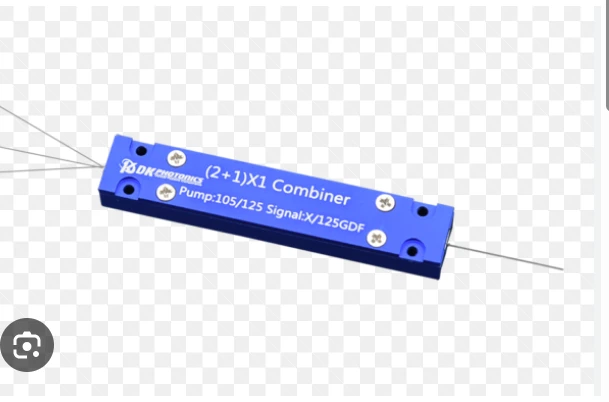
In the evolving world of photonics, fiber lasers have gained immense popularity due to their superior efficiency, high power output, and beam quality. As these systems grow in complexity and performance, the components that make up the laser system must operate with exceptional precision and robustness. Among the essential components, the pump and signal combiner plays a pivotal role in facilitating high-power operation without compromising system integrity or efficiency.
What is a Pump and Signal Combiner?
A pump and signal combiner is a specialized passive optical component designed to combine multiple high-power pump laser sources with a signal input into a single output fiber. This output typically feeds into the gain fiber of a fiber laser or amplifier. The purpose of this device is to maximize the input power into the active fiber, thus enabling the generation of high-power laser beams while maintaining signal quality.
These combiners are built using fused fiber technology or other advanced fabrication techniques to ensure low insertion loss, high power handling, and excellent beam alignment. Depending on the application, they are available in various configurations such as (6+1)×1, (7+1)×1, or (N+1)×1, where multiple pump inputs and one signal input are merged.
Why is it Crucial in Fiber Lasers?
In high-power fiber laser systems, especially those used in industrial machining, medical applications, and defense, efficient pumping of the gain medium is essential. The pump and signal combiner enables multiple diode lasers (which serve as pump sources) to inject their energy into the active fiber along with the signal laser.
This convergence of power streams ensures:
- Maximum gain efficiency
- Reduced optical loss
- Better thermal management
- Compact and robust laser design
Without such a component, integrating multiple pump sources with a single signal input would require bulkier and less efficient arrangements, reducing the overall performance and scalability of the system.
Design and Construction
The construction of a pump and signal combiner relies on precision fusion of optical fibers. Typically, the pump ports consist of multimode fibers, while the signal input is a single-mode fiber. These fibers are fused together in a tapering process where the glass cladding is melted and drawn down, allowing the optical cores to align and merge light paths.
Key specifications considered during design include:
- Pump power handling (often exceeding hundreds of watts)
- Signal wavelength compatibility
- Return loss and insertion loss
- Mode field diameter and numerical aperture
The output fiber is usually a double-clad fiber, capable of guiding both the pump light (in the inner cladding) and the signal light (in the core). This allows for efficient power transfer to the gain medium with minimal loss.
Applications of Pump and Signal Combiners
These devices are indispensable in multiple high-performance optical systems. Some common applications include:
1. Industrial Laser Cutting and Welding
Pump and signal combiners are key to delivering high-energy laser beams for precision material processing. The ability to input multiple pump powers while preserving beam quality is vital for consistent industrial operations.
2. Medical Laser Systems
In medical diagnostics and surgery, fiber lasers offer non-invasive, precise tools. Pump and signal combiners help deliver stable, high-quality laser beams needed for procedures like ophthalmic surgery or laser therapy.
3. Defense and Aerospace
Advanced targeting systems and communication platforms rely on high-power laser sources. The compact and rugged nature of combiners makes them ideal for demanding military-grade systems.
4. Scientific Research
In laboratories, pump and signal combiners are used in setups requiring high precision, such as spectroscopy, laser cooling, and nonlinear optics experiments.
Advantages of Using Pump and Signal Combiner
Using a pump and signal combiner offers several benefits that make it a valuable asset in any high-power fiber laser configuration:
- Scalability: Easy integration of multiple pump diodes allows for increased power output.
- Compactness: Reduces the size and complexity of laser systems.
- High Power Handling: Designed to endure high thermal loads without degradation.
- Low Insertion Loss: Ensures minimal power loss during coupling, maximizing efficiency.
- High Reliability: Robust fusion technology ensures long-term stability and performance.
Challenges and Considerations
While the technology is robust, there are challenges that manufacturers and integrators must consider:
- Thermal Management: High power levels require effective heat dissipation mechanisms.
- Back-reflection Protection: Unmanaged reflections can damage pump sources or disrupt signal integrity.
- Customization: Each application might require different wavelengths, fiber types, or configurations, leading to the need for tailor-made solutions.
- Cost: High-quality pump and signal combiners can be expensive due to the precision required in fabrication.
Future Trends
As the demand for high-power fiber lasers continues to surge, advancements in pump and signal combiner technology are expected. Future designs may incorporate:
- Higher power capacities (1 kW and beyond)
- Improved thermal handling through novel materials
- Integration with other optical components (such as isolators and filters)
- Automation-friendly connectors for plug-and-play installation
Furthermore, with the growth of ultrafast laser applications and the miniaturization of photonic devices, compact and multifunctional combiners will play an even more significant role.
Conclusion
The pump and signal combiner is an integral component of modern high-power fiber laser systems. Its role in efficiently combining pump and signal combiner energy with signal light directly influences the performance, scalability, and stability of the entire laser setup. As laser applications expand into newer industries and more demanding use-cases, the importance of this optical component will only grow. By understanding its functionality, advantages, and limitations, engineers and designers can better optimize their laser systems for maximum efficiency and output.
































Sign in to leave a comment.