
Understanding the Reality of the CAPF Journey
If you are preparing for the upsc capf exam, you already know that this isn't just another government test. Securing a commission as an Assistant Commandant in forces like the BSF, CRPF, CISF, ITBP, or SSB requires a rare blend of sharp academic intellect, clear analytical writing, and physical endurance.
Yet, every year, thousands of brilliant aspirants fall short not because they lacked dedication or studied fewer hours, but because they stumbled into predictable, avoidable traps.
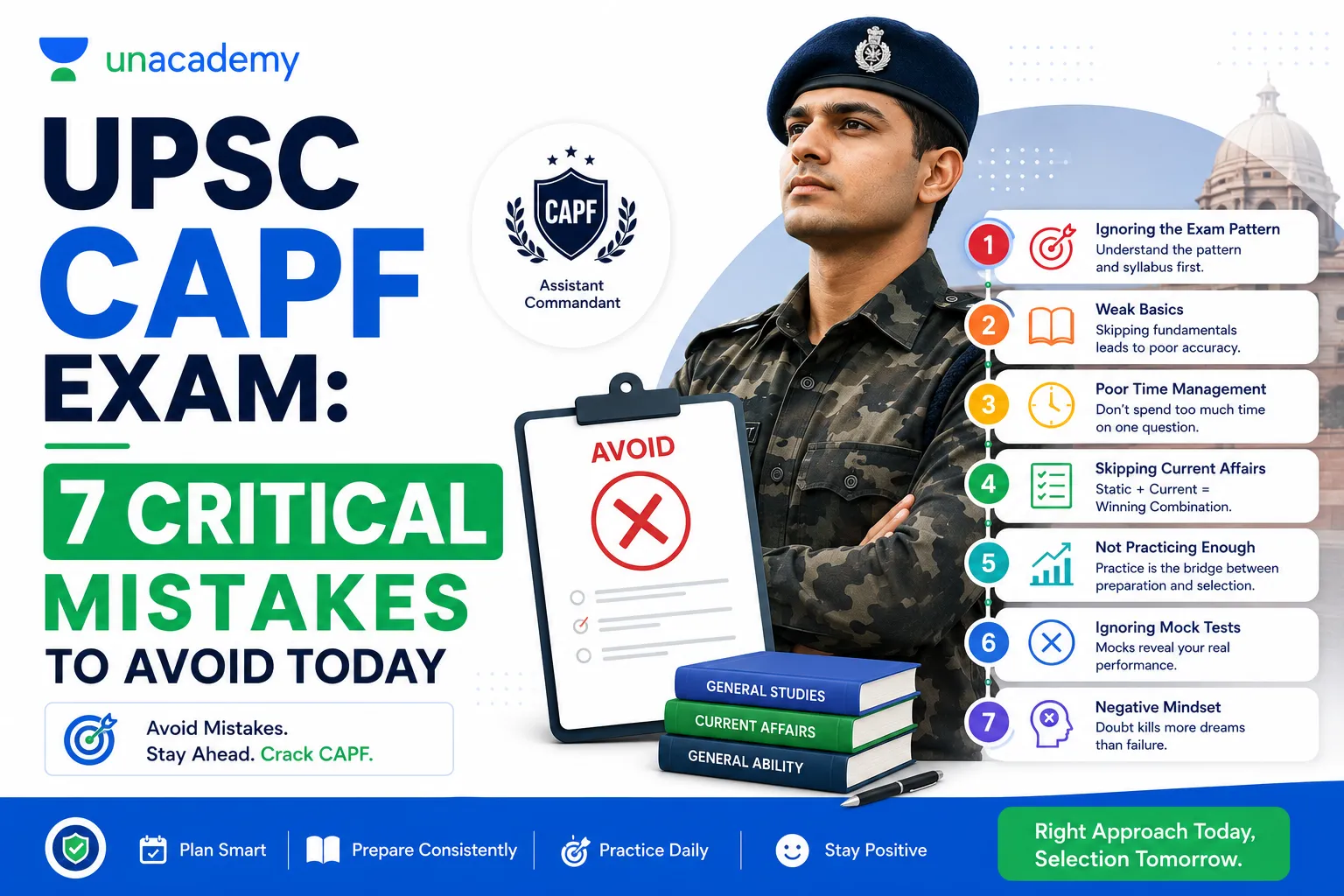
Whether you are tackling the upsc capf for the first time or trying to turn a previous attempt into a final selection, avoiding these seven critical errors will fundamentally change your trajectory.
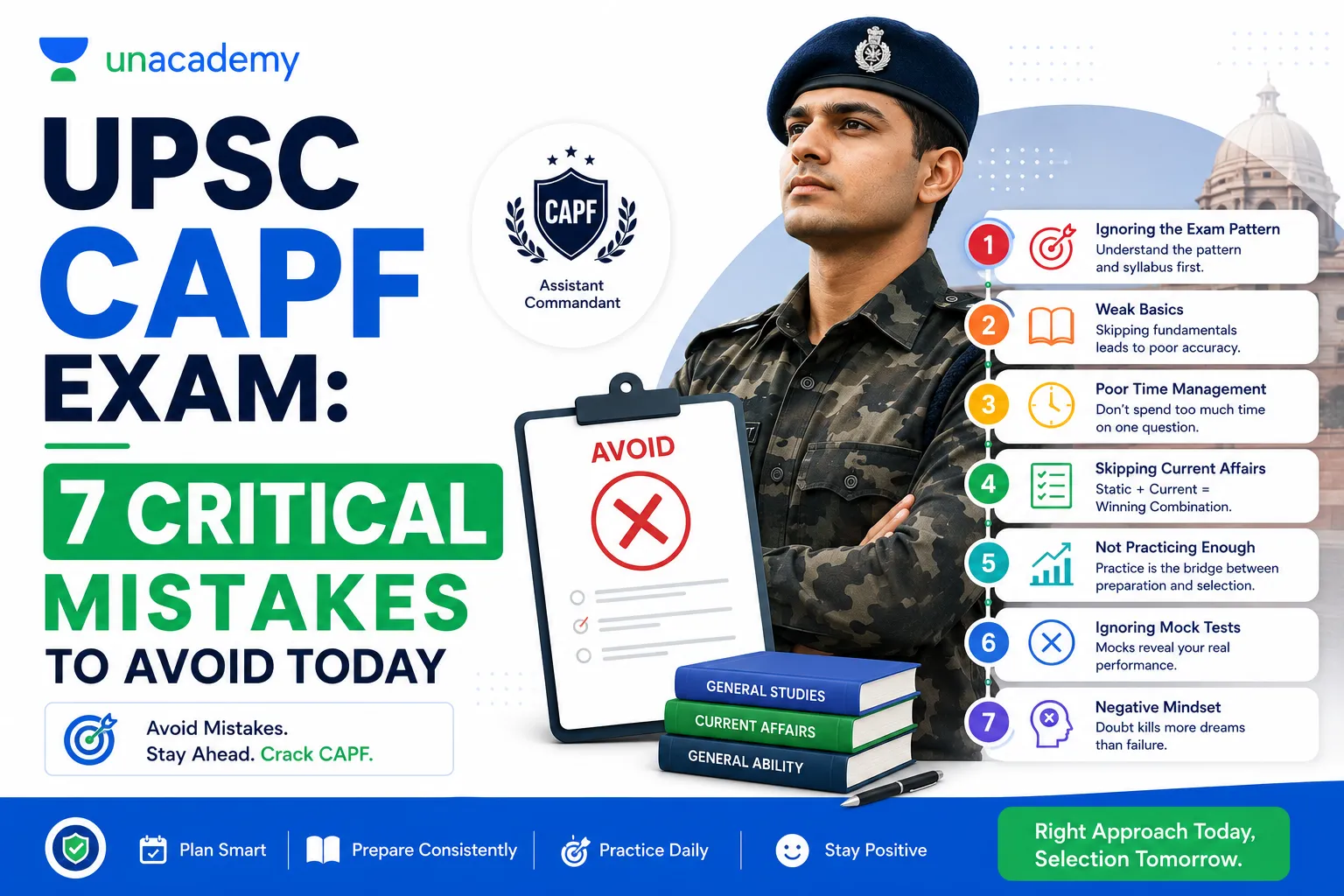
Mistakes That Cost Aspirants Their Selection
1. Treating Paper II as an Afterthought
The most widespread mistake candidates make in the capf exam is sinking 90% of their study time into Paper I (General Ability and Intelligence) while assuming Paper II (General Studies, Essay, and Comprehension) can be handled with last-minute preparation.
Paper I gets you through the initial screening, but Paper II decides your final merit rank. Writing four essays, two arguments, a report, a précis, and handling comprehension passages in three hours demands fluid writing speed and structured thinking.
- The Trap: Reading endless current affairs modules without writing a single essay under timed conditions.
- The Fix: Dedicate at least two sessions a week to answer writing. Practice organizing essays into a clear structure: context, core arguments, counter-perspectives, and a balanced forward-looking conclusion.
2. Ignoring Physical Fitness Until Written Results Are Declared
The Physical Efficiency Test (PET) is non-negotiable. Male candidates must clear a 100-meter sprint in 16 seconds and an 800-meter run in 3 minutes 45 seconds; female standards are 18 seconds and 4 minutes 45 seconds respectively. You also face long jumps and shot put (for male candidates).
Many candidates pass the written exam with high marks only to pull a hamstring or run out of breath during the 800-meter run because they tried to build stamina in just two weeks.
- The Trap: A completely sedentary study routine that leaves you physically unprepared when PET call letters arrive.
- The Fix: Incorporate a 30 to 45-minute daily physical routine jogging, mobility exercises, and core strengthening. It keeps your mind sharp during long study hours and ensures your body is ready when called.
3. Blind Guesswork in Paper I
Paper I carries a penalty of 1/3rd mark for every wrong answer. Because the competition is stiff, candidates often panic during the final 20 minutes of the exam and attempt 15–20 low-confidence questions based on pure instinct.
- The Trap: Converting potential cut-off-clearing raw scores into failing marks through reckless guessing.
- The Fix: Train yourself during mock tests to categorize questions into three buckets: Absolute Certainty, Educated Elimination (down to two options), and Complete Unknowns. Never guess blindly on the third category in the upsc capf ac written paper.
4. Preparing for CAPF Like It’s Civil Services (CSE)
While there is considerable syllabus overlap between UPSC CSE and the upsc capf exam, the testing style differs significantly. Paper I of CAPF places a stronger emphasis on direct factual precision, quantitative aptitude, logical reasoning, and general science.
| UPSC CSE Prelims | UPSC CAPF Paper I |
|---|---|
| Deep conceptual synthesis | Direct factual accuracy |
| Multi-statement elimination | Mental ability & math focus |
| Micro-economic theory | Science & security awareness |
- The Trap: Relying solely on high-level analytical readings while ignoring basic mental ability, arithmetic, and static general knowledge facts.
- The Fix: Solve the past 10 years of upsc capf question papers specifically. Notice how science, defense technology, internal security, and mental ability are weighted, and adjust your study plan accordingly.
5. Skipping Internal Security and Defense Dynamics
As a future Assistant Commandant, you are expected to understand the operational context of the forces. Paper II frequently features topics on border management, left-wing extremism, cyber warfare, coastal security, and theater commands.
- The Trap: Writing generic essays that sound like general social studies topics rather than security-aware responses.
- The Fix: Maintain a dedicated notebook for internal security topics. Note down relevant committee reports, mandate differences between forces (e.g., BSF vs. ITBP), and current border infrastructure projects.
6. Mismanaging Medium and Language Rules in Paper II
UPSC rules for Paper II are strict: candidates can write essays in Hindi or English, but arguments, reports, précis, and comprehension MUST be written in English. Mixing mediums incorrectly or filling essay sections in the wrong language leads to lost marks.
- The Trap: Losing track of basic grammar, structural coherence, or language constraints under exam pressure.
- The Fix: Practice précis writing and argument structuring strictly in English. Work on concise summarizing skills—précis writing requires expressing the core message in one-third of the original word count without losing essential meaning.
7. Over-collecting Resources Instead of Revising
It is easy to accumulate dozens of PDFs, telegram channels, and thick reference books. However, reading five different sources once is far less effective than reviewing two standard sources five times.
- The Trap: Resource fatigue right before the capf exam, leaving you with fragmented memories of key facts and dates.
- The Fix: Stick to core standard textbooks for Polity, History, Geography, and Economy. Combine them with one reliable monthly current affairs digest and your own concise short notes.
What Real Candidates Experienced
"I missed the final merit list in my first attempt by just 8 marks. I had scored well in Paper I, but my Paper II was completely unstructured because I hadn't practiced writing complete test papers within the 3-hour limit. Once I started writing weekly timed mocks, my score jumped significantly."
— Vikram S., Selected CAPF Candidate
"The biggest shock for me wasn't the written test; it was the 800-meter run during PET. I assumed my normal evening walks were enough. I barely made it across the finish line with a pulled calf muscle. Start running at least three months in advance!"
— Ananya R., Assistant Commandant Aspirant
Frequently Asked Questions
Q1. Can I prepare for the upsc capf ac exam along with UPSC Civil Services?
Yes, the core syllabus (Polity, History, Geography, Economy, Current Affairs) overlaps heavily. However, you must dedicate separate time to CAPF-specific areas: quantitative aptitude, mental ability, internal security issues, and Paper II argument/report writing formats.
Q2. What is the minimum qualifying mark for Paper I and Paper II?
UPSC sets a minimum qualifying mark for Paper I first. Only candidates who clear the Paper I cut-off have their Paper II evaluated. Additionally, candidates must secure a minimum qualifying percentage in Paper II (usually around 25%) to be considered for the written merit list.
Q3. How strict are the physical and medical standards in the capf exam?
They are strictly enforced by the Ministry of Home Affairs nodal authorities. Medical parameters regarding vision, chest expansion, height-weight ratios, and surgical histories (like LASIK restrictions) are strictly verified. Review the official UPSC notification guidelines before applying.
Q4. Is negative marking applicable to both papers in the upsc capf exam?
No. Negative marking (1/3rd deduction per incorrect answer) applies only to Paper I (MCQ). Paper II is descriptive and evaluated manually, so there is no negative marking scheme, though poor grammar or formatting can reduce your overall score.
Q5. How should I approach Argument Writing in Paper II?
Argument writing requires presenting balanced points For and Against a given motion, followed by a brief, neutral conclusion. Focus on clarity, use bulleted logic, and support your points with real-world examples or data rather than emotional opinions.
Final Thoughts
Preparing for the upsc capf exam is a marathon that tests both your mental strength and physical readiness. Success comes down to balance: combining solid subject knowledge with consistent writing practice and physical discipline. Address these seven common mistakes early in your prep, stay disciplined with your daily routine, and approach each stage of the selection process with purpose.






























Sign in to leave a comment.