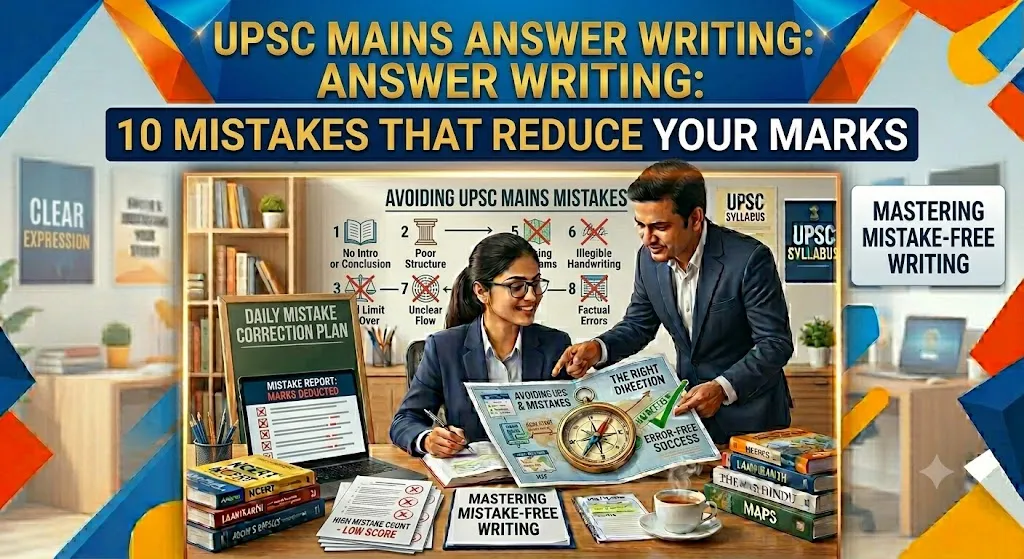

You have cleared the Prelims hurdle, the syllabus is consolidated, and your desk is piled high with standard reference books. But as you transition to the descriptive stage of the examination, a harsh reality sets in: knowing the content is only half the battle. The Union Public Service Commission (UPSC) Civil Services Main Examination is fundamentally a test of data processing, structural discipline, and communication under extreme time pressure.
Many brilliant candidates miss out on a final rank not because they lack knowledge, but because they unintentionally sabotage their answer scripts. In a competitive ecosystem where a fraction of a mark decides your service allocation, minor formatting and structural blunders accumulate into a massive score penalty across nine papers.
Let us dissect the 10 most common errors candidates make in upsc mains answer writing and explore how you can correct them to build a flawless presentation template.
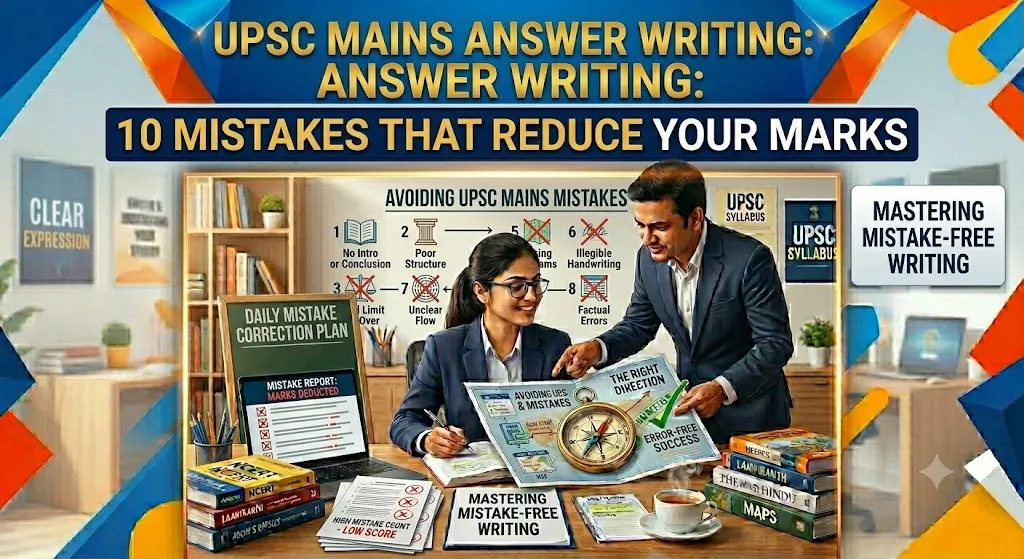
1. Misinterpreting the Command Words (Directives)
UPSC questions never just ask you to write what you know; they anchor the question with specific directives like Critically Analyze, Elucidate, Evaluate, or Discuss.
- The Mistake: Treating every directive as an invitation to write a generic essay.
- The Correction: If a prompt asks you to "Critically Analyze," your layout must present both the structural benefits and the underlying constraints. If it asks you to "Elucidate," you must use concrete examples to make an abstract concept clear.
2. Writing Winding, Generic Introductions
When an evaluator has hundreds of scripts to grade, they can spot filler text from a mile away.
- The Mistake: Starting an answer on a topic like Sedition or Artificial Intelligence with a vague, philosophical story.
- The Correction: Streamline your answer writing strategy for upsc mains by opening with a crisp, 30-word hook. Use a definitive legal or institutional definition, cite a recent national index ranking, or state a major recent policy announcement or Supreme Court judgment.
3. Ignoring the Sub-Parts of a Complex Prompt
Modern UPSC questions are rarely simple, single-statement prompts. They usually contain two or three hidden sub-questions wrapped inside a single paragraph.
- The Mistake: Getting carried away writing about the first part of the question because you know it well, while completely ignoring the final sub-section.
- The Correction: As soon as you read a question, physically underline and number the distinct sub-queries. Dedicate explicit, bold subheadings in your booklet to address each numbered part. This micro-structuring is vital for an optimal upsc mains answer writing output.
4. Relying on Dense, Unscannable Paragraphs
Evaluators check papers rapidly. If your core arguments, data points, and recommendations are buried inside long, unbroken blocks of text, you risk losing marks simply because your insights were overlooked.
- The Mistake: Writing your entire response like a traditional university essay.
- The Correction: To master how to write answers in upsc mains, you must break the body down into bullet points under clear headings. Keep your sentences short, punchy, and highly focused to respect the examiner's time.
5. Presenting Opinions Without Empirical Backing
As a future civil servant, your arguments must reflect objective, data-driven reasoning rather than emotional or politically biased opinions.
- The Mistake: Stating that a policy has "failed completely" without providing any factual evidence.
- The Correction: Back up every major assertion with facts. Ground your arguments in data from recognized sources like the Periodic Labour Force Survey (PLFS), National Family Health Survey (NFHS), Supreme Court judgments, or major committee reports. Incorporating these metrics seamlessly is a hallmark of an advanced upsc mains answer writing strategy 2026.
Insights from the Aspirant Journey
"In my first attempt, I thought upsc mains answer writing was all about showcasing how much I had read. I wrote beautiful, long paragraphs but consistently ran out of time, leaving multiple questions unattempted. Shifting to a structured, point-wise presentation layout under a strict upsc mains answer writing strategy 2026 framework helped me complete the paper comfortably and significantly improved my GS-2 and GS-3 scores."
— Riddhima Sen, Selected IAS Officer
"The hardest habit to break was ignoring the directive words. I used to write the same style of answer whether the prompt said 'Discuss' or 'Critically Evaluate'. Learning how to write answers in upsc mains by explicitly addressing the command words using opposing subheadings was a major turning point for me. A systematic answer writing strategy for upsc mains saves you from visual monotony."
— Amit Vikram, Civil Services Aspirant
6. Poor Time Budgeting Across Questions
Leaving even a single 10- or 15-mark question completely blank in the question-cum-answer booklet (QCAB) deals a massive blow to your scoring potential.
- The Mistake: Spending 15 minutes perfecting your first three answers, leaving you with less than five minutes each for the final few questions.
- The Correction: Stick to a strict internal timer. Budget approximately 7 minutes for a 10-mark (150 words) question and 11 minutes for a 15-mark (250 words) question. When the time is up, conclude your answer immediately and move on.
7. Over-Complicating Diagrams and Flowcharts
Visual aids are excellent tools to break up monotonous text, but they should save you time, not consume it.
- The Mistake: Drawing detailed, artistic illustrations or maps that take up half a page and require multiple pens.
- The Correction: Use rapid, clean micro-diagrams like hub-and-spoke models, simple process flowcharts to show cause-and-effect, or basic block diagrams to map out stakeholder relationships.
8. Providing Purely Critical, One-Sided Conclusions
UPSC is looking for pragmatic, balanced future administrators, not detached, cynical critics.
- The Mistake: Ending your answer by simply listing government failures without offering a constructive path forward.
- The Correction: Always close your upsc mains answer writing templates with a forward-looking, solution-oriented conclusion. Align your final sentences with official, progressive visions like NITI Aayog's strategy documents, Law Commission recommendations, or the United Nations Sustainable Development Goals (SDGs).
9. Neglecting the Spatial and Word Limits
Writing significantly over the word limit wastes precious time, while writing far below it suggests a lack of conceptual depth.
- The Mistake: Writing a sprawling 350-word essay for a simple 150-word question because it happens to be your favorite topic.
- The Correction: Train your eye to recognize the physical layout of the QCAB pages. Formulating a proper answer writing strategy for upsc mains means staying within the designated blank boundaries while keeping your word count within 10% of the official requirement.
10. Practicing Without a Strict Revision Loop
Many candidates write answers daily but never look back at their work or check it against high-quality reference scripts.
- The Mistake: Measuring progress solely by the number of pages written, without evaluating the quality of the content.
- The Correction: After writing a mock answer, compare your structure directly with the script layouts of recent top rankers. Analyze how they organize their introductions, highlight data points, and apply an intuitive upsc mains answer writing strategy 2026 to iteratively refine your own habits.
Formatting Comparison: The Mark Penalty vs. The High-Score Layout
To understand why presentation alters your scoring potential, look at how subtle formatting differences change the visual scannability of an answer:
| Element | The Low-Scoring Blind-Spot Template | The High-Scoring Structured Layout |
|---|---|---|
| Visual Structure | Unbroken, heavy blocks of text that hide core arguments. | Bold subheadings and numbered bullet points that stand out instantly. |
| Data Placement | Statistics and committee recommendations are buried in long sentences. | Key data points, Supreme Court rulings, and metrics are clearly underlined or boxed. |
| Directive Alignment | Addresses the broad topic generally, ignoring specific command words. | Crucial for mastering how to write answers in upsc mains by dividing arguments into balanced categories. |
| Visual Relief | Monotonous text walls spanning across multiple pages. | Incorporates well-placed, rapid micro-flowcharts to explain complex processes. |
Frequently Asked Questions (FAQs)
Should I prioritize completing the paper over perfecting a few answers?
Yes, absolutely. Completing the paper is the single most important factor in your upsc mains answer writing strategy 2026. Writing twenty average, well-structured answers will always net you a higher total score than writing twelve flawless responses and leaving the remaining eight questions completely blank.
How do I handle a question when I have absolutely no idea about the topic?
Do not leave the page completely blank, as that guarantees zero marks. Instead, carefully break down the prompt's core keywords. Apply a reliable answer writing strategy for upsc mains by analyzing the broader socio-economic, administrative, or geographical context of the topic, and organize your basic points using clear subheadings to secure vital partial credit.
Is it necessary to use a different pen for headings and diagrams?
No, switching pens during the exam wastes valuable seconds that you cannot afford to lose. Stick to a single high-quality blue or black pen for your entire paper. Use simple techniques like double-underlining or drawing neat boxes to make your headings, statistics, and micro-diagrams stand out clearly during upsc mains answer writing.
How many lines should my introduction and conclusion be?
As a general rule of thumb, your introduction and conclusion should each take up about 10% to 15% of your total answer space. For a 150-word question, keep them to around 3 to 4 lines each. For a 250-word question, you can expand them to roughly 5 to 6 lines, ensuring the vast majority of your space is reserved for a detailed, multi-dimensional body, which is a core tenet of understanding how to write answers in upsc mains.
Final Thoughts: Building a Resilient Writing System
Mastering the art of descriptive paper presentation is the result of steady, daily discipline rather than sudden bursts of inspiration. Your initial mock answers might feel slow, messy, or structurally weak, which is an entirely natural part of the learning curve.
By systematically identifying and eliminating these ten common formatting and structural errors from your routine, you replace guesswork with a calculated, high-scoring workflow. Focus on building clean presentation layouts, execute a bulletproof upsc mains answer writing strategy 2026, stick rigidly to your internal timers, and let structural precision carry your scores to the top of the list.



























Sign in to leave a comment.