
You have spent months sitting at your desk, buried under standard textbooks, editorial clippings, and monthly current affairs compilations. Your brain is a massive warehouse of facts, committees, and constitutional articles. But when you look at a blank sheet of paper with a complex GS paper question staring back at you, that warehouse can feel completely locked.
It is a uniquely frustrating feeling. You know the material, but your hand freezes.
The truth is, the Civil Services Examination does not reward the person who knows the most; it rewards the person who can package what they know into a coherent, structured, and legible argument in exactly seven minutes. Stepping into the 2026 mains cycle, the competition demands more than just rote reproduction. It requires a systematic approach to the page.
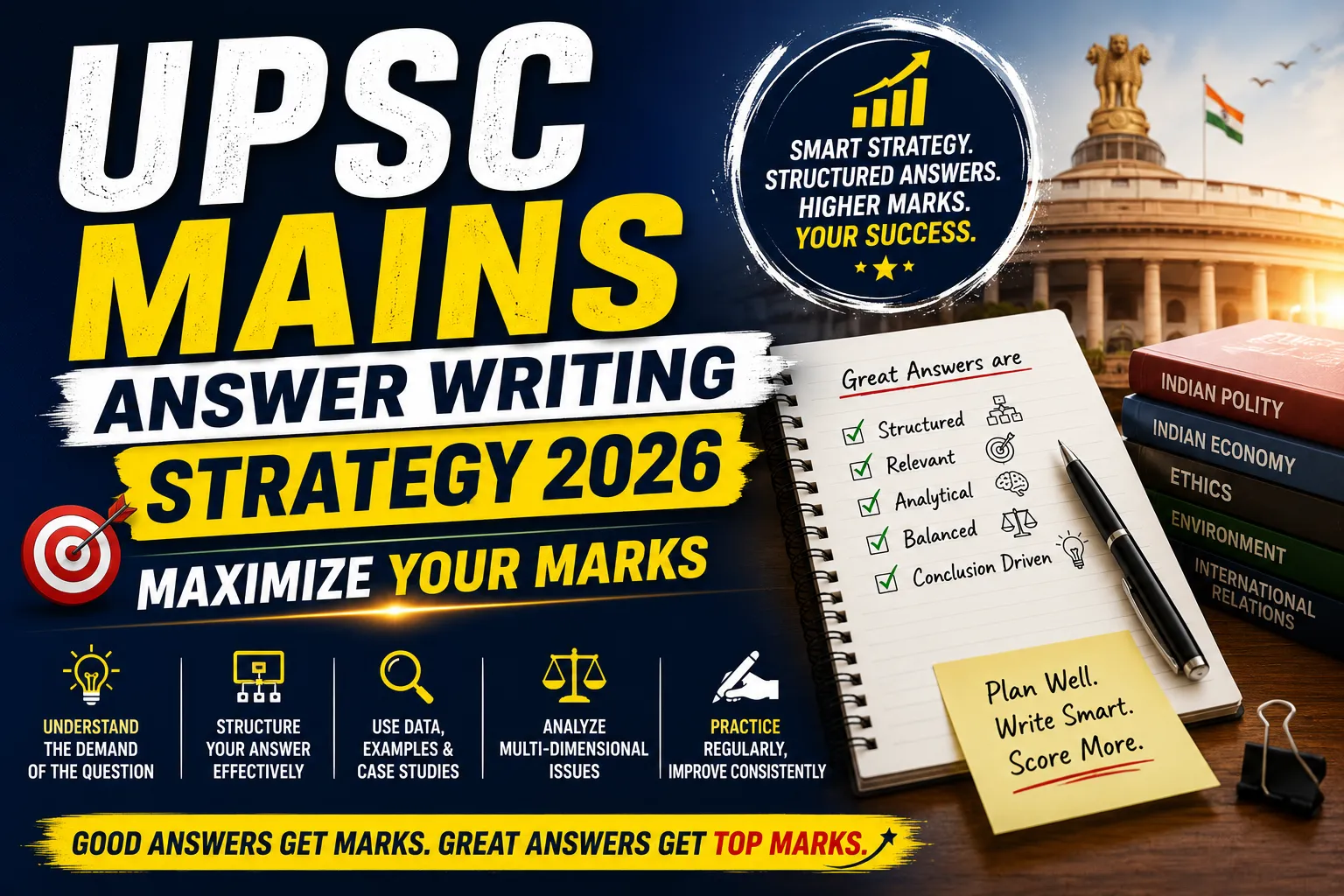
Let’s break down a practical, field-tested upsc mains answer writing strategy 2026 that moves away from vague advice and focuses on what actually catches an evaluator’s eye.
The Anatomy of a High-Scoring Answer
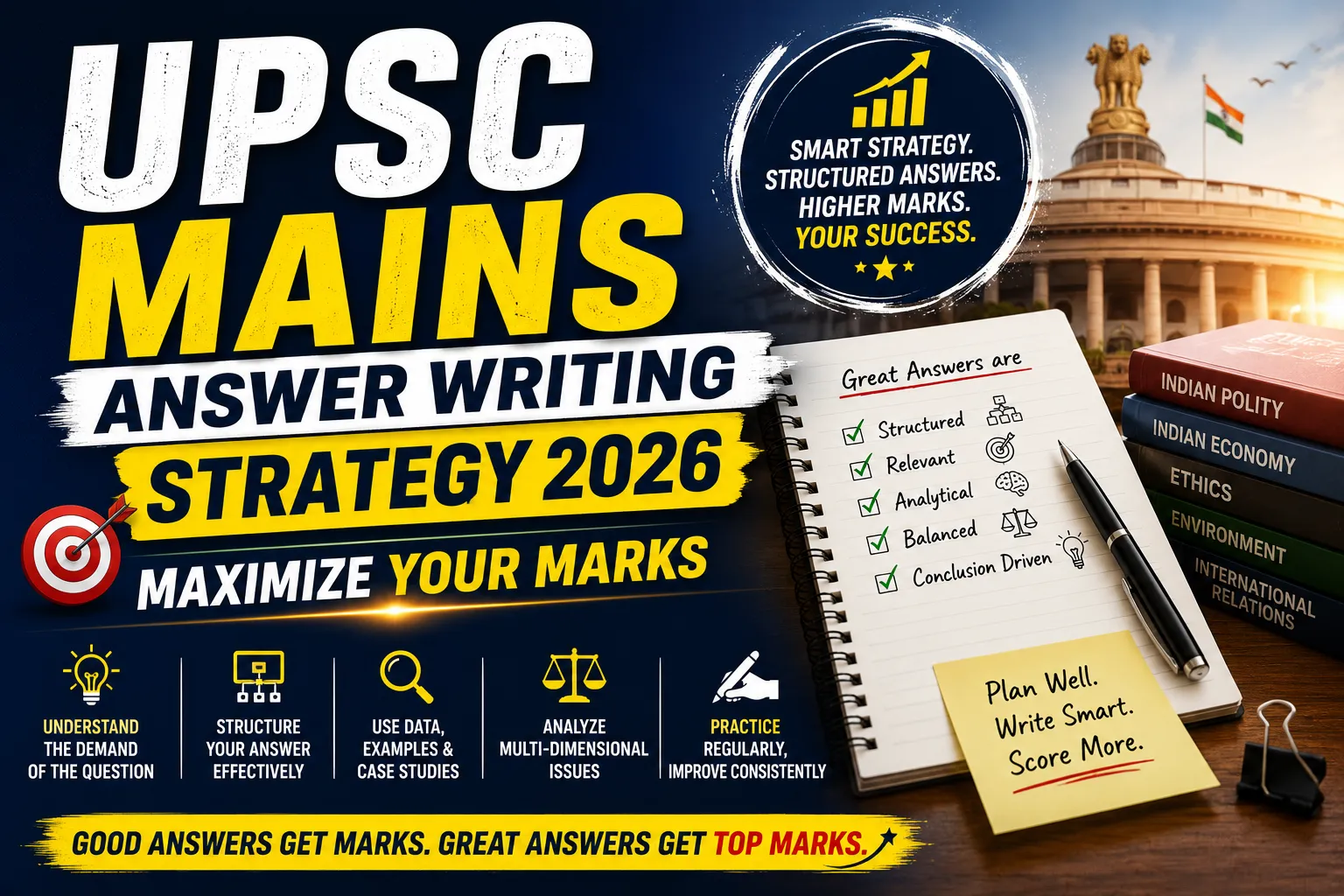
Every good answer follows a predictable architecture: Introduction, Body, and Conclusion. While that sounds elementary, the execution is where most candidates lose their footing.
1. The Introduction: Setting the Context Immediately
An evaluator spends less than a couple of minutes on your paper. If your introduction is a winding, generic definition, you have already lost their active interest.
Your introduction should do one of three things:
- Provide a Data Point or Report: If the question is on unemployment, start with recent Periodic Labour Force Survey (PLFS) data.
- Cite the Constitution: If it is a polity question, anchor it immediately with the relevant Article or Supreme Court judgment.
- Define with Context: If it is a technical topic like Generative AI, define it briefly while referencing its current socio-economic impact.
2. The Body Paragraphs: Structural Clarity Over Dense Prose
The body of your answer is where you win or lose the mark race. Do not write long, dense paragraphs. Examiners do not have the time to hunt for your brilliant insights hidden deep inside a wall of text.
Instead, break your thoughts into distinct subheadings that mirror the keywords of the question. If a question asks for the "causes and implications" of a crisis, your subheadings should explicitly be "Causes of [X Crisis]" and "Implications of [X Crisis]."
3. The Conclusion: Forward-Looking and Balanced
Never leave an answer hanging on a negative note. Even if the question asks you to critically analyze a massive systemic failure, your conclusion must offer a constructive way forward. Align your final thoughts with constitutional values, sustainable development goals (SDGs), or authoritative committee recommendations.
Step-by-Step: How to Write Answers in UPSC Mains
When you are practicing at home or sitting in a test series cabin, use this four-step mental framework before your pen even touches the paper.
Step 1: Decode the Directive Word
Before diving into your upsc mains answer writing process, look at the tail words. They change the entire trajectory of your content:
- "Discuss": Requires you to explore multiple dimensions, pros, cons, and implications.
- "Critically Analyze": Demands that you look beneath the surface, weigh the merits against the flaws, and give a balanced judgment supported by evidence.
- "Evaluate": Asks you to pass a verdict on how successful a policy or concept has been based on actual outcomes.
Step 2: The 360-Degree Brainstorm (PESTLE Framework)
To ensure your answer writing strategy for upsc mains remains holistic, use the PESTLE shortcut during your 30-second brainstorming window. Try to look at the issue through these lenses:
[P]olitical → Governance, federalism, policy gaps [E]conomic → Fiscal cost, growth, resource allocation [S]ocio-cultural → Impact on vulnerable groups, gender, community [T]echnological → Digital divide, automation, efficiency [L]egal → Acts, judgements, constitutional provisions [E]nvironmental → Sustainability, climate resilience
Step 3: Draft with Visual Anchors
Whenever you can, convert a long explanation into a simple schematic diagram, a hub-and-spoke model, or a small map. If you are discussing an infrastructure corridor, a quick, ten-second hand-drawn map of India showing that corridor adds immense visual value and breaks the monotony for the examiner.
Real-World Application: Deconstructing a GS Paper II Question
Let’s look at a practical example to understand how to write answers in upsc mains without getting bogged down in academic jargon.
Question: “The local self-government system in India has significantly empowered rural communities, yet it remains hampered by functional and financial infirmities.” Critically analyze.
Here is how you structure this effectively on your answer sheet:
The Blueprint
- Introduction (30–40 words): Mention the 73rd Constitutional Amendment Act. Note that while it institutionalized grassroots democracy, the journey toward complete devolution of the 3 Fs (Functions, Funds, and Functionaries) remains incomplete.
- Subheading 1: Successes in Empowerment: Use bullet points here. Mention increased political participation of women due to reservations, localized grievance redressal, and targeted asset creation via MGNREGA.
- Subheading 2: Functional and Financial Infirmities: Highlight issues like the irregular state finance commission setups, excessive dependence on untied grants, and the phenomenon of 'Sarpanch Patis' (where husbands exercise real power behind elected women).
- Conclusion (30 words): Suggest a way forward by citing the recommendations of the 2nd Administrative Reforms Commission (ARC) on strengthening local finances to transition from mere administrative organs to true institutions of self-government.
Common Pitfalls in UPSC Mains Answer Writing
Even highly knowledgeable candidates stumble because they treat the exam like a university essay. Avoid these common mistakes:
- The Information Dump: Writing everything you know about a topic rather than what the question specifically asked. If the question asks about the impact of climate change on agriculture, do not spend two pages explaining the science of global warming.
- Ignoring the Word and Time Limit: Spending twelve minutes writing a flawless answer for a 10-mark question means you will run out of time for a 15-mark question later. Consistency across all 20 questions beats having three brilliant answers and three blank pages.
- Overcomplicating the Language: You do not get extra points for using obscure vocabulary. Clear, crisp, and grammatically correct English that communicates an idea instantly is far more effective.
Perspectives from the Desk: What Candidates Learn the Hard Way
"During my first attempt, I thought my upsc mains answer writing needed to look like an academic research paper. I wrote long paragraphs and used complex terminology. I couldn't finish the GS 3 paper on time and missed the interview call. In my next attempt, I shifted completely to clean subheadings, bullet points, and data-backed intros. The difference in my scores was stark."
— Ananya R., Cleared the Exam in 2024
"The biggest shift in my answer writing strategy for upsc mains happened when I stopped reading new material and started writing two answers every single day under a strict timer. You realize very quickly that under pressure, you only remember 40% of what you read. That 40% needs to be presented beautifully."
— Siddharth K., Selected in the 2025 Cycle
Frequently Asked Questions
1. When should I start my upsc mains answer writing practice?
You should ideally begin writing answers once you have completed at least 50% of your foundational syllabus and have a basic grasp of current affairs. Writing answers without a base level of core knowledge can lead to frustration and poor structural habits.
2. Is it mandatory to write all answers in bullet points?
No, it is not mandatory, but it is highly recommended for GS papers. Bullet points make your arguments distinct and highly scannable. However, for the Essay paper and certain humanities options, a well-structured paragraph format remains the norm.
3. How many data points and committee names should I include per answer?
Do not overdo it. One or two relevant data points, a Supreme Court case law, or a committee recommendation per answer is more than enough to ground your arguments in fact. The quality and relevance of the data matter far more than the quantity.
4. What should I do if I know absolutely nothing about a question?
If you are completely blank on a question, it is safer to leave it than to write entirely irrelevant filler material. However, if you understand the core theme but lack specific data, write a generalized structural answer based on macro concepts. You might pick up a valuable 1 or 2 marks instead of a flat zero.
5. How do I improve my writing speed for the GS papers?
Speed is a byproduct of clarity of thought. When you struggle to remember points, your pen stops. To improve your speed, focus on active revision through concise micro-notes. Once your mental recall becomes faster, your physical writing speed will naturally catch up.
Conclusion
At its core, a successful upsc mains answer writing strategy 2026 is about empathy for the person checking your paper. The evaluator has a towering stack of answer scripts to evaluate through a meticulous lens. By presenting your arguments with clear headers, logical data anchors, and clean formatting, you make their job easier. When you make their job effortless, they reward you with those crucial extra half-marks across questions—and those half-marks are exactly what bridge the gap between the consolidated reserve list and your top service preference.



























Sign in to leave a comment.