
You know that exact moment during your preparation when the sheer weight of the syllabus hits you? You’ve read the standard textbooks three times over, your room is cluttered with sticky notes, and you can explain the core philosophy of the Indian Constitution in your sleep. But then, you sit down with a blank sheet of paper, look at a previous year's question, and your mind goes completely blank.
Knowing the facts is one thing. Translating that massive web of knowledge into a coherent, sharp, 150-word response in under seven minutes is a completely different beast.
If you are struggling with how to write answers in upsc mains, you are not alone. The transition from passive reading to active writing is arguably the hardest part of this journey. The good news is that high-scoring answers aren't written by geniuses who know absolutely everything; they are crafted by candidates who understand structure, presentation, and examiner psychology.
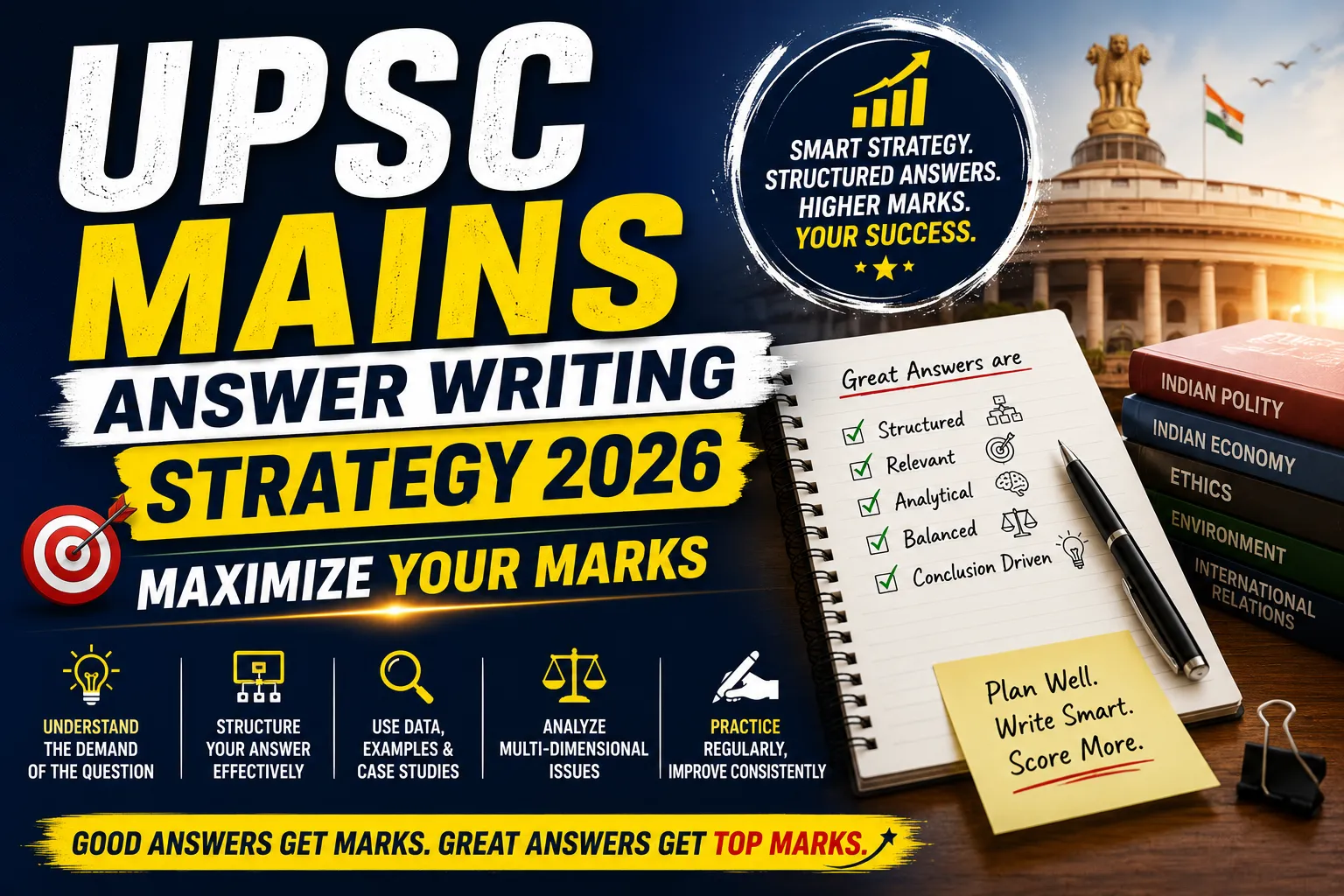
Let's break down a practical, field-tested upsc mains answer writing strategy that moves away from generic advice and focuses on what actually ticks the boxes on the evaluator's desk.
The Core Reality of UPSC Mains Evaluation
Before putting pen to paper, it helps to look at the process through the eyes of the person checking your copy. An evaluator is reviewing dozens of booklets a day. They are exhausted, pressed for time, and looking at pages of dense, unbroken paragraphs.
If your layout forces them to hunt for the actual answer, you have already lost half a mark. Multiply that by twenty questions across four papers, and that is the difference between making the interview list and missing the cutoff entirely.
Your goal is to make their job as easy as possible. A professional structure doesn't just display your knowledge; it respects the evaluator's time.
Decoding the Anatomy of a High-Scoring Answer
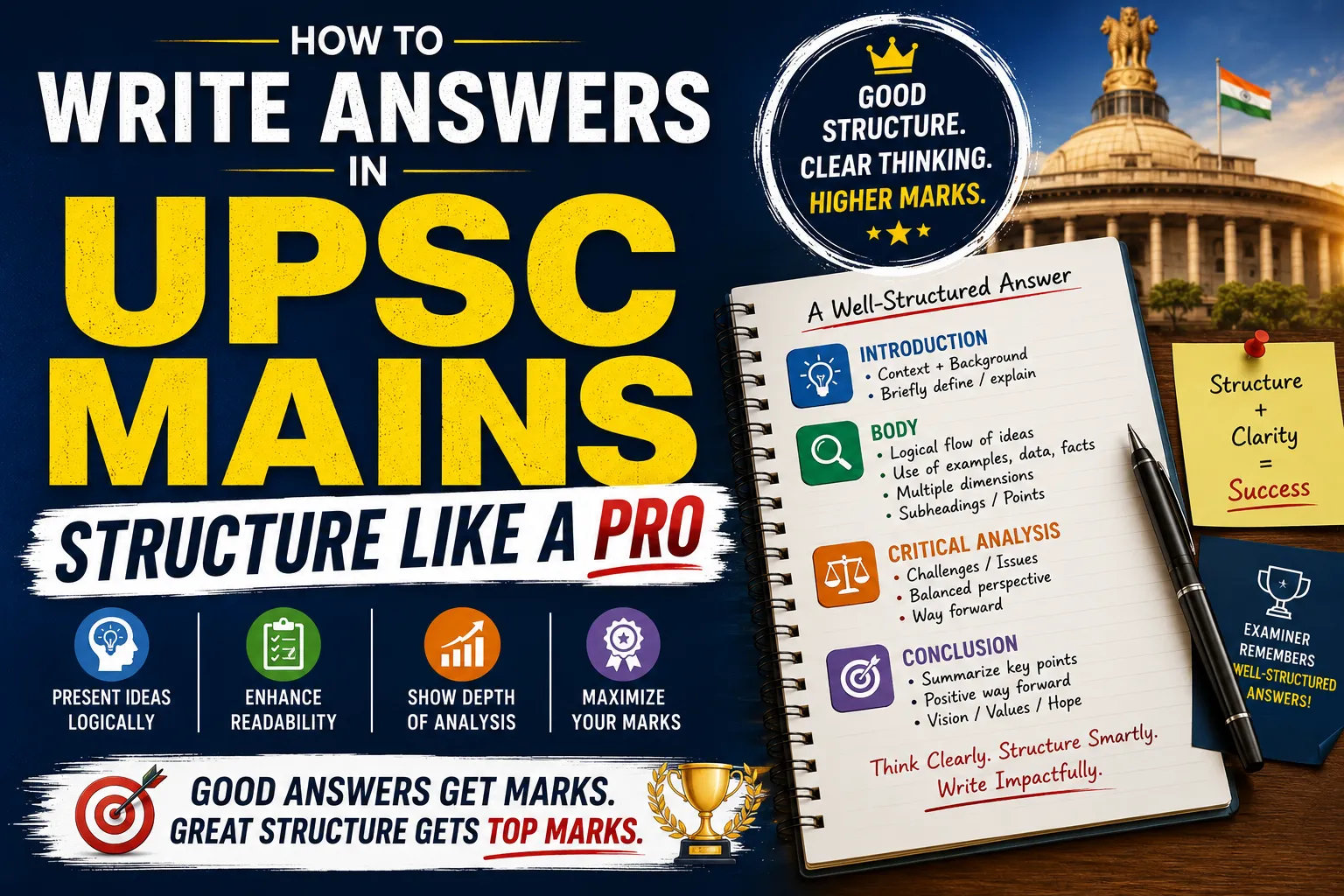
Every solid response in the civil services exam relies on a classic three-part architecture: Introduction, Body, and Conclusion. While this sounds basic, the execution is where most candidates falter. Here is how to approach upsc mains answer writing like a seasoned professional.
1. The Introduction: Breaking the Ice Instantly
Your introduction should never be a vague preamble. It needs to tell the examiner that you have understood the exact context of the question within the first two lines.
- The Data/Fact Approach: If the question is about unemployment or poverty, start with a recent report, NITI Aayog index, or periodic labour force survey statistic.
- The Structural Approach: For Polity questions, directly reference the relevant Articles of the Constitution or a landmark Supreme Court judgment.
- The Definitive Approach: If the question introduces a complex or technical term (like 'Generative AI' or 'Green Hydrogen'), provide a crisp, textbook definition.
Keep it limited to 10% of your total word limit. If it’s a 10-marker question, your introduction shouldn't stretch past 20 to 25 words.
2. The Body: The Core Engine of Your Response
This is where you earn your bread and butter. The absolute golden rule here is to address every single sub-part of the question explicitly. Often, UPSC asks multi-layered questions (e.g., "Discuss the causes of land degradation in India. What are its socio-economic impacts? Suggest remedial measures.").
To master the answer writing strategy for upsc mains, use the question's own keywords as your sub-headings. This ensures you don't accidentally skip a section under exam pressure, and it tells the examiner exactly where to look for the points they are evaluating.
- Points over Paragraphs: Use bullet points for arguments. They are easier to read, quicker to write, and look incredibly neat.
- The Multi-Dimensional Paradigm: Don't just look at a problem through one lens. Try to cover political, economic, social, environmental, legal, and historical dimensions (the PESTLE framework).
3. The Conclusion: A Forward-Looking Finish
Never leave an answer hanging, and never repeat what you already wrote in the body. A UPSC conclusion needs to be progressive, optimistic, and solution-oriented.
Align your final thoughts with constitutional ideals, government visions (like Sabka Saath, Sabka Vikas), Sustainable Development Goals (SDGs), or major committee recommendations. It should sound like it was written by an administrative officer, not a cynical critic.
Micro-Formatting: The Secret to High Visibility
When you look at the answer sheets of previous toppers, you will notice distinct formatting habits. They treat their answer space like prime real estate.
Use Lean Diagrams and Micro-Maps
Do not draw elaborate artistic masterpieces. You do not have the time. Instead, learn to draw a rough map of India in under 15 seconds to show geographic features, industrial corridors, or geopolitical border issues. Use simple hub-and-spoke diagrams to list out features or causes quickly.
Master the Art of Direct Underlining
When you write a key term, an economic figure, or a committee name (like the Sarkaria Commission or K.S. Puttaswamy judgment), underline it cleanly. This guides the examiner's eyes directly to your value-addition points, ensuring they don't get lost in your handwriting.
Common Structural Mistakes That Cost Marks
Even with great content, certain structural flaws can quietly tank your scores. Keep an eye out for these subtle traps during your daily practice:
- Answering what you know, not what is asked: If a question asks you to critically evaluate a scheme, do not just list its benefits for two pages. Balance it with structural bottlenecks and implementation challenges.
- Ignoring directive words: Words like Discuss, Analyze, Elucidate, and Examine have distinct meanings. "Elucidate" means you need to make something clear with examples, while "Examine" requires you to look closely at the hidden assumptions or facts of an issue.
- The Paragraph Wall: Writing a 250-word answer in three massive chunks of text. It creates visual fatigue instantly. Break it down using micro-headings and numbering.
What Peer Experience Looks Like
Hearing how other aspirants navigate the blank-page syndrome can help ground your own practice. Here are two distinct experiences from candidates refining their approach for the upsc mains answer writing strategy 2026 cycle:
"During my first attempt, I treated Mains like a university exam. I wrote long, beautiful paragraphs with rich vocabulary. I couldn't even finish 15 questions in GS-3 because I ran out of time, and my scores reflected that. This year, I switched completely to sub-headings, brief bullet points, and boxed data. My speed shot up drastically, and I can actually finish the papers now."
— Ananya R., New Delhi
"The biggest breakthrough for me was learning to use the question's own words as my headers. I used to waste precious seconds thinking about catchy headings. Now, if the question says 'examine the challenges,' my heading is literally 'Challenges Involved.' It keeps me on track and keeps the structure incredibly tight."
— Siddharth K., Bengaluru
Frequently Asked Questions (FAQs)
1. When should I ideally start my upsc mains answer writing practice?
You should start writing answers once you have a decent grasp of the basic static syllabus (at least 50-60%). Attempting answers without a foundational knowledge base can lead to frustration and poor structural habits. Begin with previous year questions (PYQs) to understand the standard of the exam.
2. Is it mandatory to use points, or can I write in paragraphs?
While it isn't legally mandatory, using a bulleted or numbered point format is highly recommended for General Studies papers. It improves readability, allows you to showcase diverse points in a limited space, and helps you maintain a clear layout under strict time limits. For the Essay paper, however, stick to a structured paragraph format.
3. How do I improve my speed to finish the paper in three hours?
Speed is a byproduct of structural muscle memory and mental clarity. When you know exactly how to structure your introduction, body, and conclusion, you spend less time thinking about how to write and more time on what to write. Practice with strict timer-based sectional tests before jumping into full-length mocks.
4. How important are diagrams, flowcharts, and maps in the exam?
They are highly effective tools for saving time and breaking up visual monotony. A simple flowchart can explain a supply chain or a legislative process far quicker than a paragraph of text. Use them where they add genuine value, rather than just forcing them into every answer as a decorative element.
5. How should I approach current affairs integration in my answers?
Current affairs should act as the anchor or the validation for your static points. Use recent news items, bills, international summits, or statistical reports to introduce your answer or to back up an argument in the body. It shows the evaluator that your knowledge is updated and practical.
Conclusion
At the end of the day, an exceptional Mains answer is simply a combination of accurate content and clean packaging. You don't need a flawless literary style; you need a system that delivers clarity under intense pressure. As you build your routine, treat every blank page not as a test of your memory, but as an exercise in clear communication. Focus on breaking down the prompt, keeping your layouts scannable, and directly addressing the core conflict of the question. Consistency in daily practice will gradually turn this structured framework into second nature.




























Sign in to leave a comment.