
The shift from UPSC Prelims to Mains is often a jarring reality check. One day you are filtering out incorrect options in a multiple-choice matrix; the next, you are staring at a blank sheet of paper, expected to synthesize structural unemployment, the crisis of local self-governance, and the ethical dilemmas of artificial intelligence into a cohesive 250-word argument.
The sheer volume of the General Studies syllabus is enough to trigger analysis paralysis. You collect textbooks, bookmark countless editorials, and download every monthly current affairs compilation you can find. Yet, when you sit down to write an answer, your mind goes blank. The problem is not a lack of information; it is the absence of information architecture. Without structured, exam-oriented upsc mains gs notes, you are essentially walking into the exam room with raw data but no real capacity to assemble it under tight time constraints.
Why Standard Textbooks Fail the Mains Test
Many aspirants spend months reading thick reference books cover-to-cover, believing that repetition equals preparation. While textbooks provide a solid foundational understanding for Prelims, they are rarely organized around the specific demands of the Mains exam.
A standard textbook chapter explains a concept chronologically or descriptively. However, a Mains question demands an analytical dissection. You need to present the core issue, current data, structural bottlenecks, forward-looking solutions, and relevant administrative committees within seven to ten minutes.
Relying solely on external compilations or a generic upsc mains notes pdf downloaded from a random channel often backfires. These documents are frequently data-heavy but analytical-light. They give you the facts, but they do not teach you how to think. Effective upsc mains notes act as a cognitive bridge, converting passive knowledge into functional, active arguments that you can deploy instantly under pressure.
The Anatomy of High-Yield UPSC Mains GS Notes
High-yield note-making is a process of extreme reduction. Your goal is not to rewrite the textbook in your own handwriting, but to create a highly condensed repository of components that make an answer stand out to an examiner.
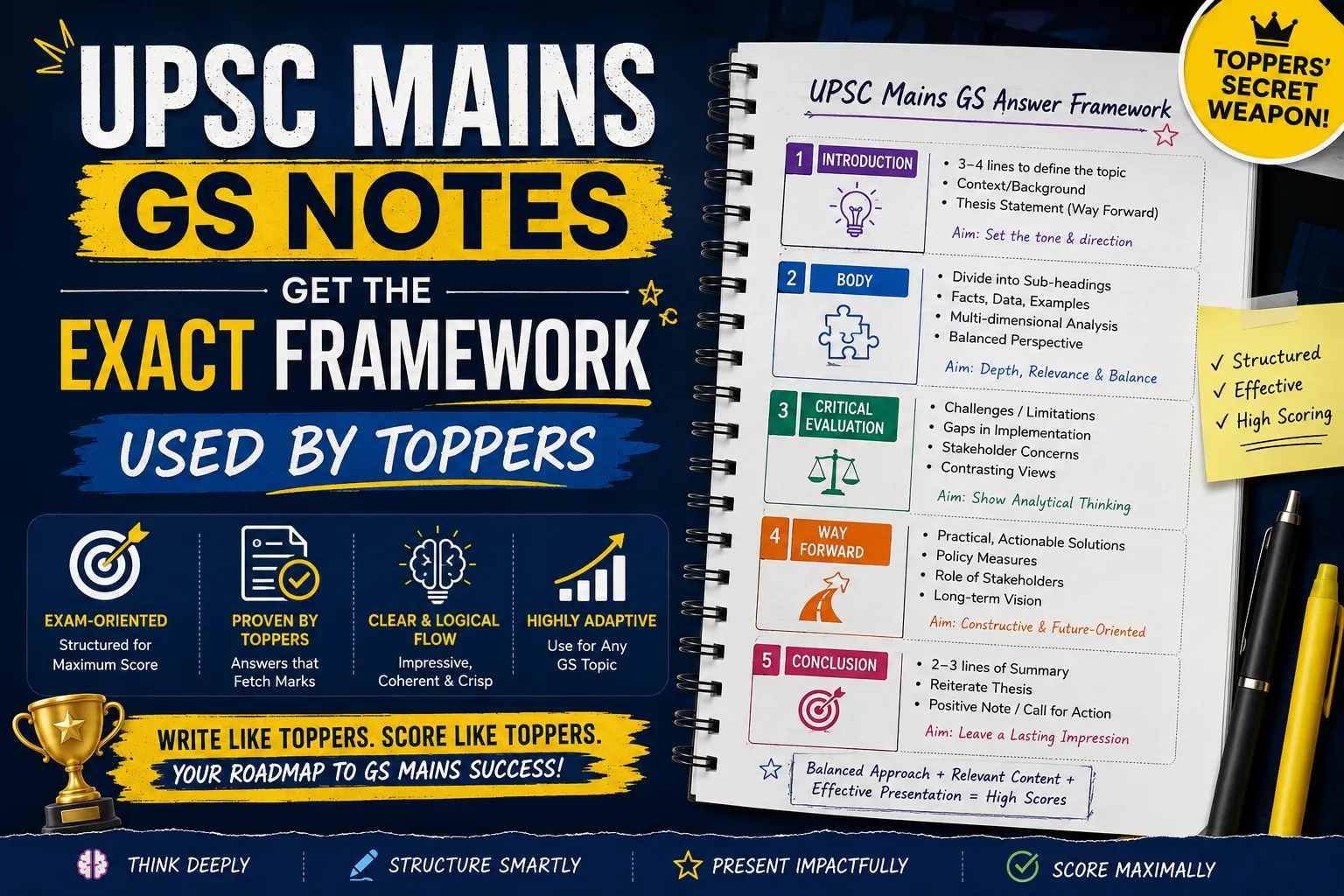
When analyzing the upsc mains study material you collect, filter every piece of information through a four-part framework:
1. The Context and Definitional Clarity
Every topic under the GS syllabus whether it is 'Investment Models' in GS 3 or 'Pressure Groups' in GS 2 needs a precise, institutional definition. Do not write vague, conversational introductions. Your notes should include definitions sourced from the Constitution, Supreme Court judgments, or international bodies like the UN or World Bank.
2. Hard Data, Core Statistics, and Case Studies
An argument without data is just an opinion. If you are writing about agrarian distress, your notes must have the exact percentage of small and marginal farmers according to the Agriculture Census, alongside the latest NITI Aayog recommendations. Collect small, memorable case studies—such as a specific district's successful water conservation model—to add a layer of practical realism to your answers.
3. Structural Bottlenecks and Arguments (The Why)
Mains questions frequently ask you to critically evaluate or analyze an issue. Your upsc mains gs notes should map out the structural, financial, and administrative challenges of a given topic using clear bullet points. Avoid long, winding paragraphs. Use clean, analytical headers like "Institutional Deficiencies," "Fiscal Asymmetry," or "Societal Resistance."
4. The Way Forward and Committee Reports
Never leave an answer on a negative note. Examiners look for bureaucratic problem-solving capabilities. Your notes should conclude each topic with actionable solutions backed by bodies like the Second Administrative Reforms Commission (2nd ARC), Law Commission reports, or Parliamentary Standing Committees.
Step-by-Step: How to Build Your GS Notes Archive
Creating a functional system requires a balance between digital flexibility and static clarity. The syllabus is highly dynamic, meaning your notes must be capable of evolving without becoming disorganized clutter.
Step 1: Deconstruct the Syllabus Line by Line
The official UPSC syllabus is your blueprint. Create a dedicated document or digital notebook page for every single sub-topic mentioned in the syllabus. If GS 2 lists "Statutory, regulatory and various quasi-judicial bodies," you should have a distinct section for bodies like the NGT, CCI, and NHRC.
Step 2: Prioritize Issue-Based Over News-Based Tracking
A common trap is making notes on every daily news development. If an issue like federal friction over fiscal transfers dominates the news for three months, you do not need three months of daily notes. You need one comprehensive page on "Fiscal Federalism" that captures the underlying constitutional provisions, the current points of friction, the Finance Commission's stance, and a balanced solution.
Step 3: Condense into Micro-Notes for Revision
Your initial draft of notes will inevitably be long. A month before the exam, these need to undergo a second distillation. Convert your comprehensive pages into micro-notes or single-page cheat sheets. If a topic cannot fit onto one side of an A4 sheet using keywords, diagrams, and short phrases, it remains too bulky to revise in the short window between papers.
Common Mistakes in Managing UPSC Mains Study Material
To ensure your preparation remains streamlined, it is crucial to recognize the structural traps outlined in image_c07ae5.png. Replacing these counterproductive habits with intentional habits makes a significant difference in your final retention:
- Digital Hoarding vs. Selective Curation: Instead of downloading every generic upsc mains notes pdf available online, stick to one primary core source per syllabus topic and supplement it with necessary data updates.
- Passive Copying vs. Active Processing: Highlighting text or copying long sentences verbatim from daily newspapers yields little retention. Instead, practice active processing by writing down the core essence of an editorial using your own analytical keywords.
- Ignoring GS Paper 4 (Ethics) vs. Framework Building: Many candidates focus solely on data-heavy core subjects like economy or polity, neglecting the Ethics paper. Avoid this by treating Ethics like GS 1–3; establish a framework by defining key moral values and maintaining a catalog of real-world examples.
Experiences from the Trenches: Aspirant Perspectives
Anoop K., Cleared CSE 2025 (Rank 214):
"During my first two attempts, my room was flooded with every possible piece of upsc mains study material I could buy. I spent all my time reading and zero time consolidating. In my third attempt, I stopped buying new materials and focused strictly on making single-page micro-notes for every single micro-topic in the syllabus. Being able to visualize my own upsc mains notes during the actual exam hours made all the difference in completing the papers on time."
Priyanka M., Selected for State Services, Preparing for Mains 2027:
"I used to think that downloading a comprehensive upsc mains notes pdf from a top coaching institute was enough. But when I tried writing answers, I realized I couldn't recall their phrasing. The turning point came when I started forcing myself to write three bullet points of challenges and two committee recommendations for every major issue in my own digital notebook. Making your own upsc mains gs notes forces your brain to process the material, rather than just look at it."
Frequently Asked Questions
1. Should I make digital notes or handwritten notes for UPSC Mains?
Both mediums work, but digital tools like Evernote, OneNote, or Notion offer a distinct advantage for Mains preparation: searchability and ease of updating. Since current affairs must be integrated directly into your static core topics, digital notes allow you to add new data points, Supreme Court rulings, or committee recommendations without ruining your layout or running out of physical margin space.
2. When is the ideal time to start making upsc mains notes?
The foundation should be laid during your integrated Prelims-cum-Mains preparation phase. However, the intensive consolidation of your upsc mains gs notes should happen in the months leading up to Prelims, leaving the post-Prelims window entirely for answer writing practice, simulation tests, and high-intensity revision of your pre-made sheets.
3. How do I integrate daily editorials into my static upsc mains study material?
Do not create a separate folder for daily editorial summaries. Instead, treat editorials as source material to enhance your existing syllabus-wise topics. If you read an editorial analyzing a new labor law reform, extract the core critique or the specific statistic mentioned, and paste it directly into your GS 3 "Employment/Labor Reforms" file.
4. Can I rely entirely on a commercial upsc mains notes pdf downloaded online?
While high-quality commercial compilations are excellent for covering gaps in your content or checking how an expert structures information, they should not replace your personal processing. Use them as raw input material. Your final revision tool should always be your own compressed version, adapted to your specific writing style and memory triggers.
5. How long or detailed should my notes for a single topic be?
A good rule of thumb is that a single topic from the syllabus should not occupy more than two to three pages in its detailed form, and should be reducible to a single A4 page or digital card for final revision. If your notes on "Food Processing Industries" are thirty pages long, you have simply written a short book, not exam-oriented notes.
Conclusion
Cracking the General Studies papers is less about possessing an encyclopedic memory and more about executing structured thought under intense time constraints. The quality of your performance on exam day depends heavily on how effectively you have managed, refined, and organized your upsc mains study material over months of preparation.
By taking control of your content, avoiding the temptation of digital hoarding, and building crisp, analytical upsc mains gs notes, you transform the vast, intimidating syllabus into a predictable, manageable set of themes. Treat note-making not as an administrative chore, but as the first step of actual answer writing—the process where you decide exactly how you want to present your knowledge to the examiner.




























Sign in to leave a comment.