

Every year, lakhs of candidates download thousands of pages of a generic upsc mains notes pdf or stack their shelves with readymade upsc mains study material. Yet, when the actual mains exam comes, they struggle to clear the cutoff. Why? Because there is a massive gulf between reading an issue and structuring an answer under pressure.
Toppers don't succeed because they memorize more books than you. They succeed because they process information differently. They build a highly functional, execution-oriented repository of upsc mains notes.
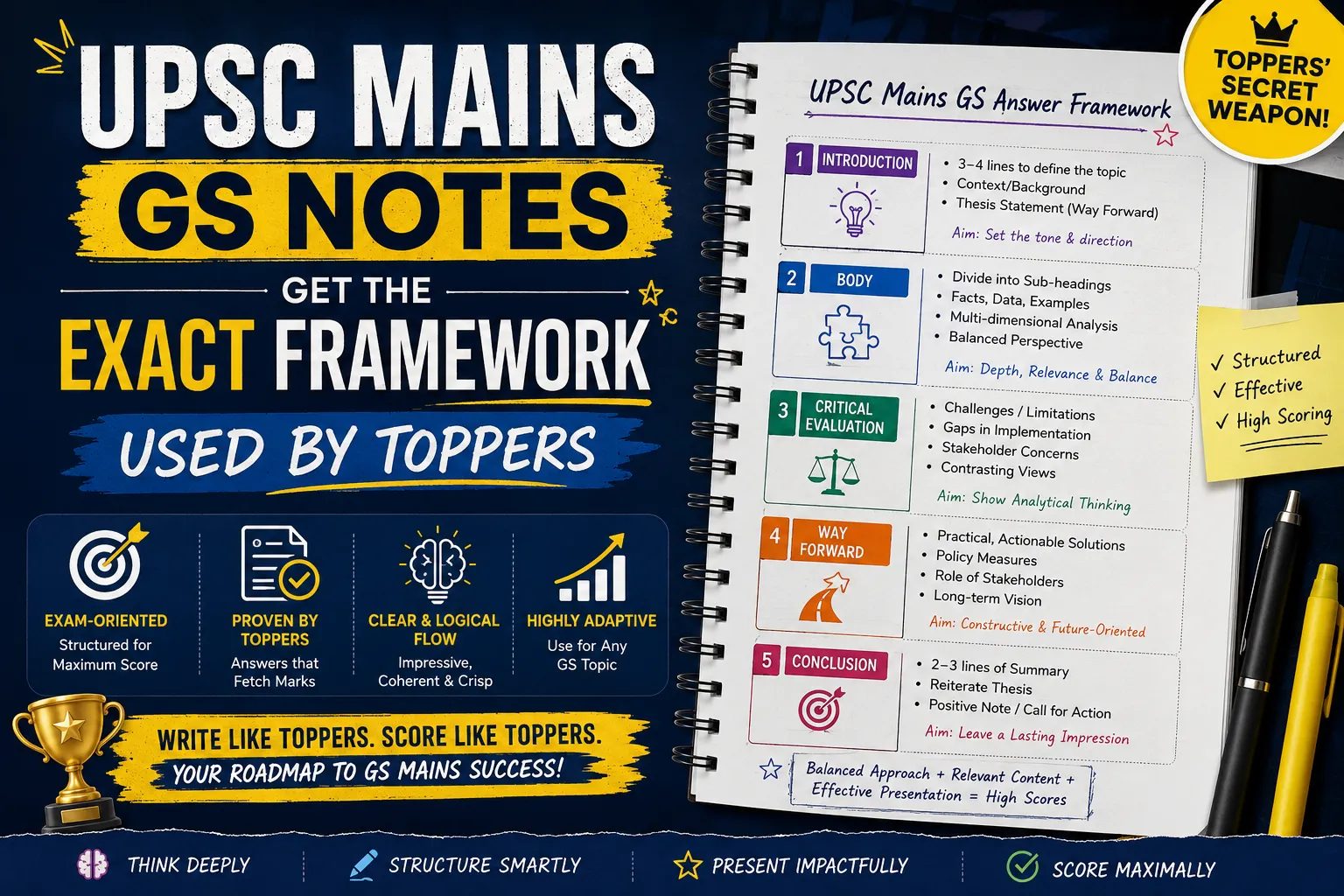
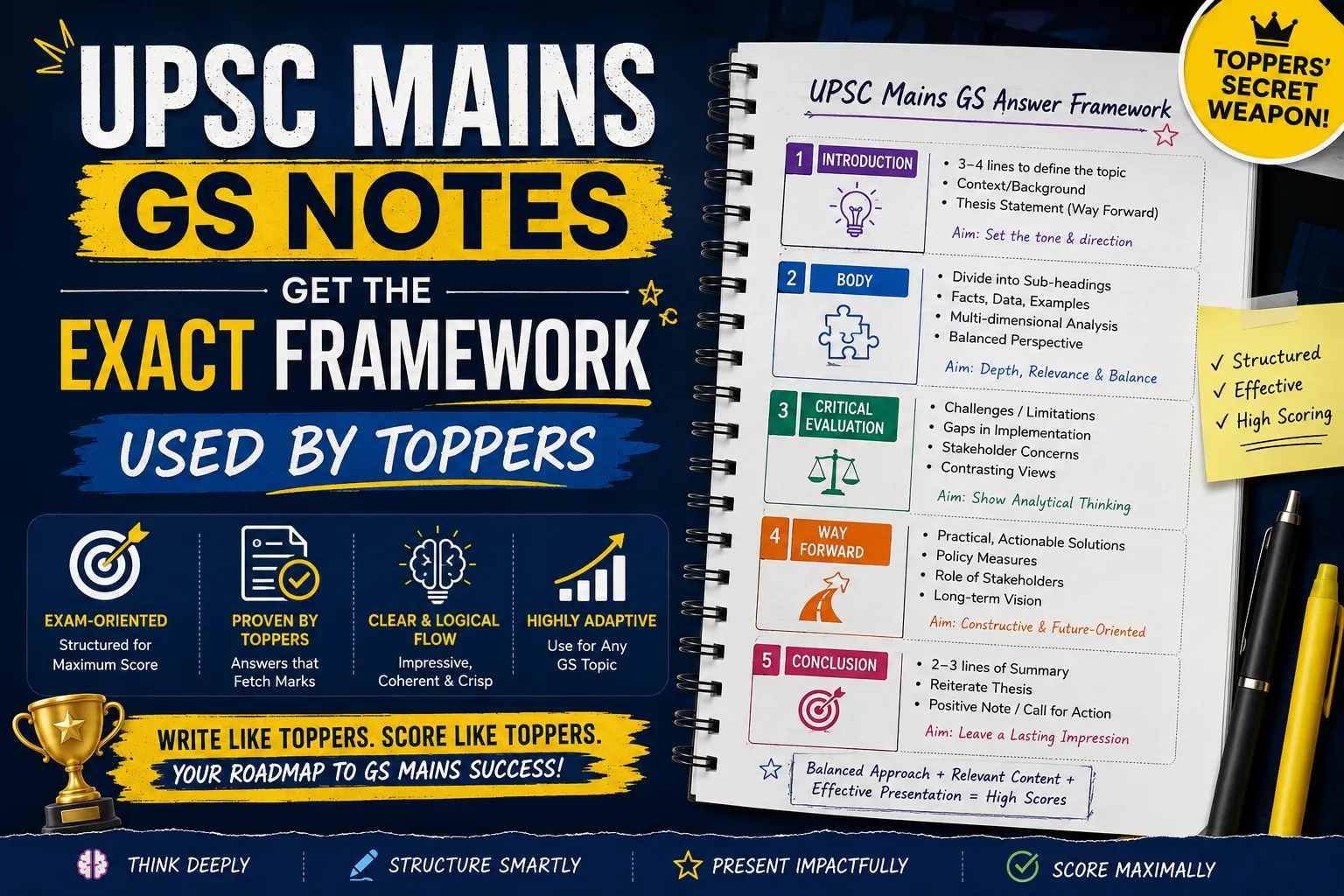
Here is the exact framework to stop consuming mindlessly and start building notes that actually convert into marks.
Why Readymade Study Material Fails the Exam Hall Test
Before looking at how to make notes, we need to address the elephant in the room: the endless scroll of coaching institute channels. It is incredibly tempting to download a beautifully formatted, free upsc mains notes pdf and call it a day. It feels like a shortcut, an efficiency hack.
But here is what happens in the examination hall on a Sunday afternoon when you are writing your third GS paper of the weekend:
- The Memory Recall Block: Your brain does not easily recall a bullet point written by a content developer sitting in a coaching hub. It recalls the mental connections you made when you synthesized the information yourself.
- The Lack of Unique Perspective: If ten thousand aspirants are memorizing the exact same bullet points from the same downloadable upsc mains study material, ten thousand answers will look identical. Evaluators read hundreds of copies a day. Sameness breeds mediocrity in marks.
- The Missing Linkage: The current pattern of the exam demands that you link static static core concepts with dynamic current affairs. Readymade material is almost always siloed. It gives you the history or it gives you the news, but it rarely gives you the bridge between them.
The Topper's Framework: The 3-Leaf Approach to GS Notes
If you look at the notebooks of candidates who consistently score high marks in General Studies, you will notice their upsc mains gs notes do not look like textbooks. They look like architectural blueprints for answers.
To make your preparation bulletproof, every single topic listed in the official syllabus should be condensed into a single, highly structured page based on three core pillars.
1. The Static Core (The "What" and "Why")
This is the foundational layer. For any syllabus topic say, Urbanization or Pressure Groups—your notes must establish the non-negotiable facts immediately.
- Definition: A precise, crisp definition (preferably quoted from an official body like the UN, World Bank, or a Supreme Court judgment).
- Historical/Constitutional Context: Which article, amendment, or historical milestone governs this?
- The Structural Issues: What are the 3 to 4 fundamental challenges plaguing this sector for decades?
2. The Dynamic Layer (The "What is Happening Now")
This is where you integrate your daily newspaper reading into your static syllabus framework. Instead of maintaining a separate diary for current affairs, insert these directly under the static topic:
- Recent Data/Indices: Do not just write "unemployment is high." Write "Unemployment stands at X% as per the latest PLFS report."
- Committees and Commissions: Recommendations from the Law Commission, NITI Aayog reports, or Administrative Reforms Commission (ARC).
- Case Studies: A specific district magistrate’s initiative or a successful state-level model that proves a point.
3. The Blueprint for the Answer (The Forward Path)
Mains questions almost always end with "Critically Analyze" or "Suggest Measures." Your notes must have pre-baked conclusions and way-forward points so you do not waste precious seconds thinking on your feet in the exam hall.
- Arguments For/Against: Clear, balanced binary perspectives.
- The Way Forward: Structural, actionable solutions rather than vague, idealistic statements.
Step-by-Step: How to Structure a Syllabus Topic
Let’s turn this abstract theory into a concrete example. Suppose you are preparing notes for General Studies Paper II on the topic of Alternative Dispute Resolution (ADR).
Instead of writing five pages of prose, your upsc mains notes should look exactly like this:
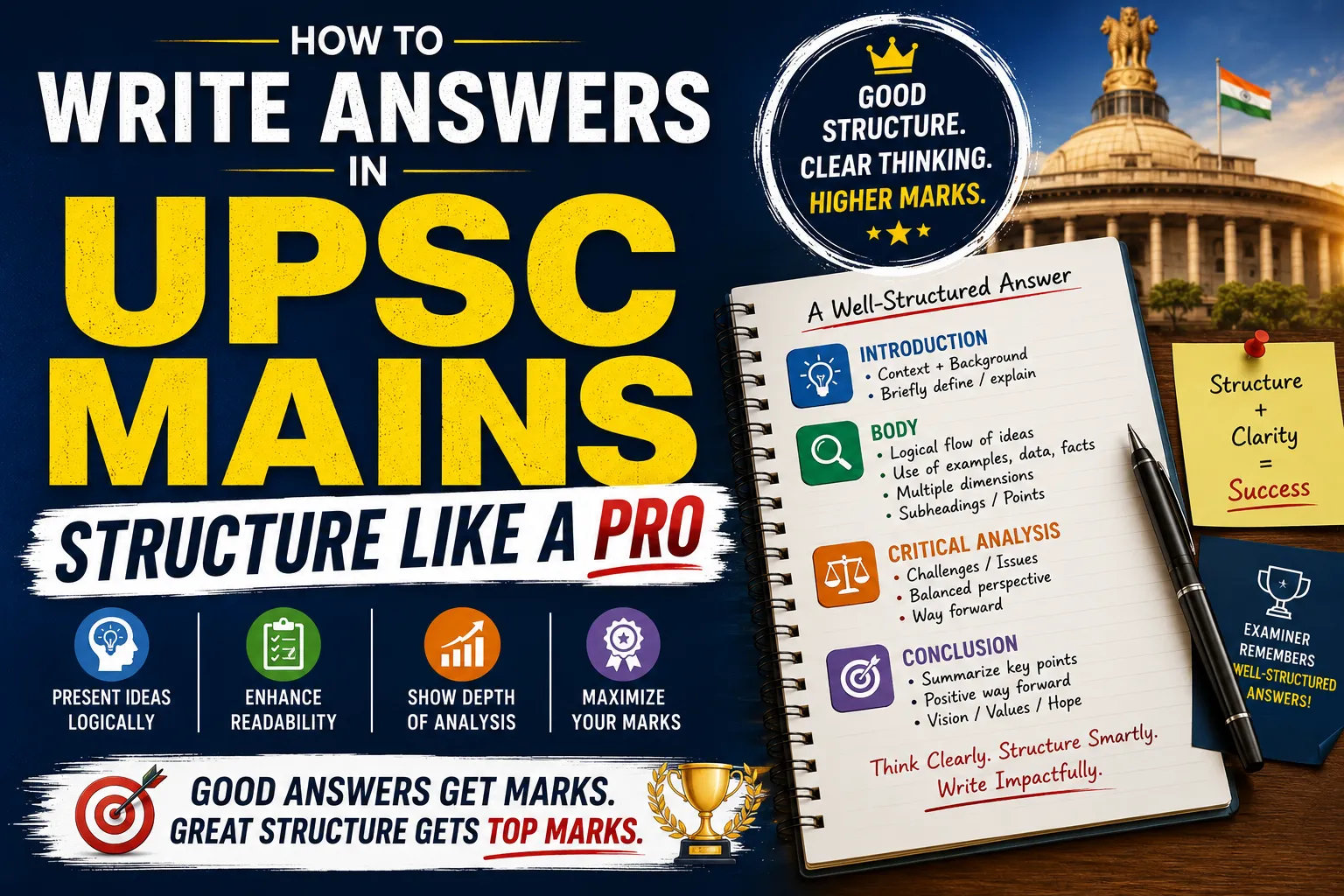
Syllabus Topic: Alternative Dispute Resolution (ADR) Mechanisms
- Definition: A mechanism to resolve disputes outside the traditional judiciary using a neutral third party (Arbitration, Mediation, Conciliation, Lok Adalats).
- The Core Need:
- Over 5 crore cases pending across Indian courts (NJDG data).
- Average time to resolve a commercial dispute is significantly higher than global averages.
Key Constitutional Backing: Article 39A (Equal justice and free legal aid).
- Major Challenges with Current ADR:
- Institutional Lacunae: Lack of trained, professional mediators.
- Enforceability Issues: Arbitral awards are frequently challenged in appellate courts, defeating the purpose of speed.
- Cultural Inertia: Litigants and lawyers still prefer the traditional adversarial court system.
- Recent Developments & Data:
- Passing of the Mediation Act, 2023 (making pre-litigation mediation voluntary but structured).
- Growth of Online Dispute Resolution (ODR) post-pandemic.
- Way Forward / Committee Recommendations:
- Implement Malimath Committee recommendations on judicial reforms.
- Scale up rural Gram Nyayalayas with hybrid technology.
- Pre-baked Conclusion: "ADR is no longer just an alternative; it is a necessity to transform the Indian judicial landscape from one of procedural delay to one of substantive, timely delivery of justice, fulfilling the promise of Article 21."
Common Mistakes When Creating UPSC Mains Notes
Even with the best intentions, it is incredibly easy to slip into bad habits that turn your study space into a storage facility for useless paper.
- Treating Note-Making as a First-Read Activity: Never make notes when you read a book for the first time. Everything will seem important, and you will end up rewriting the textbook in your own handwriting. Always read a source at least twice before extracting points.
- Failing to Leave White Space: If you are using physical paper, leave one-third of the page completely blank. If you are using digital tools, keep a dedicated section for updates. The socio-economic landscape changes rapidly; your upsc mains gs notes must have room to grow.
- Over-complicating the Tech Stack: Digital note-taking is fantastic for editing, but do not spend three weeks organizing complex tag systems, nested folders, or aesthetic templates. Whether you choose paper, Notion, OneNote, or simple text files, consistency matters infinitely more than the software features.
Perspectives from the Trenches: Aspirant Experiences
To understand how this works in practice, look at how the shift from passive reading to active note-making changes an aspirant's trajectory.
Experience 1: The Transition from Digital Hoarder to Focused Writer
"For my first two attempts, my strategy was simple: collect every weekly and monthly upsc mains notes pdf I could find on Telegram. I had around 4GB of materials cleanly organized into folders. But inside the exam hall, I couldn't structure a single answer cleanly because I hadn't processed the information myself. In my third attempt, I stopped downloading external summaries. I limited myself to standard books and built one-page summaries for every syllabus keyword. My GS marks increased by 65 marks overall."
— Ananya R., Cleared Mains 2025
Experience 2: Mastering the Balance of Static and Dynamic Content
"I used to make separate registers for daily current affairs and separate notebooks for static subjects like geography and polity. Connecting them during revision was an absolute nightmare. When I started pasting my current affairs snippets directly into my core upsc mains study material binders under the exact syllabus headings, my answer writing became instinctive. I didn't have to rack my brain for examples; the data point was already sitting right next to the concept."
— Siddharth K., Selected in 2025 Cycle
Frequently Asked Questions
1. Should I make my upsc mains notes digitally or on paper?
Choose what suits your natural workflow. Digital notes (Notion, Evernote, OneNote) offer unparalleled advantages for the mains exam because you can easily update current affairs, search for keywords, and rearrange topics. However, if writing on paper helps you retain information better, use loose sheets in ring binders. Avoid bound notebooks, as you cannot insert updates between pages easily.
2. When is the ideal time to start making upsc mains gs notes?
Do not start making notes at the very beginning of your preparation. Spend the first 3 to 4 months building a conceptual foundation by reading basic NCERTs and standard reference books. Once you understand the core concepts and have analyzed past years' question papers (PYQs) to see how questions are framed, you can start synthesizing your structured notes.
3. How detailed should my upsc mains study material summaries be?
Your notes should be highly condensed. They are meant for rapid revision, not regular reading. A good rule of thumb is the 1:10 rule: 100 pages of text should boil down to no more than 10 pages of high-quality, actionable notes. Focus on keywords, data, committee names, and structural bullet points rather than full grammatical sentences.
4. Can I rely entirely on a commercial upsc mains notes pdf downloaded online?
No. While you can use high-quality institutional material to fill gaps in your knowledge or cover niche topics (like Internal Security or Disaster Management), you should not rely on them as your sole source. Personal processing is what builds the mental pathways required for quick recall during the actual exam. Use commercial material as a raw ingredient, but cook the final dish yourself.
5. How often should I update my notes with current affairs?
Instead of updating your notes every single day, which disrupts your study rhythm, do it weekly or bi-weekly. Dedicate a Saturday afternoon to take the important editorial insights, statistics, and case studies you gathered during the week and file them under their respective static syllabus topics in your primary notes.
Conclusion
At the end of the day, your notes are not a testament to how hard you work; they are functional tools designed for a single purpose: helping you write high-quality answers in a high-pressure environment. A masterfully crafted set of upsc mains notes gives you clarity when the clock is ticking down and you have only seven minutes left to address a complex, multi-layered question.
Stop collecting, stop hoarding PDFs, and stop highlighting every line on the page. Pick up the official syllabus, isolate a single keyword, look at how it has been tested over the past five years, and build your first structured one-page summary. That is how the momentum shifts, and that is how you close the gap between being an aspirant and becoming a selected officer.

























Sign in to leave a comment.