

It is 2:45 PM on a blindingly hot Sunday. You are sitting at your desk, staring at a General Studies mock paper. Your eyes are heavy, your head is throbbing from trying to recall a random 12th-century land revenue term, and you have just realized that your last three guesses were spectacularly wrong. If this sounds painfully familiar, you are exactly where thousands of civil services aspirants find themselves every single week.
The tension building up to the upsc prelims can feel overwhelming. With the official upsc prelims date 2026 set for May 24, 2026, the countdown is firmly underway. You might feel like you are running a race against time, trying to balance revision with solving endless test series.
But here is a truth you need to hear: solving a hundred mock tests will not save you if you are doing it mindlessly. Many candidates treat mock papers like a score-card validation tool. If they score above 100, they celebrate; if they drop to 75, they spiral into self-doubt. Mocks are not a crystal ball predicting your final rank. They are diagnostic toolkits designed to expose your weak spots before the actual upsc prelims exam does.
Let us pull back the curtain on how to actually use mock tests to build an unbreakable strategy for the upcoming upsc prelims 2026.
Why Your Current Mock Test Approach Might Be Failing You
Most aspirants fall into the trap of horizontal consumption. They finish a subject, buy a test booklet, solve it, check the answer key, calculate their score, feel briefly miserable or happy, and move on to the next booklet.
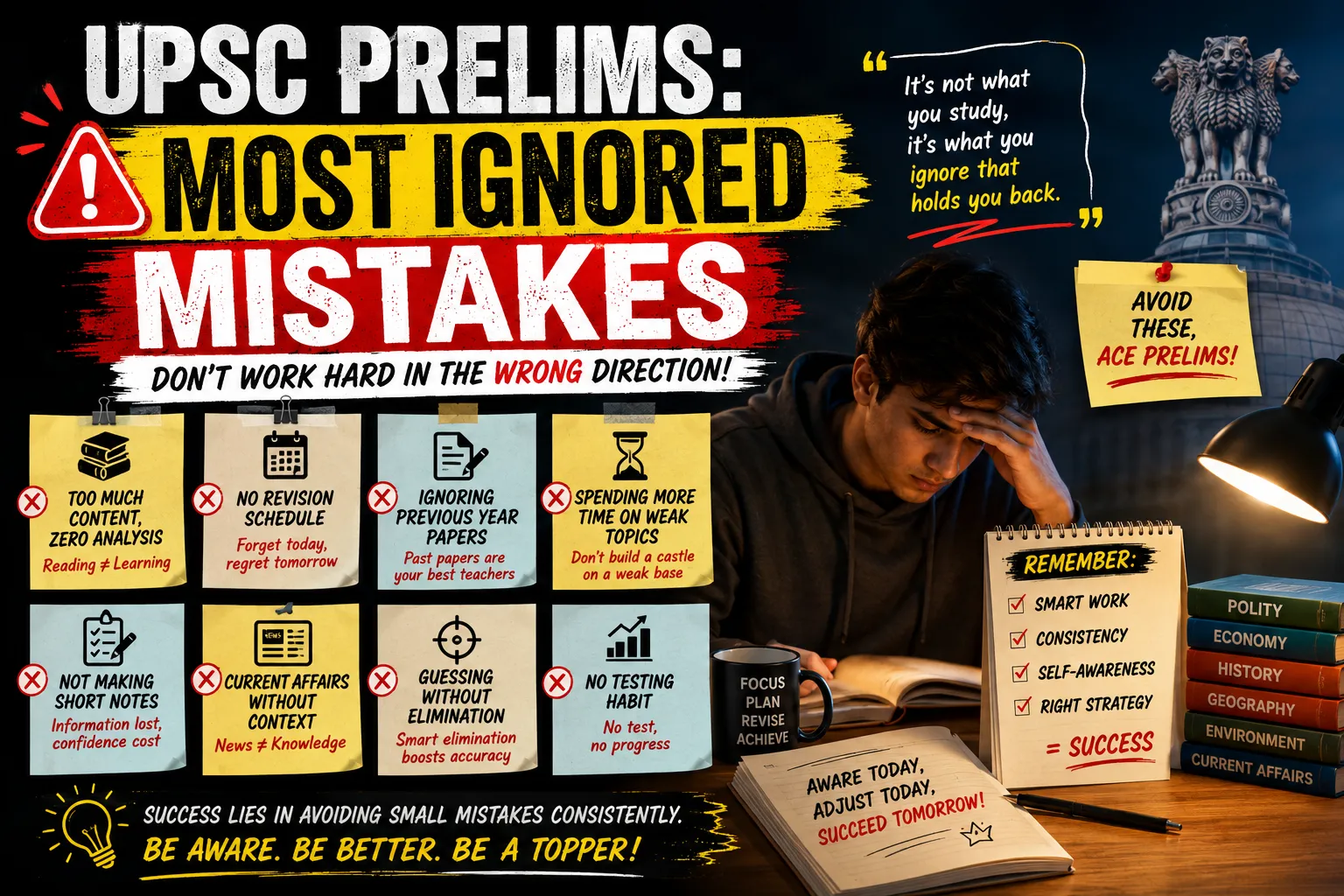
This routine completely misses the point. When you sit for the upsc prelims, you are not just being tested on your knowledge. You are being tested on your decision-making under intense psychological stress. If your mock test strategy does not train your brain to handle uncertainty, eliminate options logically, and manage time, you are merely collecting facts instead of building a competitive strategy.
Step-by-Step Guide to the Ultimate Mock Test Strategy
To make your preparation truly count for upsc prelims 2026, you need a structured, deliberate approach to every single paper you attempt.
1. The Three-Cycle Attempt Technique
When you look at a mock paper, do not try to solve it linearly from question 1 to 100. Instead, approach the upsc prelims exam paper in three distinct sweeps:
- Cycle 1 (The Absolute Certainties): Go through the entire paper and solve only the questions where you are 100% sure of the answer. This builds immediate psychological confidence and secures your baseline marks. For most well-prepared candidates, this is usually around 30 to 35 questions.
- Cycle 2 (The Calculated Gambles): Go back to the beginning. This time, focus on questions where you can confidently eliminate two options. This is where your analytical thinking kicks in. Use your core conceptual knowledge to weigh the remaining two choices.
- Cycle 3 (The High-Risk Zone): In the final 20 minutes, look at the questions where you have eliminated only one option or find the topic vaguely familiar. Only attempt a few of these if your overall attempt count is dangerously low. Leave completely clueless questions untouched.
2. The 3-Hour Post-Test Autopsy
Answering the test takes two hours, but analyzing it should take at least three. This is where the real learning happens. When reviewing your incorrect answers, categorize your mistakes into three specific buckets:
| Type of Mistake | What it Means | How to Fix It |
|---|---|---|
| Silly / Blunder | Misreading "not correct" as "correct," or bubbling the wrong circle. | Slow down your reading speed. Underline structural keywords in the question statement. |
| Knowledge Gap | You have simply never read about the topic before. | Do not panic. Note down the concept briefly in a consolidated notebook and move on. |
| Logical Failure | You knew the topic but fell for a trap or overthought the options. | Track your elimination patterns. Understand why the examiner's logic differed from yours. |
3. Simulating Real Exam Conditions
As the upsc prelims date 2026 approaches, your biological clock matters just as much as your study hours. Do not solve mock tests wrapped in a blanket at midnight.
Solve General Studies mock papers strictly between 9:30 AM and 11:30 AM. More importantly, solve your CSAT mocks between 2:30 PM and 4:30 PM. The afternoon slump is real, and training your brain to solve complex math and logical reasoning puzzles while feeling groggy is essential to mastering the upsc prelims.
The Common Mistakes You Need to Stop Making Immediately
Over-relying on Coaching Institute Explanations
Coaching institutes often craft highly factual, sometimes obscure questions to make their test series look challenging. If you miss a hyper-specific question about an obscure 5th-century coin, do not lose sleep over it. The actual Commission papers prioritize conceptual clarity, trend analysis, and administrative logic over absolute trivia.
Ignoring CSAT Until the Last Month
Year after year, exceptional candidates miss the General Studies cutoff simply because they fail to clear the qualifying marks in Paper 2. Treat CSAT with respect. Dedicate at least one mock test per week to it, especially if your educational background is not inherently quantitative.
Chasing the "Magic Attempt Number"
There is no universal sweet spot for how many questions you should attempt in the upsc prelims. Some toppers qualify by marking 75 questions with high accuracy, while others succeed by attempting 92 with a higher risk appetite. Your mock test phase is meant for discovering your personal equilibrium point between risk and accuracy.
Real Perspectives from the Trenches
"In my second attempt, I was consistently scoring 110+ in coaching mock tests but flunked the actual exam because I panicked when the question pattern shifted. For the next attempt, I stopped tracking mock scores altogether. I used mocks purely to practice how I would react when faced with 10 questions in a row that I knew absolutely nothing about. That shift in mindset changed everything."
— Ananya R., Selected in IRS
"I used to spend days making beautiful, colored notes from mock test answer keys. My room looked like a library, but my brain was empty. I realized that re-reading my standard textbooks (NCERTs and Laxmikanth) after identifying my conceptual blind spots via mocks was ten times more effective than memorizing low-yield facts from test keys."
— Siddharth K., Aspiring Civil Servant
Frequently Asked Questions (FAQs)
Q1: How many mock tests should I ideally solve before the upsc prelims 2026?
Quality heavily beats quantity here. Solving between 30 to 40 well-chosen papers including sectionals, full-length tests, and official previous year questions (PYQs) is more than enough if you analyze them deeply. Doing 100 tests superficially will only cause burnout.
Q2: My mock test scores are stuck in the 70-80 range. How do I cross the cutoff?
Platues usually happen when you keep making the same conceptual or structural errors. Look at your last five tests and trace your negative marks. Are you losing marks because of aggressive guessing, or are you losing them in core areas like Polity and Economy? Fix the foundational concepts in your core subjects, and your score will naturally cross the 100-mark threshold.
Q3: How should I balance Previous Year Questions (PYQs) with new mock tests?
PYQs are your primary anchor. They teach you the actual language, tone, and logical traps set by the paper setters. Use mock tests to practice time management and check your syllabus coverage, but return to PYQs every single week to align your brain with the actual standards of the upsc prelims exam.
Q4: Should I buy full-length test series from multiple coachings?
It is a good practice to mix and match at least two different coaching test series for your full-length mocks. Different institutes have different styles of framing questions. Experiencing varied formats helps prevent you from getting overly comfortable with just one coaching institute's predictable style.
Q5: How do I handle unpredictable current affairs questions in the mocks?
If a current affairs question is based on a major policy change, landmark judgment, or prominent international conflict, learn it. If it is based on a random, single-line mention of an obscure species from an isolated island that no mainstream newspaper covered, ignore it. Focus your energy on the high-yielding core areas.
A Grounded Perspective on the Finish Line
When you sit for the exam on the upsc prelims date 2026, you will be greeted by questions that look entirely unfamiliar. No mock test series in the market can replicate the exact flavor of the official paper, and they aren't meant to.
The ultimate goal of your mock test routine is to build emotional stability and sound execution. Mocks teach you how to remain calm when your mind goes blank, how to hold your ground when your calculated guesses fail, and how to systematically eliminate choices using cold, hard logic. Treat every test as an experiment, learn from the data it provides, refine your strategy, and keep moving forward calmly. Your preparation is a work in progress, and every single mistake you catch today is one less mistake you will make on exam day.




























Sign in to leave a comment.