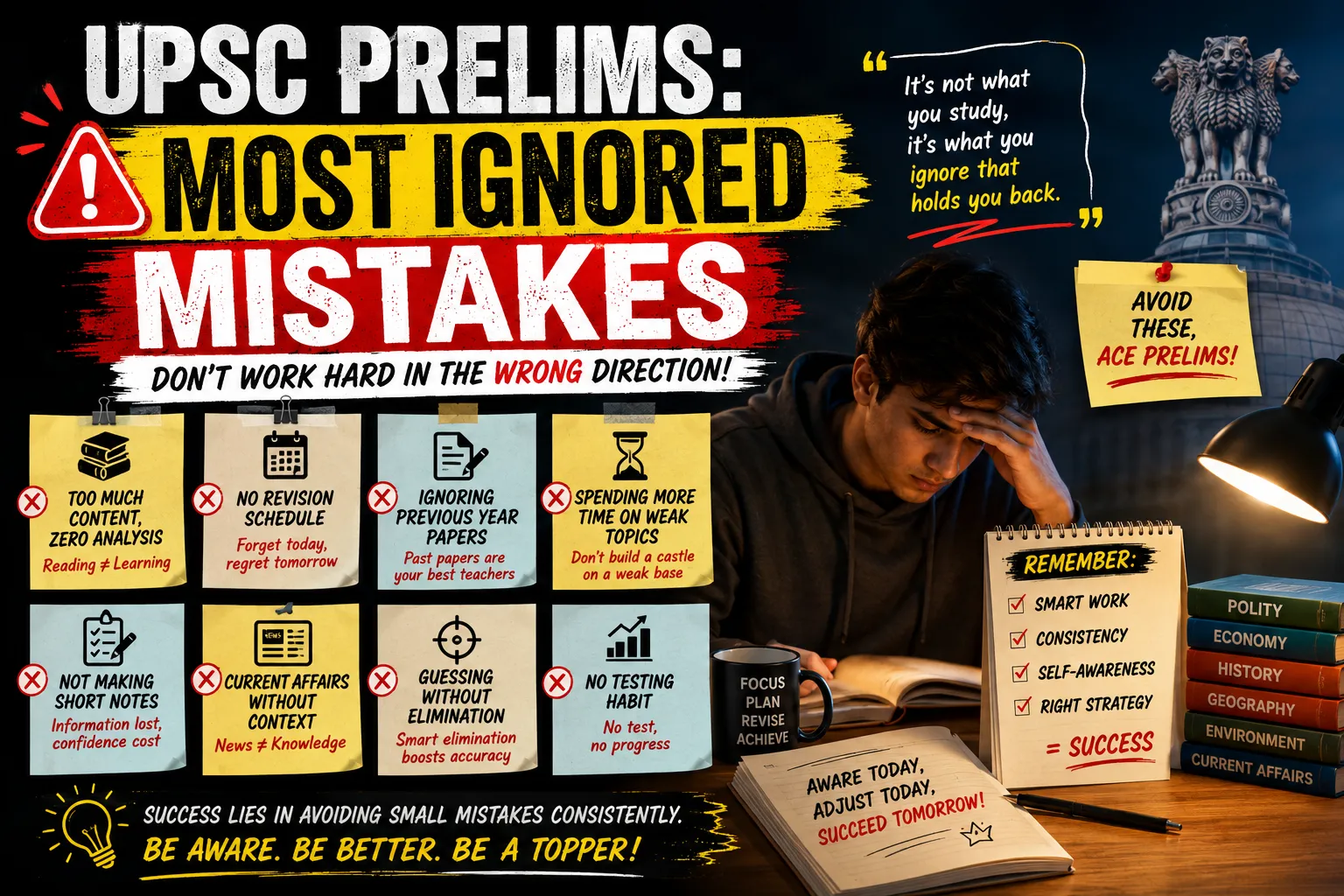

Are you making these silent mistakes in your UPSC preparation? Learn the hidden pitfalls that cost aspirants the UPSC Prelims and how to fix them.
Every year, when the upsc prelims exam concludes, a familiar silence settles over libraries and study rooms across India. It is a heavy, reflective silence. Thousands of aspirants who poured 10 to 12 hours a day into their books realize that the paper did not care about how many pages they read. It cared about how they processed those pages.
If you are preparing for the upsc prelims 2026, it is easy to assume that failing this stage is the result of not studying enough. But more often than not, the culprit isn’t a lack of effort. It is a set of invisible, ignored patterns that creep into your daily routine. You might be mastering massive textbooks while completely missing the subtle execution errors that actually determine your score on the final upsc prelims date 2026.
Let’s look beyond the standard advice of "study hard" and pull back the curtain on the mistakes that are genuinely costing aspirants their selection.
1. The Illusion of Coverage: Hoarding Resources vs. Deep Assimilation
It starts with a subtle anxiety. You see a new compilation in the market, or a peer mentions a niche textbook, and you immediately buy it. You feel a sense of security just seeing it on your shelf.
This is the "resource trap." The upsc prelims does not reward the person who has read four different books on Modern History. It rewards the person who has read Spectrum four times and can remember the exact institutional difference between two British-era acts under intense exam pressure.
When you spread your attention across multiple materials, your brain forms shallow memories. You will look at a question on the day of the upsc prelims exam, recognize the topic, narrow it down to two options, and then guess wrong. Why? Because you "knew" the topic conceptually, but you hadn't consolidated the micro-details.
The Fix: Pick one standard source for each subject. Lock it in. If a current affairs monthly magazine gives you 80% of what you need, accept that the remaining 20% is not worth sacrificing your mental clarity over.
2. Treating CSAT as a Qualifying Afterthought
"I’ll start looking at Paper II after March."
This single sentence has ruined more UPSC journeys than perhaps any difficult General Studies question. Over the last few years, the Civil Services Aptitude Test (CSAT) has shifted from a basic mental math and reading check to an entirely different beast, frequently leaning into complex permutations, combinations, and advanced number systems.
If you leave CSAT for the final month before the upsc prelims date 2026, you are gambling with your entire year. Panic during the afternoon session is real, especially if your morning GS Paper I went reasonably well. If your mind freezes on a lengthy math problem, it impacts your reading comprehension speed too.
How to Gauge Your Real CSAT Standing
Don't trust your academic background. Do this instead:
- Take a blank printout of the previous two years' CSAT papers.
- Sit in a quiet room from 2:30 PM to 4:30 PM (matching the actual exam timing).
- Solve it honestly without looking at answer keys.
- If you are scoring anywhere below 90 marks under exam conditions, you need a structured, weekly CSAT schedule starting right now.
3. Reverse Engineering Mock Tests (The Wrong Way)
Mock tests are excellent tools for practicing time management and identifying blind spots. However, a dangerous trend has emerged: using mock test answer keys as a substitute for standard textbooks.
When you answer a question incorrectly in a mock, reading the three-line explanation at the back of the booklet gives you a temporary sense of knowledge. But that knowledge is isolated. You haven't gone back to your core geography or polity text to see why that detail mattered in the broader framework of the chapter.
Furthermore, many test series tend to focus heavily on obscure facts just to look difficult. If you spend your energy memorizing these hyper-specific mock explanations while neglecting basic NCERT concepts, your preparation architecture becomes incredibly fragile.
4. Misinterpreting the "Elimination Technique" Trend
There was a time when identifying absolute words like only, all, or drastically could get you through half the options in a tricky question. Relying on those superficial tricks today is an easy way to miss the cutoff.
The upsc prelims exam has fundamentally changed its option formatting. With pairs-based questions ("Only one pair," "Only two pairs"), standard elimination tricks are practically obsolete.
Old Pattern: Standard A, B, C, D options where knowing one false statement clears the board. New Pattern: You must evaluate the absolute truth of each independent statement.
If your entire strategy relies on finding clever shortcuts rather than building a solid, logical foundation of the syllabus, you will find yourself completely unequipped to handle the paper. There are no shortcuts around knowing the core facts.
5. Ignoring the Psychology of the 3-Hour Break
No one talks about what happens between 11:30 AM and 2:30 PM on exam day.
You walk out of the morning General Studies paper. The streets outside the center are chaotic. Parents are waiting, auto-rickshaws are honking, and groups of aspirants are standing on corners actively debating whether a specific question's answer should be option B or C.
If you match your answers during that three-hour window, you are actively sabotaging your CSAT paper. If you think you did poorly in the morning, the despair will cloud your focus in the afternoon. If you think you aced it, complacency might make you careless with complex data interpretation questions.
Things You Should Know: The Realities of Exam Day
| The Pitfall | What Actually Happens | The Proactive Adjustment |
|---|---|---|
| The Revision Avalanche | Trying to read entire current affairs compilations in the final 72 hours leads to cognitive fatigue. | Stop consuming new data 5 days before the exam. Focus purely on personal short notes. |
| Omr Bubbling Errors | Leaving all OMR shading for the last 15 minutes causes panic and misaligned rows. | Bubble your answers in distinct waves (e.g., after every 15–20 completed questions). |
| The "Safe Attempt" Myth | Deciding beforehand that you must attempt exactly 85 questions, regardless of paper difficulty. | Let the toughness of the paper dictate your attempts. Read the room, not a pre-set rulebook. |
Real Perspectives: Experiences from the Field
To get a better sense of how these silent mistakes play out in real life, let's look at what two seasoned aspirants discovered during their journeys:
"In my second attempt, I missed the GS cutoff by just 1.2 marks. I blamed my luck. But when I looked closer, I realized I had skipped revising the basic maps of West Asia because I was too busy reading a 300-page current affairs shortcut booklet. I traded fundamental geography for speculative current updates."
— Ananya R., Delhi
"I am an engineering graduate, so I completely ignored CSAT. On the day of the exam, the math section felt completely different from what I expected. I panicked, spent too much time on a single number series question, and missed the qualifying mark by 2 points. My GS score was 104. That was a very hard pill to swallow."
— Siddharth M., Bengaluru
Summary for Your Final Lap
As you align your schedule for the upsc prelims 2026, treat your preparation like a craft. Read the primary texts until they are second nature, treat CSAT with the professional respect it demands, and stop treating mock test scores as a personal validation of your intelligence. They are simply diagnostic tools.
On the day of the exam, it isn't the most well-read person who clears the paper; it is the most stable, observant, and adaptable mind in the room.
Frequently Asked Questions (FAQs)
Q1: When is the official upsc prelims date 2026?
The Union Public Service Commission has scheduled the upsc prelims 2026 to take place on May 24, 2026 (Sunday). It is a single-day exam consisting of two mandatory sessions.
Q2: What are the exact timings for the upsc prelims exam papers?
The morning session (General Studies Paper I) is held from 9:30 AM to 11:30 AM. The afternoon session (CSAT Paper II) runs from 2:30 PM to 4:30 PM. Keep in mind that the entry gates close exactly 30 minutes before each session starts, meaning you must be inside by 9:00 AM and 2:00 PM respectively.
Q3: How many mock tests should I realistically solve before the upsc prelims?
Quality matters far more than volume. Solving between 30 to 40 well-chosen, comprehensive mock tests is generally more than enough, provided you spend equal time thoroughly analyzing your errors and correcting your core concepts using standard textbooks.
Q4: Can I rely purely on current affairs monthly compilations to pass the upsc prelims 2026?
No. Current affairs are simply extensions of static concepts. Without a firm understanding of basic static subjects such as Polity, Economy, Modern History, and Core Environment—current affairs compilations will feel like disconnected facts that are difficult to retain or apply under pressure.
Q5: What is a safe score to target in the GS Paper 1 of the upsc prelims?
Cutoffs change every year depending on the difficulty of the paper and the general performance of the candidates. Instead of aiming for a fixed, arbitrary number, focus on achieving a high accuracy rate on your high-confidence questions and avoiding unnecessary blind guessing on highly ambiguous options.




























Sign in to leave a comment.