

You can feel it in the air. The pile of Laxmikanth, Spectrum, and monthly current affairs compilations sitting on your desk isn't just a stack of books anymore it feels like a physical weight. With the UPSC Civil Services Preliminary Examination just around the corner, the initial excitement of preparation often gives way to a quiet, creeping panic. You look at your notes and feel like you remember absolutely nothing. Your mock scores are fluctuating, your sleep cycle is erratic, and your mind keeps wandering to "what if" scenarios.
If this sounds exactly like your current reality, take a deep breath. What you are feeling is entirely normal, and more importantly, it is experienced by almost every single aspirant sitting for the exam including those who will top it.
At this stage, the game changes from a test of knowledge to a test of mental endurance and strategic execution. You cannot read everything, nor do you need to. Success in these final days comes down to subtraction rather than addition knowing what not to do. To help you navigate this high-pressure window with a clear head, let’s break down the last minute tips for UPSC Prelims by highlighting five critical mistakes you must avoid right now.
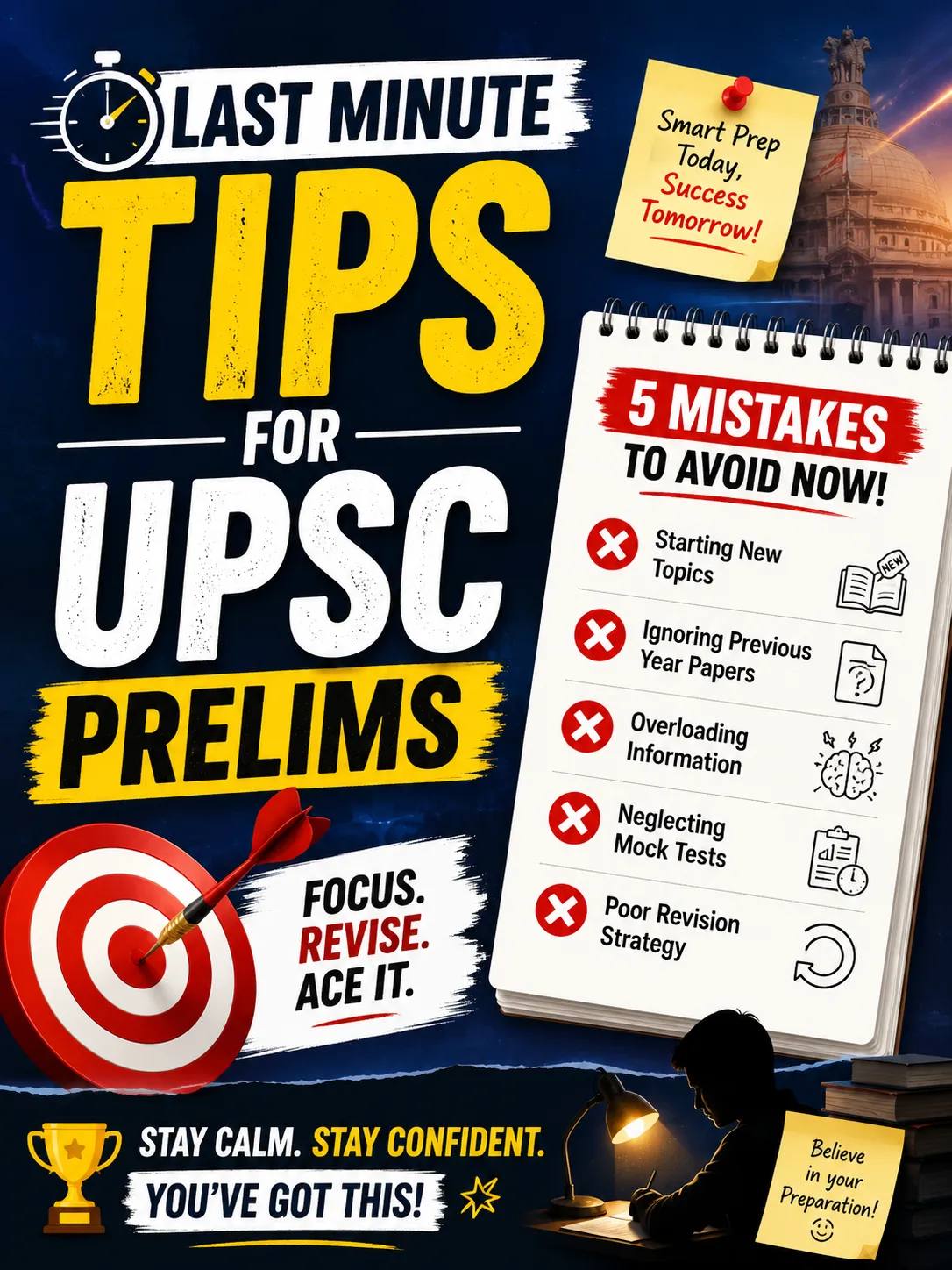
1. The Trap of Collecting New Study Materials
It happens to everyone. A friend forwards a "highly leaked" 100-page current affairs compilation on a Telegram channel, or a coaching institute drops a last-minute "sure-shot" PDF prediction file. Suddenly, a wave of FOMO (Fear Of Missing Out) hits you. You print it out, stack it on top of your existing materials, and try to force-feed your brain new data.
This is arguably the most dangerous pitfall in your upsc prelims last minute preparation. Attempting to process new information right now dilutes the clarity of what you already know. The UPSC Prelims paper is notorious for creating options that test your precision. If you have read a topic once from a new source, you will experience a vague sense of familiarity in the exam hall, but you won't have the clarity required to eliminate the close options.
What to Do Instead:
Focus entirely on how to revise for your upsc prelims in last days. Stick strictly to your primary sources. If you have read Laxmikanth four times, read your highlighted sections a fifth time. Your brain relies on visual memory; looking at the same familiar font, underlined sentences, and margin notes builds a subconscious confidence that text from a brand-new PDF simply cannot replicate.
2. Neglecting CSAT Out of Overconfidence
Every year, a heartbreaking number of brilliant aspirants score well above the General Studies Paper 1 cutoff, only to fail the Civil Services Aptitude Test (CSAT). It is incredibly easy to fall into the trap of assuming that because you have a background in engineering, commerce, or science, you can easily clear the 33% qualifying threshold ($66.67$ marks) without specific preparation.
The reality of recent UPSC trends shows that the CSAT paper has become increasingly demanding. The quantitative aptitude section frequently touches CAT-level logical reasoning, and the reading comprehension passages are highly nuanced. Treating CSAT as an afterthought during your last minute strategy for upsc prelims is an unnecessary risk.
A Quick CSAT Checklist for the Final Days:
- Formulas & Concepts: Spend just one hour a day reviewing core mathematical formulas (Number Systems, Permutations & Combinations, Ratios, and Percentages).
- Time Management Planning: Decide your sequence of attempt beforehand. Will you tackle Reading Comprehension first, or Quant?
- The Accuracy Metric: Remember, CSAT is not about attempting all 80 questions; it’s about ensuring that the 40 or 45 you do attempt are highly accurate.
3. Over-Analyzing and Obsessing Over Mock Test Scores
It is a common ritual: you sit down for a full-length mock test a few days before the exam, secure a score well below your expectations, and spend the next twelve hours questioning your entire preparation journey.
Important Realization: Mock tests are designed by commercial coaching institutes. Their primary utility is to help you practice time management, fine-tune your elimination techniques, and get used to sitting in one place for two hours. They are not perfect predictors of your actual UPSC performance.
UPSC’s questioning style is entirely different. While mock tests often focus on obscure, trivial facts to make the paper challenging, the actual UPSC exam emphasizes conceptual clarity, logical extrapolation, and smart elimination.
4. Ruining Your Biological Clock and Sleep Cycle
Your mind is your primary tool on exam day. You can memorize every fact in the syllabus, but if your brain is foggy due to a chronic lack of sleep, you will misread questions, mark wrong bubbles on the OMR sheet, and struggle to recall basic information.
Many aspirants adopt a nocturnal schedule, studying until 4:00 AM and sleeping through the morning. If you enter the exam hall with this sleep cycle, your brain will naturally be in its lowest energy state during the critical hours of 09:30 AM to 11:30 AM (GS Paper 1) and 02:30 PM to 04:30 PM (CSAT).
Transitioning Your Biological Clock:
Start waking up early immediately. Force your mind to be completely alert during the exact exam windows. Sit at your study desk during these hours without using your phone, working through PYQs (Previous Year Questions) or core revisions. This conditions your brain to operate at peak cognitive capacity precisely when it matters most.
5. Paralyzing Yourself with a Rigid Strategy
Entering the exam room with a fixed mindset such as “I must attempt exactly 85 questions to clear the cutoff” is a recipe for panic.
The difficulty level of the UPSC Prelims paper fluctuates wildly from year to year. If the paper turns out to be exceptionally tough or unconventional, a rigid target will force you to make wild guesses just to reach your arbitrary number, leading to heavy negative marking. Conversely, if the paper is straightforward and you stop early because you hit your pre-determined target, you might miss out on a safe margin.
The Dynamic Attempt Approach:
Adopt a fluid, round-based approach to the paper:
- Round 1: Go from question 1 to 100. Answer only those where you are 100% certain. This builds immediate momentum and secures your base score.
- Round 2: Tackle questions where you can confidently eliminate two options. This is where your logical elimination skills and gut instinct come into play.
- Round 3: Evaluate questions where you have eliminated only one option. Proceed with extreme caution here, keeping a close eye on your cumulative risk.
Let the paper dictate your number of attempts, not a preconceived notion born from last year's cutoffs.
Testimonials & Reader Experiences
Aarav S., Cleared Prelims 2024:
"Two weeks before my third attempt, I was scoring around 75-80 in institutional mocks. I panicked and almost started buying new current affairs booklets. Thankfully, a senior told me to drop the new stuff and just read the basic polity and economy notes again. I stopped giving mocks entirely in the final week and just solved UPSC PYQs to align my brain with their logic. That shift in perspective saved my attempt."
Meera Nair, Selected in CSE 2024:
"In my first attempt, I failed CSAT by just two marks because I spent too much time on a single tough math puzzle in the first twenty minutes. The next year, I learned to be ruthless with my time management—if a question looked complex, I skipped it instantly to find the easier ones. Having a flexible approach in the exam room is just as important as knowing the syllabus."
FAQ Section
Q1. How many hours should I study daily in the final days of UPSC Prelims?
Quality matters far more than quantity right now. Aim for 7 to 8 hours of focused, distraction-free study. Spend this time entirely on high-yield revision and reviewing past mistakes. Overworking yourself to the point of exhaustion will only increase your anxiety levels.
Q2. Should I stop solving mock tests entirely a week before the exam?
Yes, it is highly recommended to stop solving full-length mock tests 5 to 7 days before the exam. Instead, pivot your focus entirely toward solving official UPSC Previous Year Questions (PYQs) from the last 10 years. This helps you get accustomed to the actual language, tone, and logic used by the Commission.
Q3. Which subjects should I prioritize for a quick last-minute revision?
Focus heavily on high-yield, static areas where accuracy can be maximized. Polity, Modern History, Economy, and Environment/Ecology traditionally form the backbone of the GS Paper 1. Ensuring your core concepts are absolutely airtight in these subjects provides the highest return on investment for your time.
Q4. How should I manage exam anxiety and stress in the final 48 hours?
Acknowledge that anxiety is a natural response to an exam of this magnitude. To manage it, keep your physical environment calm, avoid discussing preparation levels with peers, and get adequate sleep. Remind yourself that you do not need to score 100% to qualify; you simply need to clear a screening threshold.
Q5. What are the absolute essentials to carry to the UPSC Prelims exam hall?
Ensure you have a clear, double-checked printout of your e-Admit Card, an original valid photo identity card (matching the one mentioned in your application form), two high-quality black ballpoint pens for marking the OMR sheet, and a simple analogue wrist watch. Avoid carrying any digital gadgets, smartwatches, or extensive study notes to the center.
Conclusion
When you step into the examination hall, remember that the goal of UPSC Prelims is not to score a perfect 200 out of 200. It is a qualifying screening test designed to filter candidates for the Mains stage. You do not need to know the answer to every obscure question on the paper; you simply need to remain calm enough to unlock and apply the knowledge you have steadily built over the past months.
Trust the process, preserve your peace of mind, sleep well, and approach the paper with a composed, methodical focus. You have done the work; now give yourself the best possible chance to let that effort show.



























Sign in to leave a comment.