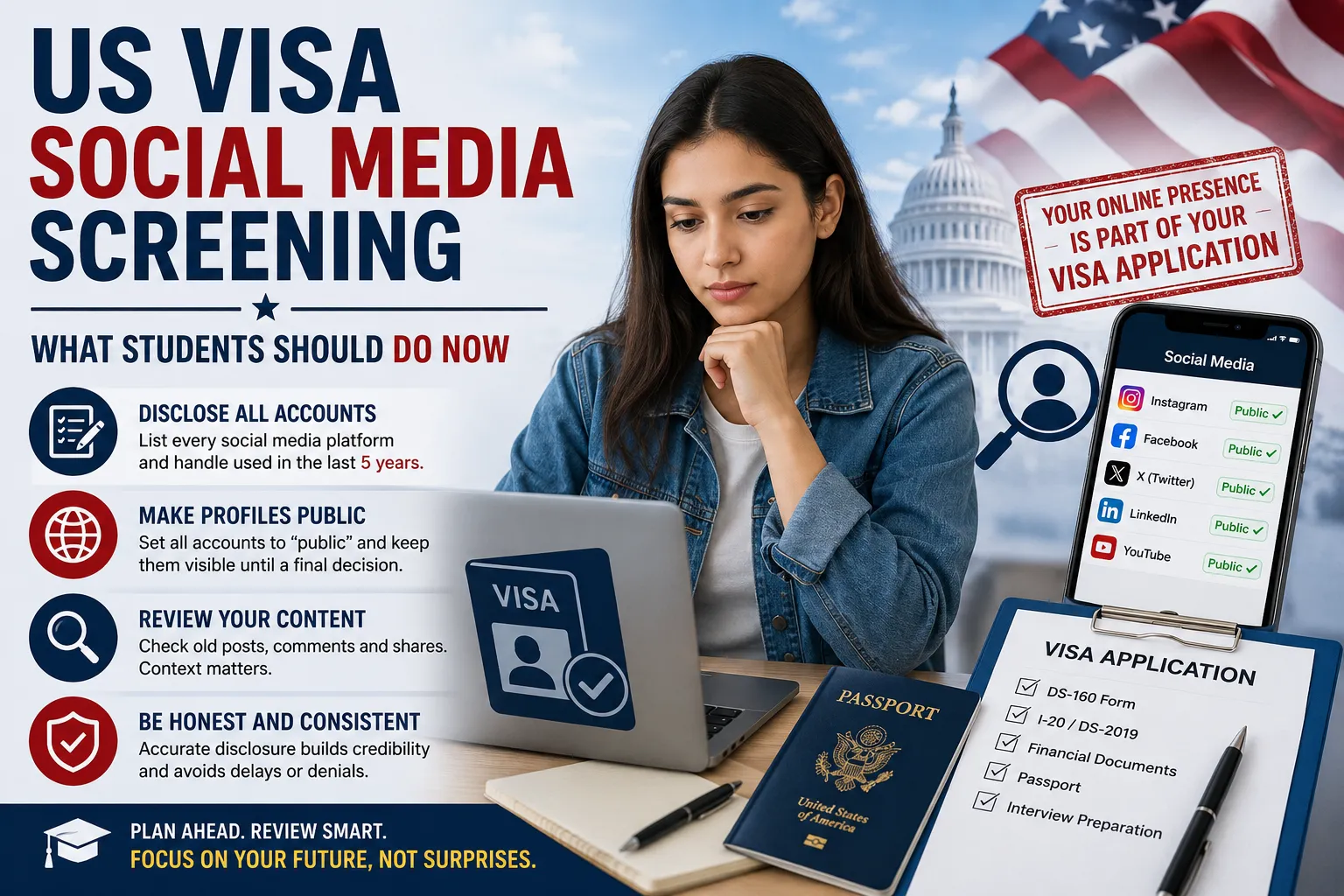

International students preparing to study in the United States have another task to add to their visa checklist in 2026: reviewing their online presence. US visa screening now includes social media review for F, M, and J visa applicants, with the policy expanding into additional categories during 2025 and 2026.
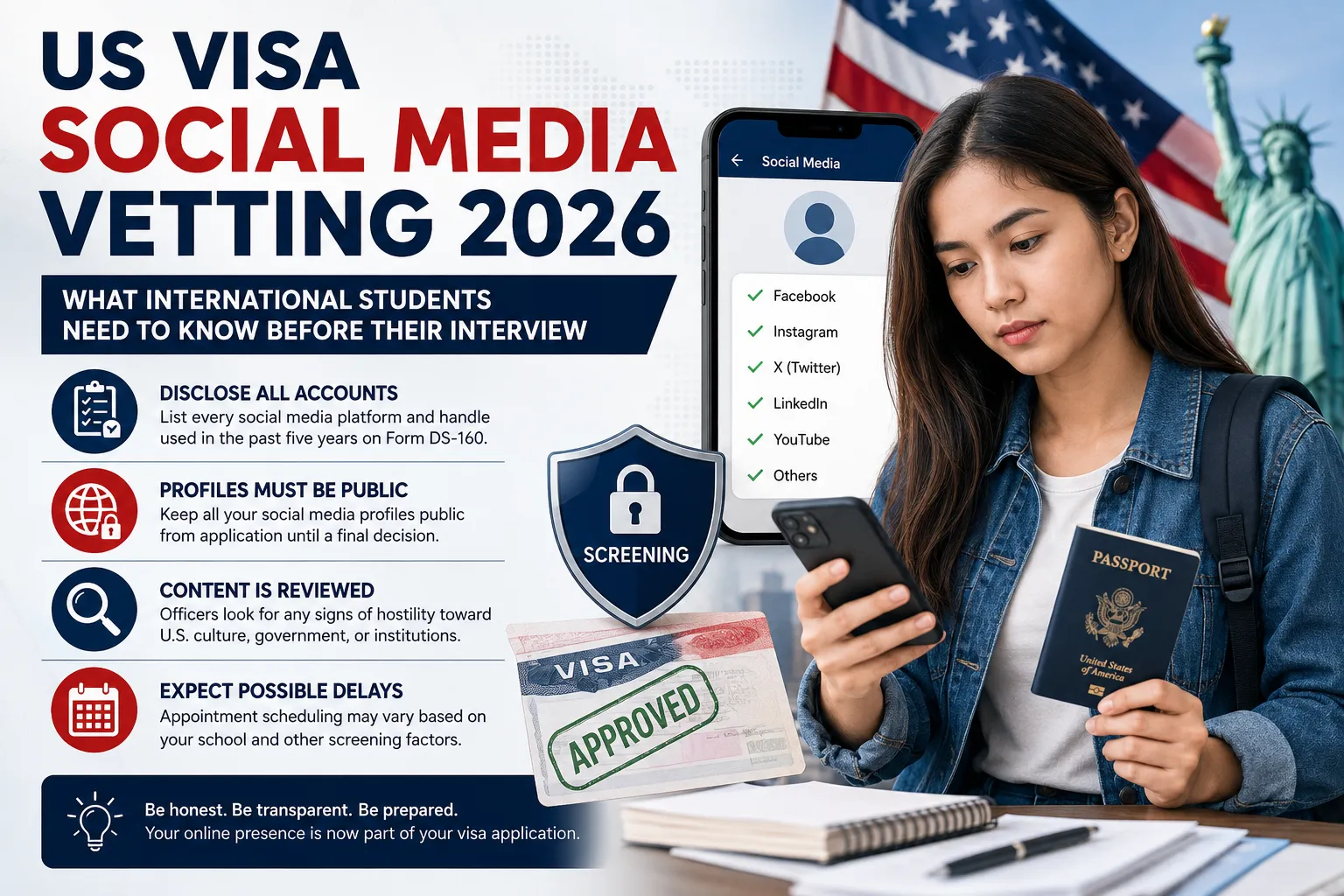
The research paper behind this article explains how the screening process developed and what it means for students preparing for a consular interview. Applicants have been instructed to disclose social media platforms and handles used during the previous five years and make their profiles publicly accessible for review.
For students, this creates a practical challenge. Many social accounts were created years ago and may no longer be used. An applicant might remember a current Instagram profile but forget an old account created during school. That forgotten account can still matter if it falls within the relevant reporting period.
The digital footprint is now part of preparation
The expansion of social media screening means students should think about their online history before completing their visa paperwork.
The policy began in June 2025 with F, M, and J visa applicants. These categories cover academic students, vocational students, and exchange visitors. The research paper states that the requirement later expanded to H-1B workers and H-4 dependents in December 2025.
Another major expansion followed on March 30, 2026, bringing several additional visa categories into the screening process. Reports from August 2026 indicate that further categories could be affected, although the paper distinguishes these reported developments from formally published regulations.
The direction is clear even as the exact scope can change: applicants should pay attention to their digital footprint as part of the wider visa process.
Reported guidance also indicates that officers may look for content suggesting hostile attitudes toward U.S. citizens, culture, government, institutions, or founding principles. This gives officers considerable room to assess publicly available information.
That does not mean every disagreement or unpopular opinion creates a visa problem. It does mean students should know what information is publicly visible and understand how old content might appear without its original context.
Start with your five-year account history
The five-year reporting period deserves careful attention.
Students should begin by making a record of every social media platform they have used during that period. Include current accounts, inactive accounts, older profiles, and accounts where usernames have changed.
This step can be surprisingly difficult. People create accounts for different purposes and then abandon them. Some change usernames after entering university. Others use separate accounts for hobbies, school activities, or personal interests.
A complete inventory reduces the chance of forgetting something when completing the DS-160.
The research paper specifically states that inactive accounts can still fall within the disclosure requirement. Students should therefore avoid assuming that an account no longer matters simply because they have stopped posting.
Think of the process like checking an old academic transcript. You may remember your latest grades, but a complete record contains information from earlier years as well. Your digital history works in much the same way.
Once the account inventory is complete, compare it carefully with the information being entered into the visa application.
Accuracy should be the priority.
Review posts, comments, and shared content
Knowing which accounts exist is only the first step. Students should also understand what an unfamiliar reader could see.
Review older posts, comments, reposts, shared content, and public interactions. Do not focus only on the latest material.
Online conversations often lose their context over time. A comment that made sense during a specific discussion several years ago might appear very different when viewed on its own.
For example, imagine a student commented on a heated public debate during high school. Friends who participated in the original conversation understood the joke or criticism. Years later, someone viewing only the comment may not have that background.
The research paper notes that screening can involve online searches and publicly available content. Students should therefore review their digital history with the understanding that visibility may extend beyond the main feed of a single social platform.
This is not a recommendation to create a fake online identity. Instead, students should know what is available and be prepared to provide honest explanations if questions arise.
Students who are also managing demanding coursework may find it difficult to balance academic deadlines with visa preparation. Expertsmind.com's assignment help resources can provide academic support while students organize their application tasks.
Public profiles and accurate disclosure
Profile visibility is another important part of the reported process.
The research paper explains that affected applicants have been instructed to make their social media profiles public for screening. A private account may create a problem because officers cannot complete the review in the same way.
Students should check each platform individually. Privacy settings differ between services, and changing one account does not automatically change another.
Do not leave this task until the day before an interview. Give yourself enough time to identify forgotten accounts and confirm that the required settings have actually been applied.
The same principle applies to the DS-160. Students should provide the requested social media information accurately rather than leaving out an account because it seems old or unimportant.
An incomplete disclosure can create questions about the accuracy of the application itself.
For students working on academic research at the same time, deadlines can become difficult to manage. Expertsminds.com's research paper writing help is another resource students can consider when coursework and visa preparation compete for their time.
Plan your visa timeline carefully
Social media screening is only one part of the U.S. visa process. Students still need to manage university documentation, financial evidence, passports, DS-160 information, interview appointments, and other application requirements.
The research paper also discusses reports that appointment scheduling could be influenced by the percentage of international students at a particular university. It describes a reported threshold involving institutions where international students make up less than 15% of the student population.
However, the paper emphasizes that this information comes from reported guidance rather than a publicly established regulation. Students should therefore view it as a possible timing factor rather than a guaranteed rule.
The sensible response is to avoid unnecessary delays.
Starting the application process early gives students time to review their digital history, check their documentation, complete required forms, and prepare for potential interview questions.
Preparation can reduce unpleasant surprises
The expansion of social media screening has changed what international students need to consider before a U.S. visa interview.
Students cannot control whether screening policies expand further. They can control how carefully they prepare.
Create a five-year account inventory. Check old usernames. Review public posts and comments. Confirm account visibility. Make sure your application information is complete and consistent.
Most importantly, do not treat your digital footprint as something separate from your visa application. For many applicants, it is now part of the wider information considered during screening.
The best preparation is straightforward: understand what is online, disclose what the application requires, and give yourself enough time to deal with unexpected discoveries.
Your visa application tells the story you submit; your digital footprint may tell the story an officer sees. Make sure you understand both.



















Sign in to leave a comment.