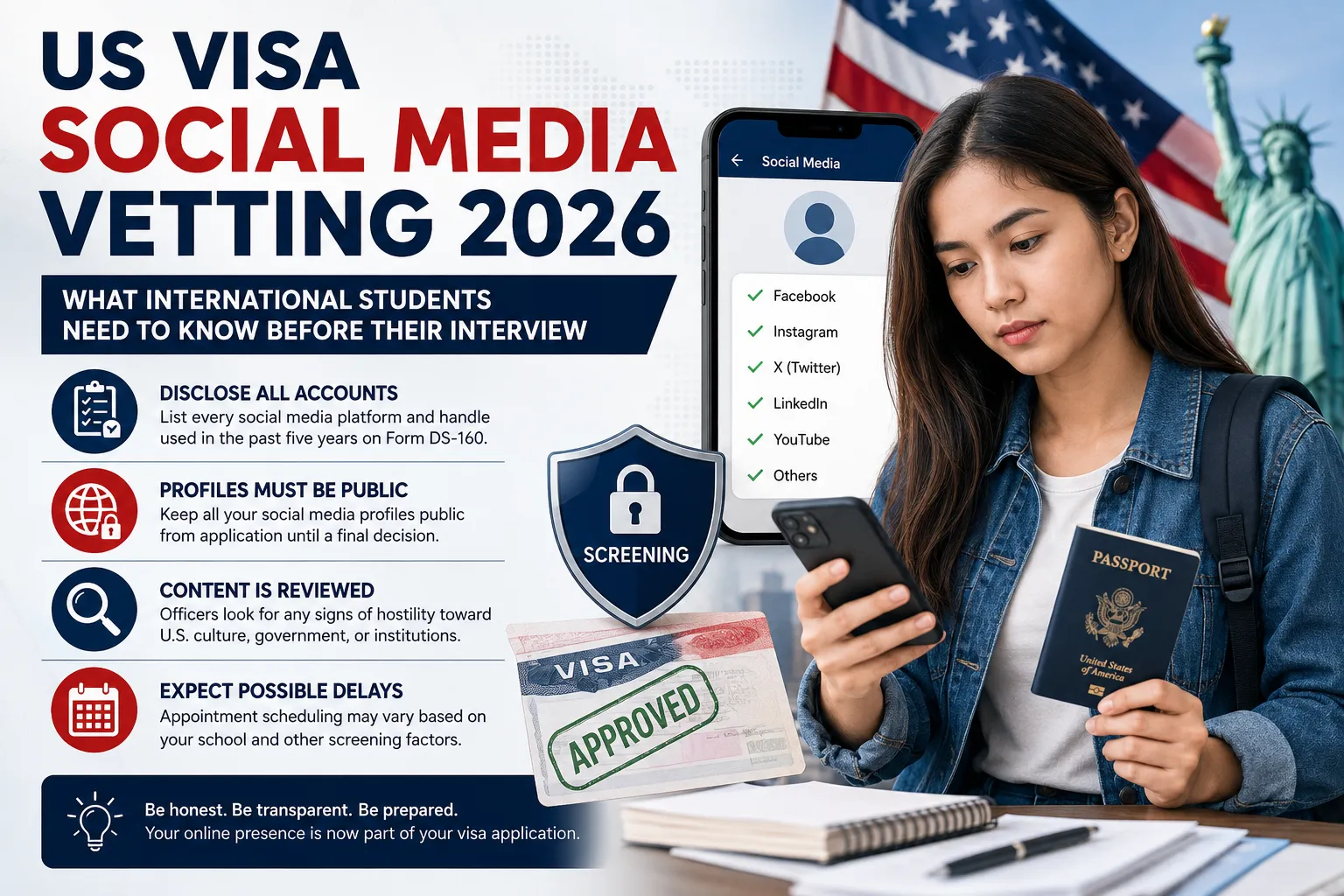

International students preparing for the United States need to think beyond admission letters and financial documents. US visa social media checks have become an important part of the preparation process for many student and exchange visa applicants. Since June 2025, applicants for F, M, and J visas have faced requirements involving public social media profiles and disclosure of platforms used during the previous five years.
The policy has continued to expand into other visa categories. For students, the biggest change is practical: an online profile that once felt separate from an immigration application may now be considered alongside the rest of the application.
Your Five-Year Online History Matters
The first step is understanding exactly how far back the review can reach.
According to the research, applicants must disclose social media platforms and handles used during the previous five years. That includes accounts that are no longer active. A profile created during high school and abandoned after graduation may still fall within the relevant period.
This makes an account inventory one of the most useful preparation steps. Students should think through every platform they have used, including accounts connected to older usernames or handles. Do not rely only on the apps currently installed on your phone.
A useful approach is to work backward from today. Record your current accounts, then identify older profiles and usernames. Check whether an account was deactivated, renamed, or simply forgotten.
The point is accuracy. A student's social media history should not become a surprise during the visa process because an old account was overlooked.
What Happens to Public Social Media Content?
Making an account public does not mean every post will automatically cause a problem. The research instead points to the broader purpose of screening: officers may review online information for signs of hostile attitudes toward U.S. citizens, culture, government, institutions, or founding principles.
That makes context important.
Imagine a student wrote a heated comment during a debate three years ago. Friends who participated in that conversation may understand exactly what the student meant. A person encountering the comment without that background sees only the words on the screen.
Students should therefore review their public history before the interview. Look at posts, comments, shared content, and older profiles from the perspective of someone who does not know you personally.
This is not a reason to panic about having opinions online. It is a reason to understand what another person could reasonably see when reviewing your profile.
The research also notes that applicants have been instructed to make their social media profiles public. A private profile can limit the required review and may therefore become an issue in the application process.
Prepare Your Digital Footprint Before the Interview
The easiest mistake to avoid is leaving social media preparation until the last minute.
Students should check their profiles well before the interview date. Review each platform separately because privacy controls can differ between services. After changing a setting, confirm that the profile is actually visible as intended.
It is also worth checking old usernames. Students often change handles without remembering every previous version. Those older names may still be associated with accounts created during the five-year period.
This preparation becomes harder when it competes with university coursework. Students preparing for a U.S. visa may also be dealing with assignments, exams, projects, and application paperwork at the same time. Expertsmind's expert learning resources can provide academic support while students focus on organizing their wider application.
The research also recommends allowing extra time for the overall visa process. Reports discussed in the paper suggest that appointment scheduling may vary depending on the international-student share of the destination university. However, this detail comes from reported guidance rather than a published regulation, so students should treat it as a possible timing issue rather than a fixed rule.
Don't Ignore the Academic Side of Visa Preparation
Visa preparation can easily become a second full-time project for students already managing demanding courses.
A student might spend one evening checking the DS-160, another gathering financial documents, and another trying to understand appointment requirements. Meanwhile, assignments and examinations continue to follow their normal deadlines.
Keeping academic work under control can make the visa process less stressful. Students looking for help with difficult coursework can use Expertsmind's assignment help resources to get additional support when deadlines overlap with application preparation.
The key is planning. Instead of treating the visa interview as an isolated event, students should build preparation into their schedule weeks or months ahead.
What International Students Should Take Away
Social media screening has developed quickly. The research traces the policy from its initial application to F, M, and J applicants in June 2025, through expansions in December 2025 and March 2026, with additional expansion reported in August 2026.
That progression means students should expect the digital side of visa preparation to remain relevant.
The most practical response is simple: know your online history, disclose accounts accurately, check public visibility, and review older content before the interview.
Students cannot control future changes to U.S. visa policy. They can control how prepared they are when those rules affect their application.
Your visa application tells the consular officer where you are going. Your digital footprint may help them understand what you have left behind. Prepare for both.











Sign in to leave a comment.