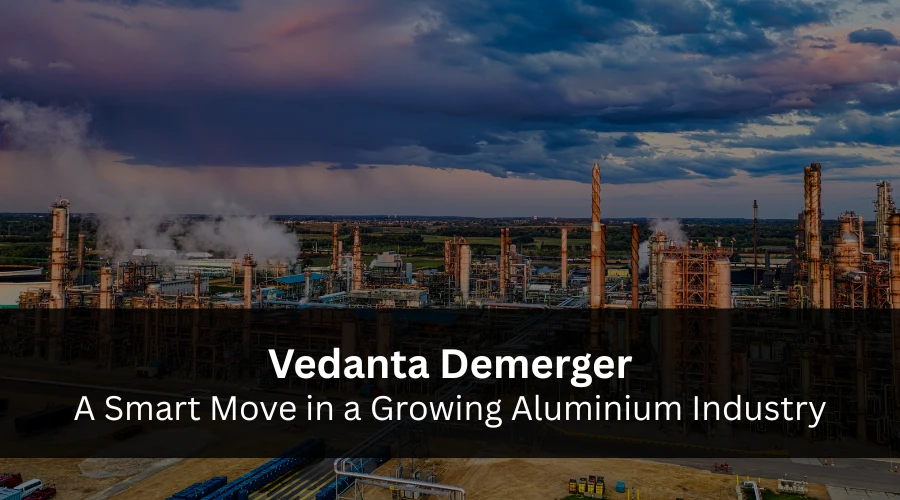

The aluminium sector is one of the fastest-growing sectors in India and across the world. It has become one of the most important metals used in transportation, construction, packaging, and renewable energy. With the rise of electric vehicles and smart infrastructure, the demand for aluminium is increasing every year.
Vedanta Limited, one of India’s leading natural resources companies, is already a major player in this field through its subsidiary- Vedanta Aluminium. Vedanta is restructuring its business by demerging it into five different entities, with each of them having its own focused strategy, operational independence, and growth strategy. According to the Vedanta demerger scheme, one of the companies formed after the restructuring will be Vedanta Aluminium— a move that aims to unlock true value and strengthen the company’s leadership in this booming sector.
Why the Aluminium Sector Is Expanding?
India’s aluminium demand is growing by around 6–7% every year, much faster than the global average. In India, the power sector continues to be the major consumer of aluminium followed by transport, packaging, building and construction sectors.
· Infrastructure development – The establishment of smart cities, roads, bridges, and industrial projects has further surged the demand for aluminium.
· Electric vehicles (EVs) – Automakers have shifted their focus to aluminium due to its lighter weight. Also, it increases the fuel efficiency.
· Renewable energy – Solar panels, wind turbines, and power lines require large amounts of aluminium.
· Sustainability push – Aluminium is 100% recyclable, making it a preferred metal for companies looking to go green. Vedanta Aluminium is India’s first aluminium producer to launch low-carbon ‘green’ aluminium, under the brand Restora.
The Government of India’s “Make in India” and “Atmanirbhar Bharat” (self-reliant India) initiatives are also encouraging local aluminium production, reducing dependence on imports, and promoting domestic industries.
Vedanta’s Position in the Aluminium Market
Vedanta Aluminium is one of India’s largest producers of aluminium and produced 2.42 million tonnes in FY25, more than 50% of India’s aluminium. Besides, it is also India’s largest aluminium producer of this “green metal”, with operations in the states of Odisha and Chhattisgarh. To understand how Vedanta Aluminium has built such dynamic leadership in this sector, it’s crucial to look at the scale and strength of its key operational assets. The key assets mentioned below not only drive Vedanta’s production capacity but also highlight why the aluminium vertical deserves to operate as an independent entity under the Vedanta Demerger Scheme.
Key Assets Aluminium Smelter- Jharsuguda (Odisha)
• World’s largest aluminium plant
• State-of-the-art1.85 MTPA smelter with 3615 MW thermal power generation facility
• Only Indians melter in the global ‘1 Million Tonne’ club
• ASI certified for showcasing sustainable operations
Bharat Aluminium Company- (BALCO), Korba (Chhattisgarh)
• Iconic 0.58 MTPA aluminium smelter, with associated 1740 MW of power generation facility
• 51% owned by Vedanta Limited, 49% by the Government of India
• Achieved massive growth from 100 KTPA in FY01 to 580 KTPA in FY24
• ASI certified for demonstrating sustainable operations
Alumina Refinery- Lanjigarh (Kalahandi district, Odisha)
• A world-class 3.5MTPA alumina refinery with 140 MW cogeneration power plant
• Expanding production capacity to 6MTPA
• Produced 1.8million tonnes of metallurgical grade alumina in FY24
As per the Vedanta demerger scheme, the aluminium business, which will operate as a separate entity, will focus on strengthening its assets as per the specialised growth strategies.
Vedanta Aluminium’s strong performance has played a big role in this improvement. InFY25, the company recorded annual aluminium production at 2,422 kt, up 2% YoY, and Annual Alumina production jumped 9% YoY, supported by the commissioning of a new train. These numbers show that Vedanta’s aluminium business is not only growing but is well-positioned for major growth in the coming years.
The Bigger Picture
The aluminium market is foraying into a new development phase, with each one focusing on sustainability, innovation, and global competitiveness. Vedanta’s decision to demerge its aluminium business is not a short-term step; it’s part of a long-term strategy to lead this transformation.
Vedanta demerger will also push the company’s plans to establish a new aluminium smelter in Dhenkanal, Odisha. Vedanta, which currently operates an aluminium capacity of 3 MTPA, through the new project is set to raise its total capacity to 6 MTPA.
By creating a standalone aluminium entity, Vedanta is giving its business the freedom and flexibility to expand faster, attract global partners, and strengthen India’s position in the global aluminium market.
Conclusion
The aluminium sector is growing rapidly, and Vedanta is ready to take full advantage of it. The planned Vedanta Demerger Scheme will help the company focus better, attract more investors, and drive growth in a more structured way.
In simple words, Vedanta’s aluminium demerger is a strategic move, reflecting Vedanta’s confidence in the future of aluminium and in India’s industrial growth story.






















Sign in to leave a comment.