

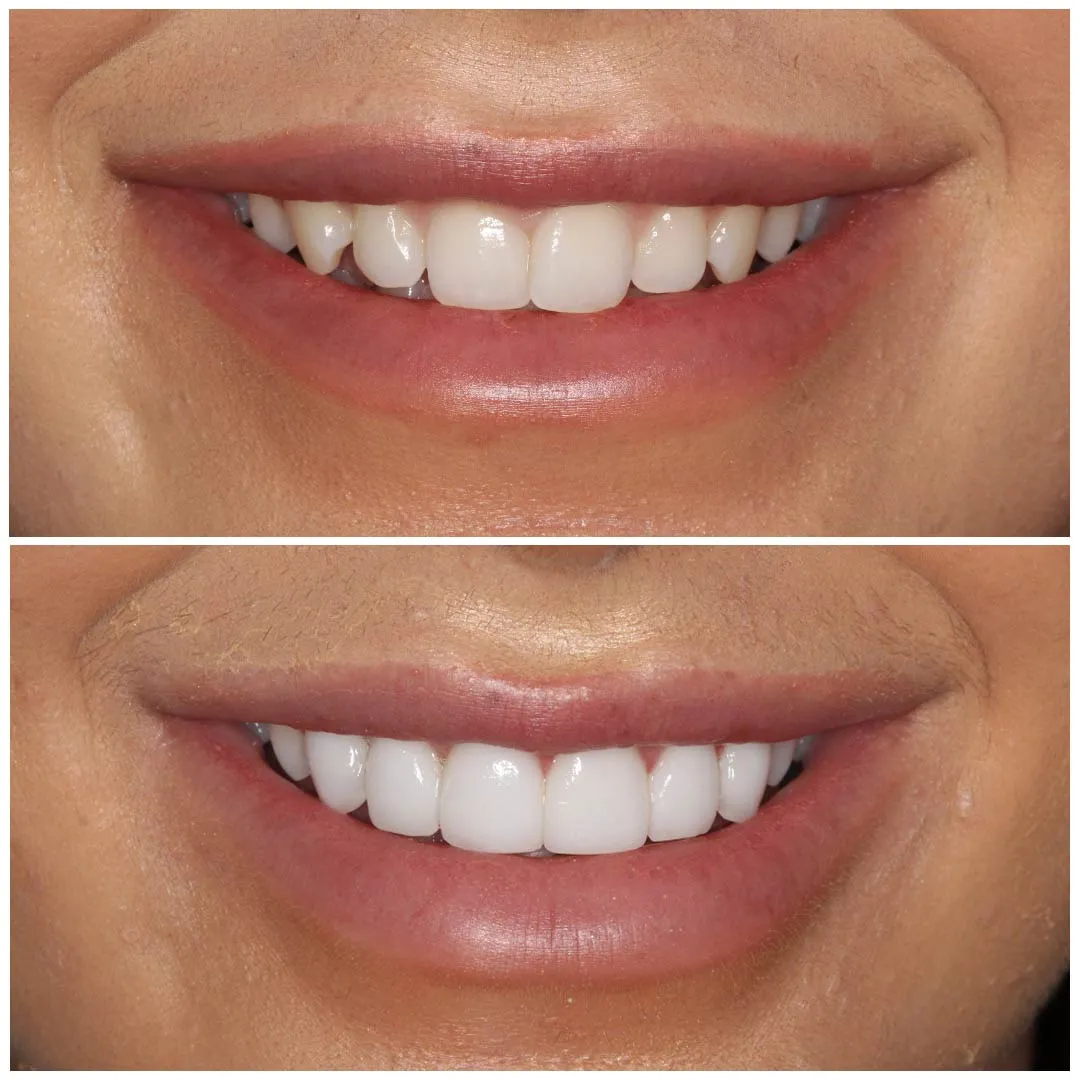
Teeth whitening suits patients who want a brighter shade without changing tooth shape, while veneers suit patients who need to fix shape, alignment, or deep discolouration alongside brightness. The right choice depends on what's actually wrong with your smile, not just budget. This guide compares both options across cost, longevity, procedure, and suitability so you can match the treatment to your specific case.
What Is the Core Difference Between Veneers and Whitening?
Whitening lightens the natural tooth using a bleaching agent, while veneers cover the tooth's visible surface with a thin shell of porcelain or composite. Whitening changes colour only. Veneers change colour, shape, size, and alignment appearance simultaneously.
This distinction determines which patients get results from each option:
- Whitening works on teeth with healthy enamel and surface-level staining from coffee, tea, wine, or ageing
- Veneers work on teeth with chips, gaps, uneven shape, or staining that whitening can't reach, such as discolouration from a dead nerve or old fillings
How Do the Procedures Compare?
Whitening takes 1-2 visits over roughly 2 weeks, while veneers take 2-3 visits across 2-4 weeks. Whitening is non-invasive — no enamel is removed. Veneers require removing 0.3-1mm of enamel per tooth, depending on whether minimal-prep or traditional veneers are used.
What Happens During a Whitening Treatment?
A dentist applies a hydrogen or carbamide peroxide gel to the teeth, then activates it with light or heat in-chair, or provides custom trays for at-home use over 1-2 weeks. In-chair whitening lifts shade by 3-8 shades in a single 60-90 minute session, while at-home kits achieve similar results gradually over 10-14 days.
What Happens During a Veneer Fitting?
A dentist first removes a thin layer of enamel, takes an impression, and fits a temporary veneer while the permanent one is fabricated in a lab over 1-2 weeks. The final appointment bonds the custom-made veneer permanently to the tooth, adjusting shape and fit chairside.
Which Option Lasts Longer?
Veneers last 10-15 years with proper care, compared to whitening results that fade within 1-3 years depending on diet and habits. Porcelain veneers resist staining almost entirely once placed, since porcelain doesn't absorb pigment the way natural enamel does.
| Factor | Teeth Whitening | Veneers |
|---|---|---|
| Longevity | 1-3 years | 10-15 years |
| Enamel removal | None | 0.3-1mm per tooth |
| Fixes shape or gaps | No | Yes |
| Reversible | Yes | No |
| Sessions required | 1-2 | 2-3 |
Which Option Costs Less?
Whitening costs significantly less upfront than veneers, though veneers cost less per year over their full lifespan due to longer durability. In-chair whitening is typically a single fixed fee, while veneers are priced per tooth, so a full smile of 6-8 veneers multiplies quickly.
Three cost factors to weigh:
- Upfront budget — whitening suits patients wanting a low-cost, immediate brightness boost
- Long-term value — veneers spread their higher upfront cost across a decade or more of use
- Touch-up costs — whitening needs repeating every 1-3 years, adding recurring cost that veneers avoid
Who Should Choose Whitening Over Veneers?
Patients with healthy tooth shape and only surface staining should choose whitening. It suits anyone wanting a quick, reversible, and budget-friendly brightness improvement before an event or as routine maintenance.
Whitening is the better fit if:
- Teeth are straight and undamaged, with only colour as the concern
- The patient wants a non-permanent option they can stop or repeat as needed
- Budget is the primary constraint
Who Should Choose Veneers Over Whitening?
Patients with chips, gaps, uneven edges, or staining that doesn't respond to bleaching should choose veneers. Veneers suit anyone wanting a comprehensive, long-lasting fix rather than a single-issue improvement.
Veneers are the better fit if:
- Teeth have visible chips, gaps, or shape irregularities alongside discolouration
- Staining is internal (tetracycline staining, trauma-related greying) rather than surface-level
- The patient wants a result lasting over a decade rather than repeated maintenance
Patients unsure which category they fall into typically benefit from an in-person shade and structure assessment. A consultation with a dentist burwood patients trust for cosmetic work can confirm within one visit whether whitening alone will meet expectations or whether veneers are needed for a lasting result.
Can You Combine Both Treatments?
Yes, combining whitening and veneers is common when a patient wants uniform colour across natural teeth and veneers together. Dentists typically whiten natural teeth first, then match veneer shade to the newly whitened result, since veneers can't be whitened once placed.
This combined approach works well as part of a broader smile design makeover, where whitening handles the natural teeth and veneers address the teeth needing structural correction. Patients interested in porcelain veneers specifically should raise this sequencing during their initial consultation.
Frequently Asked Questions
Does whitening work on veneers?
No. Whitening gel doesn't change the colour of porcelain or composite veneers, so shade must be selected correctly before veneers are placed.
Is whitening safe for sensitive teeth?
Whitening can cause temporary sensitivity in 1 out of 3 patients, though dentist-supervised treatments use lower concentrations and desensitising agents to reduce this risk compared to over-the-counter kits.
Do veneers look natural?
Yes, when properly shade-matched and shaped by an experienced dentist, porcelain veneers replicate natural tooth translucency and are difficult to distinguish from real enamel.
Can I switch from whitening to veneers later?
Yes, whitening doesn't prevent future veneer placement, and many patients whiten first to achieve their base shade before committing to veneers.
How do I know which option is right for me?
A dental consultation involving a shade assessment and structural check is the only reliable way to confirm whether whitening alone will meet your goals or whether veneers are needed.

























Sign in to leave a comment.