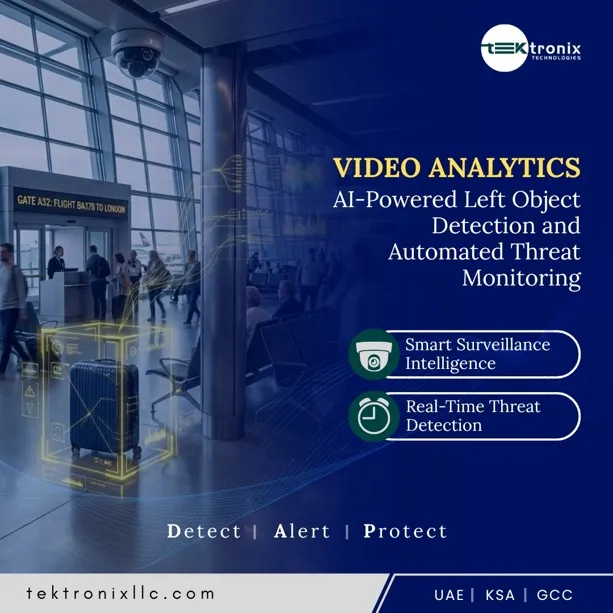

Video Analytics is transforming airport security across Saudi Arabia and the GCC, enabling security operations centres to detect threats in real time with a precision no human operator can consistently sustain. Among the most mission-critical applications of AI-Powered Video Analytics is left object detection — the automated identification of unattended bags, packages, trolleys, and any items abandoned in sensitive airport zones. In environments processing millions of passengers annually, this capability is not optional; it is the difference between a managed incident and a catastrophic security failure.
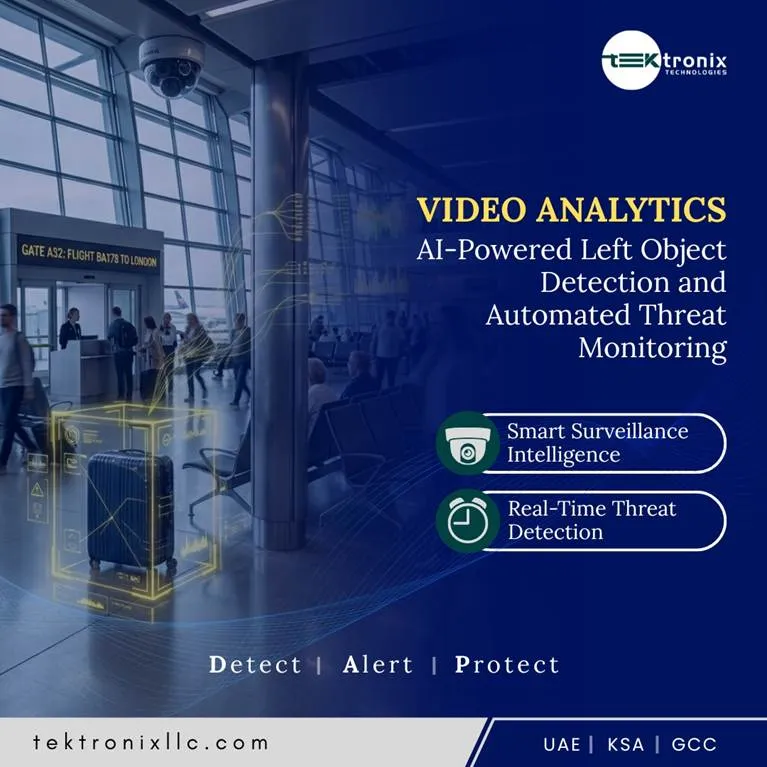
This article examines how Video Analytics Solutions purpose-built for left object detection are being deployed across airports in Video Analytics KSA and Video Analytics GCC markets, the AI architecture that drives them, and why Tektronix LLC is the region's leading implementation partner for intelligent surveillance infrastructure.
The Unattended Object Threat: Why Airports in Saudi Arabia Cannot Afford Manual Monitoring
Saudi Arabia's aviation sector is experiencing transformational growth. King Abdulaziz International Airport (KAIA) in Jeddah, King Khalid International Airport in Riyadh, and King Fahd International Airport in Dammam collectively serve tens of millions of passengers each year — a figure accelerating rapidly under Saudi Vision 2030's ambitious tourism and aviation targets. NEOM's planned aerotropolis, the Red Sea Project's Amaala airport, and Diriyah's transport infrastructure add further scale to an already complex operational landscape.
In this context, traditional CCTV monitoring — where operators manually scan dozens of feeds — is fundamentally inadequate for unattended object detection. Research by the International Air Transport Association (IATA) and airport security authorities consistently demonstrates that human vigilance degrades significantly after 20 minutes of continuous video monitoring, creating windows of vulnerability that threat actors exploit.
Video Analytics Software closes this gap entirely. By applying computer vision and deep learning to live CCTV streams, the system autonomously detects when an object is placed in a monitored zone and remains without an associated person — triggering Instant Alerts and Notifications to security personnel within seconds, not minutes.
What Is Left Object Detection? Understanding the AI Architecture
Left object detection is a specialised branch of Real-Time Object Detection that combines scene analysis, object tracking, and person-object association algorithms to identify unattended items with minimal false positives. Unlike simple motion detection — which flags any movement — left object detection understands context: it distinguishes between a trolley being pushed through a terminal and a bag placed on a bench by someone who subsequently walks away.
Core Algorithm Layers in AI-Powered Left Object Detection
The Advanced AI Recognition engine powering left object detection in airports operates through five sequential processing layers:
- Scene Baseline Modelling — the system learns the normal visual state of each camera zone, accounting for lighting variation, crowding levels, and recurring objects such as fixed furniture or signage.
- Object Segmentation & Classification — deep neural networks classify detected objects by type (bag, box, trolley, parcel), size, and position, filtering out non-threatening environmental elements.
- Person-Object Association Tracking — each object is linked to the individual who placed it. The system tracks both person and object across frames, maintaining association even when others walk between them.
- Dwell-Time Threshold Enforcement — Prolonged Detection logic monitors how long an object remains unattended. When the dwell time exceeds a configurable threshold (typically 15–120 seconds depending on zone sensitivity), the alert pipeline is triggered.
- Alert Escalation & Notification Dispatch — Instant Alerts and Notifications are generated simultaneously to the security operations centre dashboard, mobile devices, PA systems, and integrated access control platforms — enabling coordinated response without delay.
False Positive Suppression: The Critical Differentiator
One of the primary challenges in deploying left object detection in busy airport terminals is suppressing false positives — alerts triggered by objects that are not genuinely unattended. Tektronix's Video Analytics Software employs multi-frame temporal validation and confidence-score thresholding to ensure that only genuinely unattended objects — not momentarily placed items during active engagement — trigger alerts. This distinction is critical for maintaining security team trust and operational efficiency across high-volume Saudi and GCC airport environments.
Real-Time Object Detection at Scale: Technical Performance Standards
Real-Time Object Detection in an airport environment must perform reliably at scale. Tektronix's Video Analytics Solutions are engineered to meet demanding operational benchmarks:
- Sub-second object classification latency — detection and classification of new objects occurs within 200–500 milliseconds of object placement, ensuring that alert dispatch precedes any possible threat escalation.
- Multi-camera parallel processing — the platform simultaneously monitors hundreds of concurrent feeds without performance degradation, utilising GPU-accelerated inference engines deployed on-premise or via edge computing nodes.
- 99.7%+ uptime SLA — redundant processing architecture and automatic failover ensure continuous monitoring coverage aligned with GACA (General Authority of Civil Aviation) security operation requirements.
- Scalable resolution support — compatible with HD, 4K, and thermal camera streams, accommodating varying terminal layouts and infrastructure generations found across Saudi Arabia's airport estate.
- ONVIF & RTSP protocol compatibility — seamless integration with existing VMS (Video Management System) platforms including Milestone, Genetec, Avigilon, and Hikvision — protecting legacy infrastructure investments.
Instant Alerts and Notifications: From Detection to Coordinated Response
Speed of notification is as critical as accuracy of detection. When Video Analytics identifies a confirmed unattended object, the alert ecosystem activates across multiple simultaneous channels:
- Security Operations Centre (SOC) Dashboard — a visual overlay highlights the detected object on the live feed, with camera ID, zone location, object classification, and elapsed dwell time displayed in a single-glance interface.
- Mobile Push Notifications — supervisors and response teams receive geo-tagged alerts on smartphones and tablets, including a snapshot image of the detected object, enabling informed assessment before reaching the scene.
- PA System Integration — in pre-configured high-alert zones, automated announcements can be triggered to request the owner of an unattended item to return — reducing false escalations and managing passenger flow.
- Access Control Lockdown Triggers — for highest-sensitivity zones such as airside departures, immigration halls, or VIP lounges, the system can automatically initiate door-lock sequences and CCTV recording protocols.
- SIEM & Incident Management Integration — alert data is streamed to security information and event management platforms, creating an auditable incident timeline that satisfies GACA post-incident reporting requirements.
Prolonged Detection Scenarios: Airport Zones Requiring Priority Coverage
Not all airport zones carry equal risk. Effective deployment of Prolonged Detection logic requires zone-specific configuration of dwell-time thresholds and alert severity levels. Tektronix configures these parameters based on each facility's threat model and GACA security zone classification:
- Departures Check-in Halls — high passenger density and baggage handling activity require carefully tuned person-object association windows. Threshold: 45–90 seconds with confidence-score filtering above 85%.
- Security Screening Queues — items temporarily placed during security checks are excluded via integration with screening system event triggers. Only objects persisting post-screening zone clearance generate alerts.
- Airside Retail & Lounge Areas — lower crowd density allows shorter dwell-time thresholds (15–30 seconds) with higher sensitivity settings for faster response.
- Prayer Rooms & Quiet Zones — culturally sensitive spaces throughout Saudi airports require non-intrusive detection with silent alert routing to avoid unnecessary disruption.
- External Drop-off & Pick-up Zones — perimeter threat scenarios prioritise vehicle-borne device detection alongside personal item abandonment, integrating with ANPR (Automatic Number Plate Recognition) data streams.
Video Analytics KSA and Video Analytics GCC: Regional Deployment Context
Deploying intelligent video surveillance across Saudi Arabia and the broader Gulf Cooperation Council presents unique operational, regulatory, and environmental requirements that distinguish the region from European or North American deployments.
Regulatory & Standards Alignment
Tektronix's Video Analytics KSA implementations are designed in full alignment with:
- GACA Airport Security Regulations — Saudi Arabia's General Authority of Civil Aviation mandates specific unattended object response protocols aligned with ICAO Annex 17 aviation security standards.
- NCA Cybersecurity Controls — on-premise or private-cloud processing options ensure video data and biometric-adjacent intelligence never transits unsecured external networks.
- PDPL Compliance — video analytics data handling practices are configured to satisfy Saudi Arabia's Personal Data Protection Law requirements for surveillance footage retention and access.
- GCC Unified Security Framework — deployments across UAE, Kuwait, Qatar, Bahrain, and Oman align with each jurisdiction's civil aviation authority security directives.
Environmental & Infrastructure Considerations
Saudi Arabia's extreme temperatures, dust, and high-UV environments demand hardware-software co-design considerations that Tektronix addresses through:
- Thermal-resilient edge processing units rated for ambient temperatures up to 55°C, essential for outdoor terminal zones and apron-adjacent camera positions.
- Dust-resistant camera enclosure recommendations (IP66/IP67) suited to desert-environment airports in Dammam, Tabuk, and Al Ula.
- Localised Arabic-language SOC dashboards with right-to-left interface support, ensuring operational usability for Saudi security personnel.
- 24/7 bilingual (Arabic/English) technical support coverage from Tektronix's GCC regional operations team.
Why Tektronix LLC for AI Video Security
Tektronix LLC has established itself as the GCC's premier systems integrator for intelligent video surveillance and Video Analytics GCC deployments. Our authority in this domain is grounded in:
- Proven Airport Deployments — Tektronix has implemented AI-powered surveillance solutions across international and domestic airports in Saudi Arabia, the UAE, and Qatar, with documented detection performance reviews post-commissioning.
- Certified Integration Expertise — our engineering team holds certifications across major VMS platforms (Milestone XProtect, Genetec Security Center, Avigilon Control Center) and AI analytics engines, ensuring seamless interoperability.
- Vendor-Agnostic Architecture — Tektronix designs solutions around the client's existing camera estate and security infrastructure, avoiding unnecessary forklift upgrades while maximising analytics performance.
- Post-Deployment Optimisation — our 90-day performance tuning programme adjusts detection thresholds, alert routing, and integration parameters based on live operational data from the specific airport environment.
- Regulatory Advisory Services — our team provides GACA compliance documentation, ICAO security audit support, and NCA cybersecurity assessment assistance, reducing client administrative burden.
Integration Ecosystem: Video Analytics Software Within the Broader Security Stack
Left object detection does not operate in isolation. Maximum security value is achieved when Video Analytics Software is embedded within a unified physical security ecosystem. Tektronix designs integration architectures connecting left object detection with:
- Facial recognition and access control platforms for suspect tracking post-detection.
- Crowd density analytics and flow management systems to contextualise abandonment events within passenger behaviour patterns.
- Explosive trace detection (ETD) and X-ray screening system event feeds to correlate object alerts with screening outcomes.
- Emergency response management platforms (ERMS) for coordinated multi-agency incident command.
- Airport Operational Databases (AODB) to align security event timelines with flight schedules and gate assignments.
This integration depth transforms left object detection from a point solution into a force-multiplying component of a comprehensive airport security intelligence platform — the standard Tektronix delivers across Video Analytics KSA and Video Analytics GCC engagements.
Conclusion
Left object detection powered by Video Analytics is no longer an advanced-capability aspiration for GCC airports — it is an operational necessity. As Saudi Arabia's aviation sector scales toward Vision 2030 targets and regional airports handle unprecedented passenger volumes, the capacity to identify unattended objects in real time, suppress false positives intelligently, and dispatch Instant Alerts and Notifications to coordinated response teams defines the security standard that passengers, regulators, and operators now expect.
Tektronix LLC's AI-Powered Video Analytics platform delivers certified Real-Time Object Detection, configurable Prolonged Detection thresholds, and seamless VMS integration — engineered specifically for the environmental, regulatory, and operational realities of airports across Video Analytics KSA and Video Analytics GCC markets.
Whether you are commissioning a new terminal, upgrading legacy CCTV infrastructure, or responding to a GACA compliance audit, Tektronix provides the expertise, technology, and regional support to deliver Video Analytics Solutions that perform when it matters most. Contact our team today to schedule a free site assessment and proof-of-concept demonstration.




























Sign in to leave a comment.